Article | Two Studies Of Intimacy Henry Moore And Jean Dubuffet
Two Studies in Intimacy: Henry Moore & Jean Dubuffet
Ahead of the 3 March 20th Century & Contemporary Art Evening Sale in London, we examine two key pieces by Henry Moore and Jean Dubuffet and how they both use motifs of togetherness and connection to attain depth of meaning.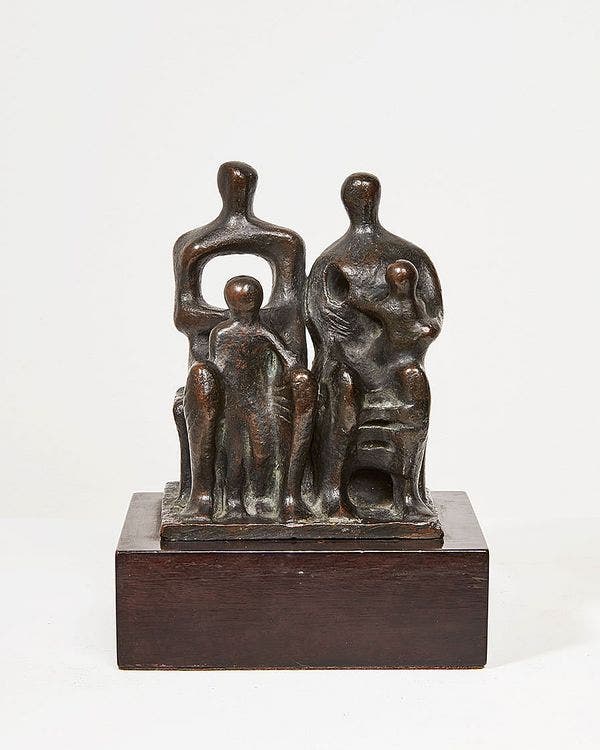
Henry Moore, Family Group, 1947. 20th Century & Contemporary Art.
Henry Moore and Family Group
The quintessential image of unity and harmony, Henry Moore’s Family Group (1946) brings together key formal and thematic elements which define the enduring familial motif in the British sculptor’s output. Two parents are presented frontally, an older child standing between the legs of the father, while a small infant sits playfully on its mother’s lap. Executed with a masterful sense of compositional balance, the mother sits to the left of the father, their bent legs perfectly mirroring one another while the positioning of the softly shaped children one above the other creates a subtle upward diagonal force that charges the piece with a sense of vitality and motion.
So central was this motif to Moore’s thinking during these years that he returned to it time and again across drawings and sculpture. Completing over 14 different sculptural variations on the Family Group, Moore also created four monumental versions of family groups, one of which – still installed at the Barclay School in Stevenage – is significant as Moore’s first ever large-scale bronze sculpture, formally commissioned by Hertfordshire County Council in 1947.
Expanding the composition to include two children, the present work is often considered one of the more complex versions of this theme; a fact complimented by Moore’s less naturalistic depiction of the figures. Adopting a more fluid treatment of form, this version of the Family Group highlights the important dialogue that Moore established with his international contemporaries, notably the undulating lines, hollows, and biomorphic shapes that dominated Pablo Picasso’s work in the 1930s. Although a relatively new medium to him at this point, Moore’s command of bronze also lends the piece a softness and mutability that speaks to the emotive power of his subject. Particularly apparent in the softly rounded forms of the heads and sloping line of the shoulders, the elegant square void in the father’s chest and rounded cavity in the mother’s right breast gives weight to Moore’s comment that “if both abstract and human elements are welded together in a work, it must have a fuller, deeper meaning.”
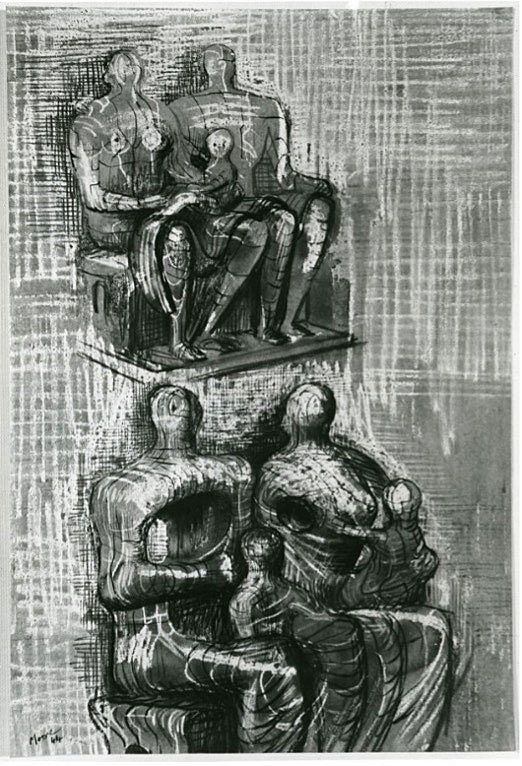
Henry Moore, Family Groups: Ideas for Sculpture, 1944. © The Henry Moore Foundation. All Rights Reserved. Photo: Henry Moore Foundation Archive.
Bauhaus founder Walter Gropius first discussed the idea of a family group with Moore in the 1930s as part of a progressive school project spearheaded by Henry Morris. As the Director for Education in Cambridgeshire, Morris had enlisted Gropius to design an ambitious project for a Village College in Impington. It was Gropius who approached Moore with the idea of creating a large sculpture especially for the project, and Moore eventually suggested a family group as image that best incapsulated the spirit and vision of the school. Sadly, a lack of funds, the departure of Gropius for America and, eventually, the onset of World War II all conspired to ensure that the project was all but forgotten until 1944, when Morris approached Moore once again. Moore’s own family unit was indirectly threatened by the war in 1940 when their Hampstead home was hit by shrapnel. Leaving London for a quiet hamlet in Hertfordshire, Moore and his wife built a family home where they lived, worked, and raised their daughter in peace.
The Family Group works highlight the fundamental relationship of drawing to Moore’s sculptural practice, a point emphasized by Moore himself in conversation with the highly esteemed critic David Sylvester, where he identified the direct relationship between the resulting sculptures and his drawing practice. In addition to also having also recently lost his mother, Moore became a parent himself in 1946, no doubt intensifying his feelings on this emotionally charged subject. Moore made many preparatory drawings of families in a variety of different arrangements and configurations during this period, several of which were then modelled in clay before being cast in bronze. Filling nearly two sketchbooks with drawings of variations on the family group theme, Moore found ways, not only of developing his compositional ideas, but of “sorting them out.” A sketch included on a drawing titled Family Groups: Ideas for Sculpture from 1944 highlights the central role that preparatory sketches played in this respect, clearly echoing the intimate arrangement and presentation of the figures in the present work.
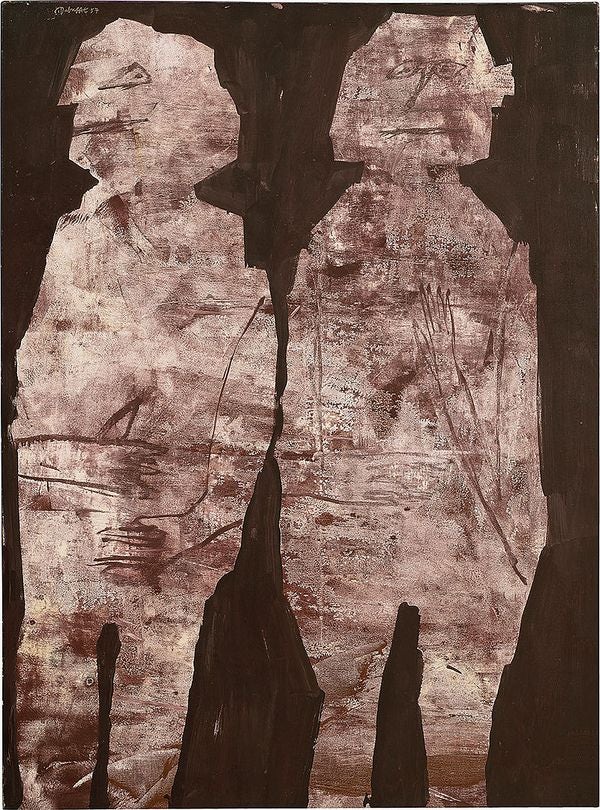
Jean Dubuffet, Nos châteaux peu denses, 1957. 20th Century & Contemporary Art.
Jean Dubuffet and Nos châteaux peu denses
Painted towards the close of 1957, Nos châteaux peu denses belongs to a small but highly significant suite of paintings executed in the mid-1950s by the pioneer of Art Brut, Jean Dubuffet. Unusual in Dubuffet’s oeuvre in their close focus on a couple rather than the individual figure, these works all feature two monolithic characters, their strikingly iridescent bodies appearing to float, cut out against a dark, matte background. Related to the broader Personnages monolithes series, they share in the same extreme flattening of the figure and manipulation of surface textures that characterize this important group of pictures.
Visually recalling the rough surfaces and uneven textures of prehistoric cave painting or ancient murals and possessing something of their timeless and distinctly human quality, Nos châteaux peu denses highlights Dubuffet’s longstanding fascination and experimentation with the spatial and textural qualities specific to wall painting. Inspired by a keen appreciation for Brassaï’s photographs of Parisian graffiti, Dubuffet closely studied the material fabric of the city, believing its walls absorbed and recorded the histories of its inhabitants and offered “its voice to that part of us which, without it, would be condemned to silence.” Especially poignant considering the role that these spaces played during the Occupation of Paris during World War II, these crumbling surfaces became palimpsests that directly connected the people with the city, opening Dubuffet to “an art that is directly plugged into our current life, that immediately emanates from our real life and our real moods.”
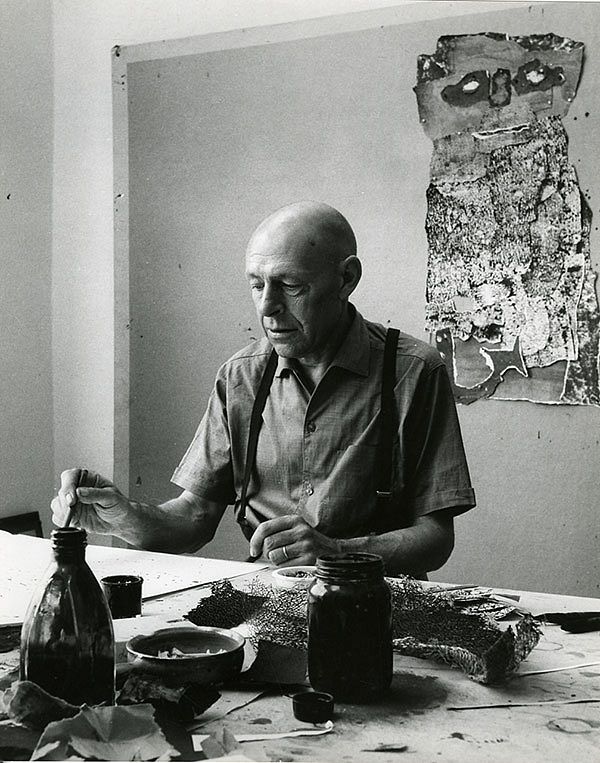
Jean Dubuffet photographed by Paolo Monti, 1960. Image: Paolo Monti / Fondazione BEIC, Biblioteca Europea di Informazione e Cultura, Artwork: © ADAGP, Paris and DACS, London 2022
In their chalky, variegated surfaces, these figures do not simply replicate the wall’s surface, but seem themselves hewn from stone, their shapes recalling the enigmatic and ancient surfaces and shape of Bronze Age “standing stones.” Dubuffet identified this directly, writing that “the indefinite blurred contours of the figures I had formed, and the way they stood out so startlingly white against the black background, made them look like menhirs.” Like these prehistoric monuments, the silhouetted figures of Nos châteaux peu denses are rendered through minimal means; standing out starkly against the dark ground, the sloping curve of shoulders, legs, and torso is loosely defined, while facial details have been applied with the greatest economy. Enigmatic and impassive, the arrangement of the two figures nevertheless seems to articulate something of the complexity of human relationships. Arguably the most compelling of this suite of monolithic couples in this regard, Nos châteaux peu denses’ focus on the couple is not straightforwardly celebratory as in the more romantically titled Les fiancés, Les voeux de marriage, or Jeunes époux, all painted in 1955. The note of melancholy struck by the title here is powerfully compounded by the subtle shift in the relationship established between the figures that, although physically close, seem each somewhat detached and unreachable, introducing an emotional and psychological depth to the slightly later work.
Included in major Dubuffet exhibitions at the Galerie Beyeler in 1965 and the 1966 travelling retrospective hosted by the Dallas Museum of Fine Art and the Walker Art Centre, Minneapolis, Nos châteaux peu denses presents a powerful case for Dubuffet’s rejection of artistic convention and pretension, representing a significant stage in the evolution of his aesthetic, his pioneering treatment of the figure, and his creation of "strange bewildering worlds that exercise a kind of fascination." A towering figure of French post-war art, Dubuffet’s work remains as provocative today as when it was first created, and has gone on to shape the artistic languages of major contemporary artists including Jean-Michel Basquiat and Rashid Johnson.
Discover More from 20th Century & Contemporary Art >
Recommended Reading