354
Audemars Piguet
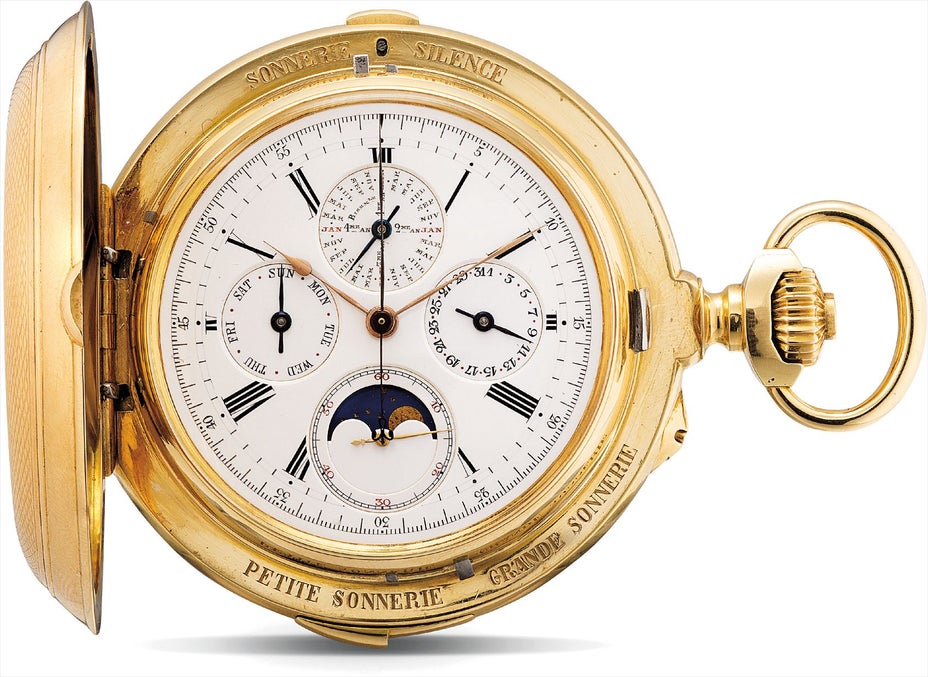
An extremely rare, highly important and unique pink gold minute repeating, perpetual calendar, chronograph two train hunter case grande and petite sonnerie clock watch with moonphases and central minute hand register
Full-Cataloguing
Grande Complication
Previously unrecorded anywhere in literature, we are delighted to present this Audemars Piguet Grande Complication clock watch. Fitted with no fewer than 11 complications, the present watch is one of the most complicated Audemars Piguet known to exist and is one of the earliest known examples to have been manufactured. Every Grande Complication made by the firm during the late 19th century was a unique piece. Due to the time it required to create each watch, there were always variations in their production. This watch is one of three petite and grand sonnerie watches with comparable complications manufactured by Audemars Piguet.
The Clock Watch was invented hundreds and hundreds of years ago. The earliest known example is dated at around 1551 and was made by French maker Jacques de la Garde. The earliest English clock watches began to appear from around 1600. The earliest known watches usually had striking trains as they originated directly from spring driven table clocks.
The grande and petite sonnerie mechanism was developed in the late 18th century. The petite mechanism strikes the quarter and the hour in passing. The grande mechanism strikes both quarter and hour at each quarter. It was Breguet who added the minute repeating mechanism to the grande and petite sonnerie clock watch in around 1801.
Following the French revolution, the Swiss produced many examples of the grande and petite sonnerie clock watch for export and this really laid the foundation for very complication watches in the 19th century. It was this development in watchmaking in Switzerland that really gave the Swiss the international reputation as master watchmakers.
The production of clock watches stopped in the 1st quarter in the 20th century due to the extremely high costs and hundreds of hours of labour to manufacture them.
This Audemars Piguet grande complication is an exceptional example with the highest quality five-part hinge case that is extremely crisp and in many ways appears to be quite unused. The case hinges are extremely tight and the case closes extremely well. The eleven complications that make up the mechanism make this clock watch one of the most important Audemars Piguet watches to have appeared on the market in recent years.
Audemars Piguet
Swiss | 1881A specialist in the manufacture of complications since it was established in 1881, Audemars Piguet never ceases to impress with a rich history of creating bold, even audacious, timepieces underpinned by traditional watchmaking at its finest. This Le Brassus-based Swiss manufacturer is one of only two major manufacturers still owned by the founding family. Since its earliest days, AP is considered a leader in the field of minute repeaters and grande complication pocket and wristwatches. The brand is devoted to preserving the history of watchmaking in the Vallée de Joux, showcased at their superb museum in Le Brassus.
Today, the brand is best known for its Royal Oak models, a revolutionary luxury sports watch launched in 1972. Other key models include early minute repeating wristwatches, vintage chronograph wristwatches, such as the oversized reference 5020, perpetual calendar watches and the Royal Oak Offshore, first introduced in 1993.