
161
Banksy
Laugh Now
- Estimate
- $300,000 - 400,000
$485,000
Lot Details
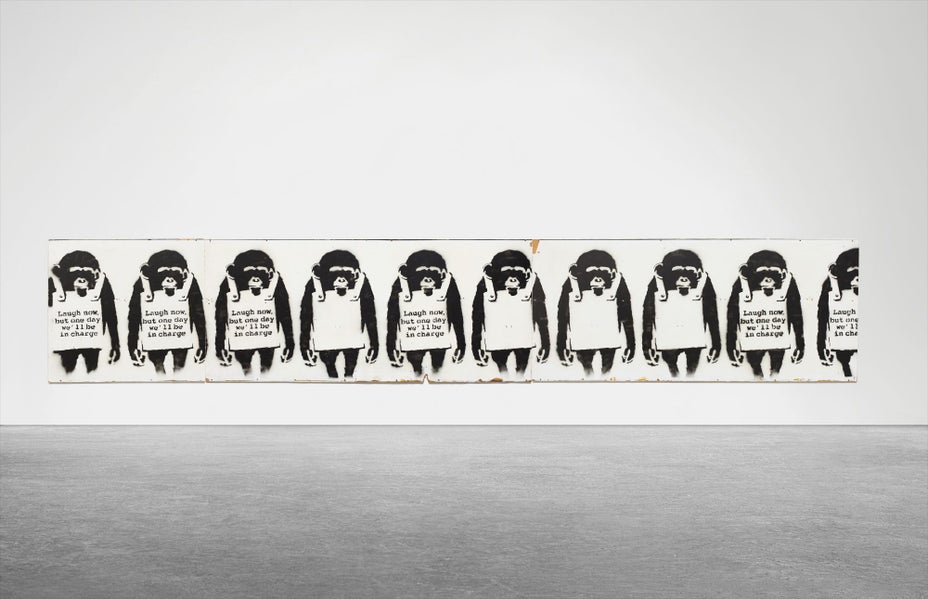
stencil spray paint on painted board, in 3 parts
42 3/8 x 237 7/8 in. (107.5 x 604.5 cm.)
This work is unique.
This work has been authenticated by Pest Control and is accompanied by a certificate of authenticity.
Specialist
Full-Cataloguing
Catalogue Essay
Banksy’s work of the past two decades has drawn a litany of both praise and controversy, and nowhere is his simultaneous appeal and notoriety more present than in Laugh Now, 2002. Comprised of his signature means of urban expression—namely board spray-painted with his own stencil designs—the present lot perfectly encapsulates Banksy’s modus operandi while conjuring the dark thematic elements that underlie such a comic piece. Ten monkeys, the last only present in half its form, stand side-by-side, full frontal and unashamed to display their sandwich-board messages. Though four fgures bear no words at all, six communicate a very specifc memo: “Laugh now, but one day we’ll be in charge.” The spare black spray paint upon the bleached white board lends the normally mischievous primates a sinister air, their expressions eliminated in a hyper-saturation of darkness. It is as if Banksy has multiplied their numbers into something resembling an army, daring observers to take pleasure in their misfortune.
Banksy’s history as a street artist and his eforts to conceal his identity make his artistic fgures his only interactive surrogates. Bearing this in mind, the monkeys upon the panel not only assume an anarchistic quality—promising full revenge upon their rise to power—but also make for a fascinating study into the future of street art. And, as his exhibition spaces shif from urban alleyways to galleries, Banksy paints a fascinating commentary on the current state of contemporary art. Indeed, the art of Banksy was once perceived as nothing more than vandalism with style, yet he is now recognized as the world’s foremost street artist. In terms of his clairvoyance, perhaps no work is more prescient than Laugh Now, 2002.
Provenance
Banksy
British | 1975Anonymous street artist Banksy first turned to graffiti as a miserable fourteen year old disillusioned with school. Inspired by the thriving graffiti community in his home city, Bristol, Banksy's works began appearing on trains and walls in 1993, and by 2001 his blocky, spray-painted works had cropped up all over the United Kingdom. Typically crafting his images with spray paint and cardboard stencils, Banksy is able to achieve a meticulous level of detail. His aesthetic is clean and instantly readable due to his knack for reducing complex political and social statements to simple visual elements.
His graffiti, paintings and screenprints use whimsy and humour to satirically critique war, capitalism, hypocrisy and greed — with not even the Royal family safe from his anti-establishment wit.
Browse ArtistHis graffiti, paintings and screenprints use whimsy and humour to satirically critique war, capitalism, hypocrisy and greed — with not even the Royal family safe from his anti-establishment wit.