

24
Agassiz Watch Co.
"Victory Watch - Charles de Gaulle"
A legendary, of enormous historical importance and extremely well preserved yellow gold worldtime openface pocket watch with polychrome cloisonné enamel dial and “Victory Monogram” and dedication to the back; made for Charles de Gaulle in commemoration of WWII victory
Estimate
CHF300,000–600,000
€326,000–651,000
$376,000–752,000
Live 9 May, 2 PM Switzerland Time
Manufacturer
Agassiz Watch Co.
Year
1945
Movement No
44’497
Case No
44’497
Model Name
"Victory Watch - Charles de Gaulle"
Material
18k yellow gold
Calibre
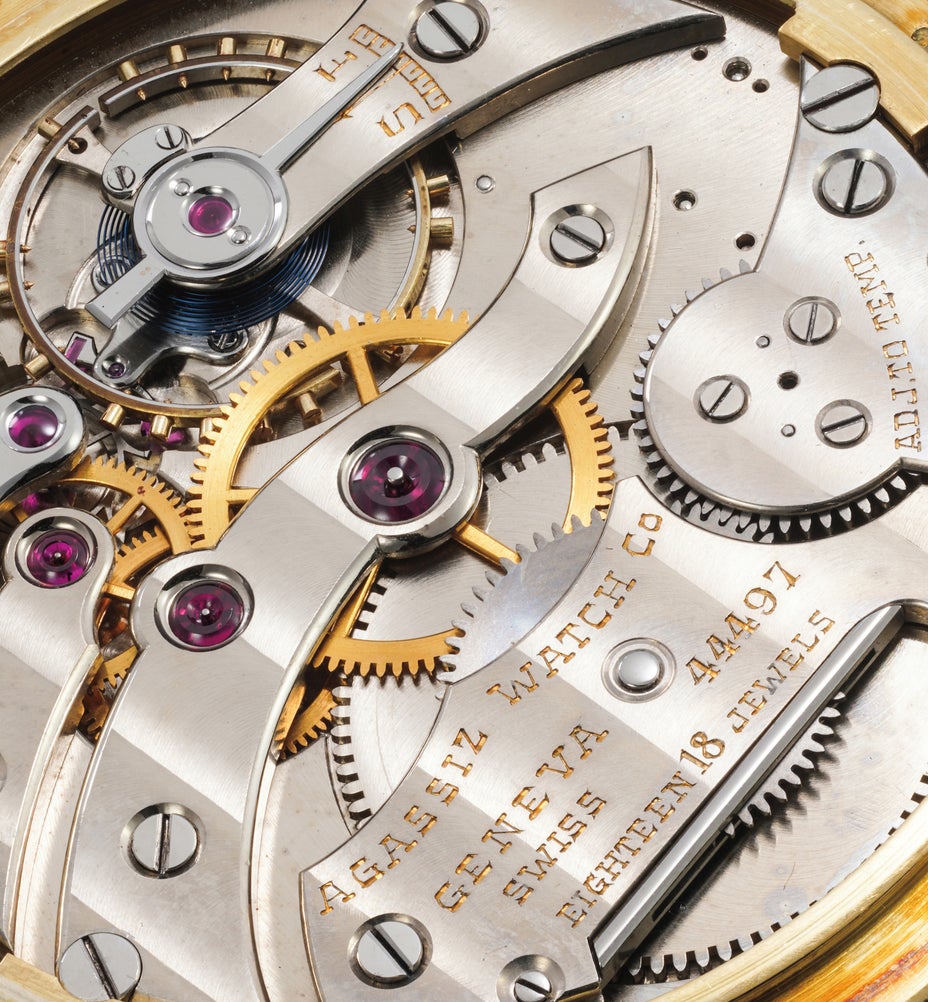
Manual, cal. 16" 18 jewels
Dimensions
46mm diameter
Full-Cataloguing
Good To Know:
- World time, polychrome cloisonné enamel dial, “Victory” caseback
- One of the most historically important watches ever made
- One of four unique pieces made to celebrate the victory in WWII - gifted to Charles de Gaulle
- Superb condition
It’s 1945, and the world is collectively gasping in relief as the most dramatic and global conflict the planet had ever seen (and has seen so far even today) dwindles to its tragic end. The moment is simply pivotal for the whole of humanity. The decisions taken at that time reverberate through history down to today. And, as it turns out, 4 pocket watches were made to celebrate this moment. Each of them features different details homaging the recipient and each was gifted to one of the four main statesmen responsible for the victory:
President of the United States Harry Truman received a piece representing the Statue of Liberty, the hour hand was in the shape of an olive branch for peace.
Marshal of the Soviet Union Joseph Stalin was gifted a piece representing a worker in front of a steel mill, the hour hand the communist 5-point star.
Prime Minister of the United Kingdom Winston Churchill was homaged with a depiction of St. George (the UK’s patron saint) slaying the dragon, the hour hand a trident.
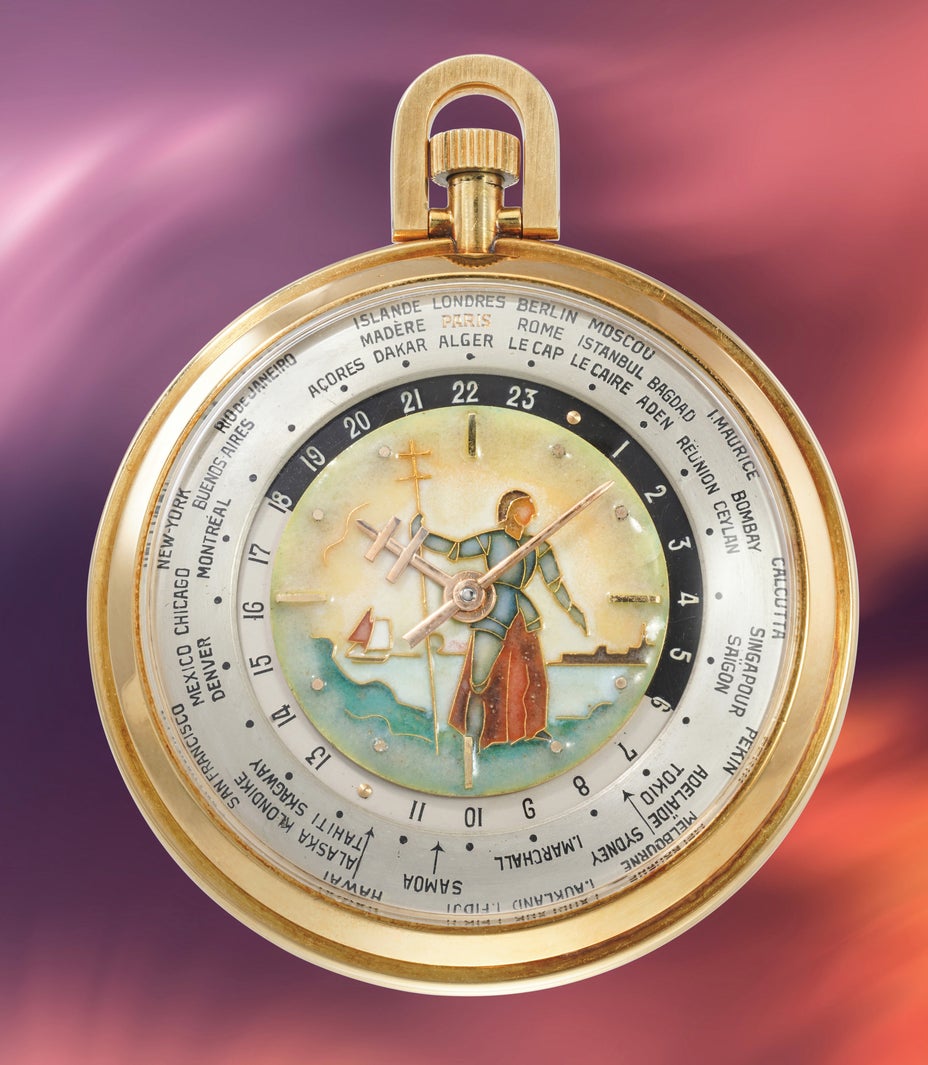
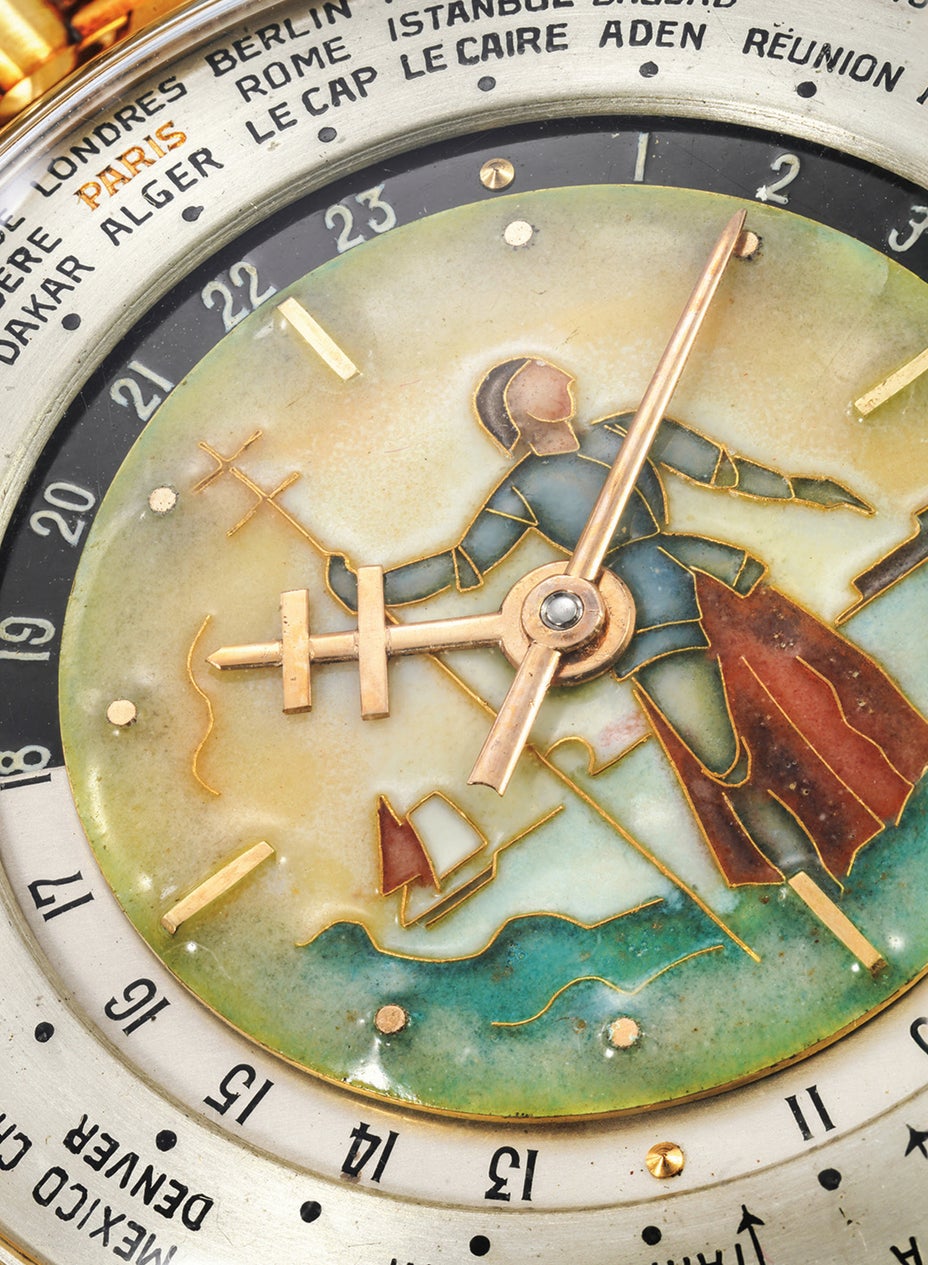
General Charles de Gaulle was given the present piece depicting Joan of Arc with the hour hand in the shape of the Cross of Lorraine - which was the symbol of Free France during the resistance.
A fifth timepiece, a world time clock, was gifted to Roosevelt’s widow Eleanor.
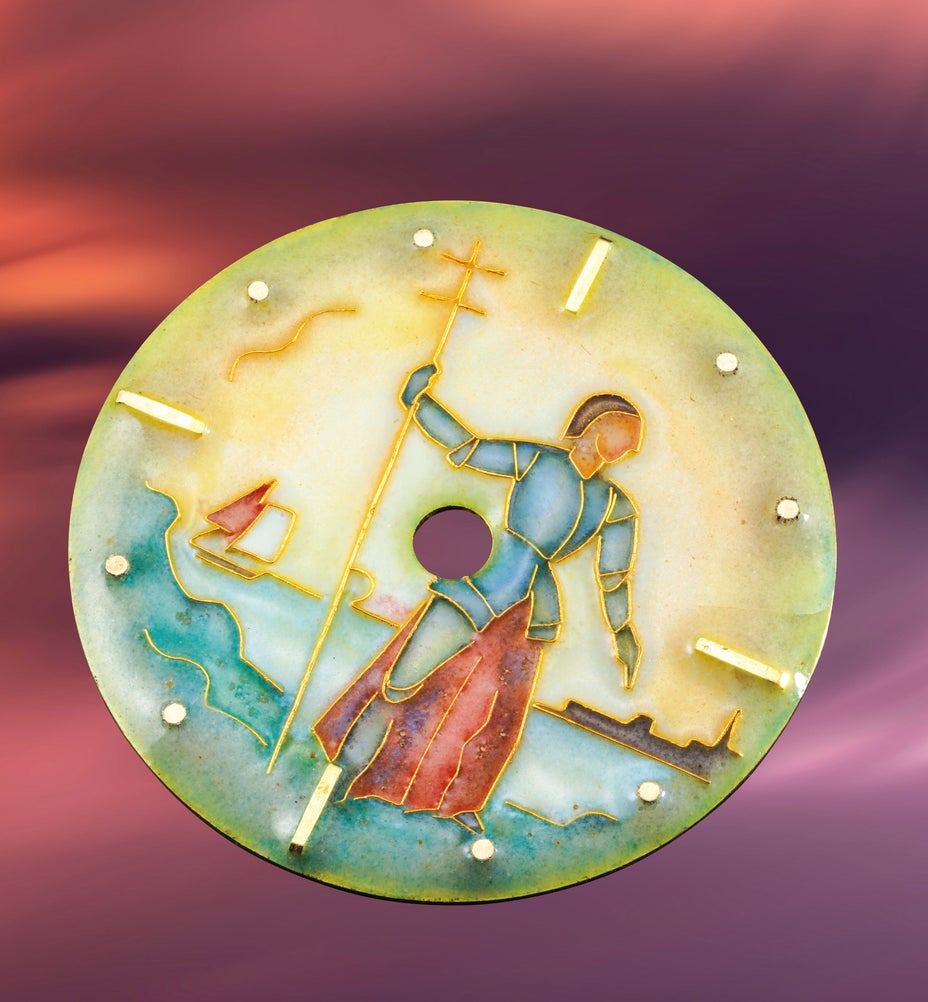
According to the Stern archives, a variety of designs and techniques were produced before settling on the final designs - highlighting the enormous amount of work spent on these gifts. The enameling was executed by Michel Deville working for Maison Stern, and for De Gaulle’s watch the choice eventually fell on a polychrome cloisonné motif representing, as mentioned, Joan of Arc. The patron saint of France is depicted while planting a staff on a shore; a sailboat and warship (symbols of peace and war) are cruising peacefully in the distance. On the dial as well as for the hour hand, the Cross of Lorraine is present - at the tip of the staff.
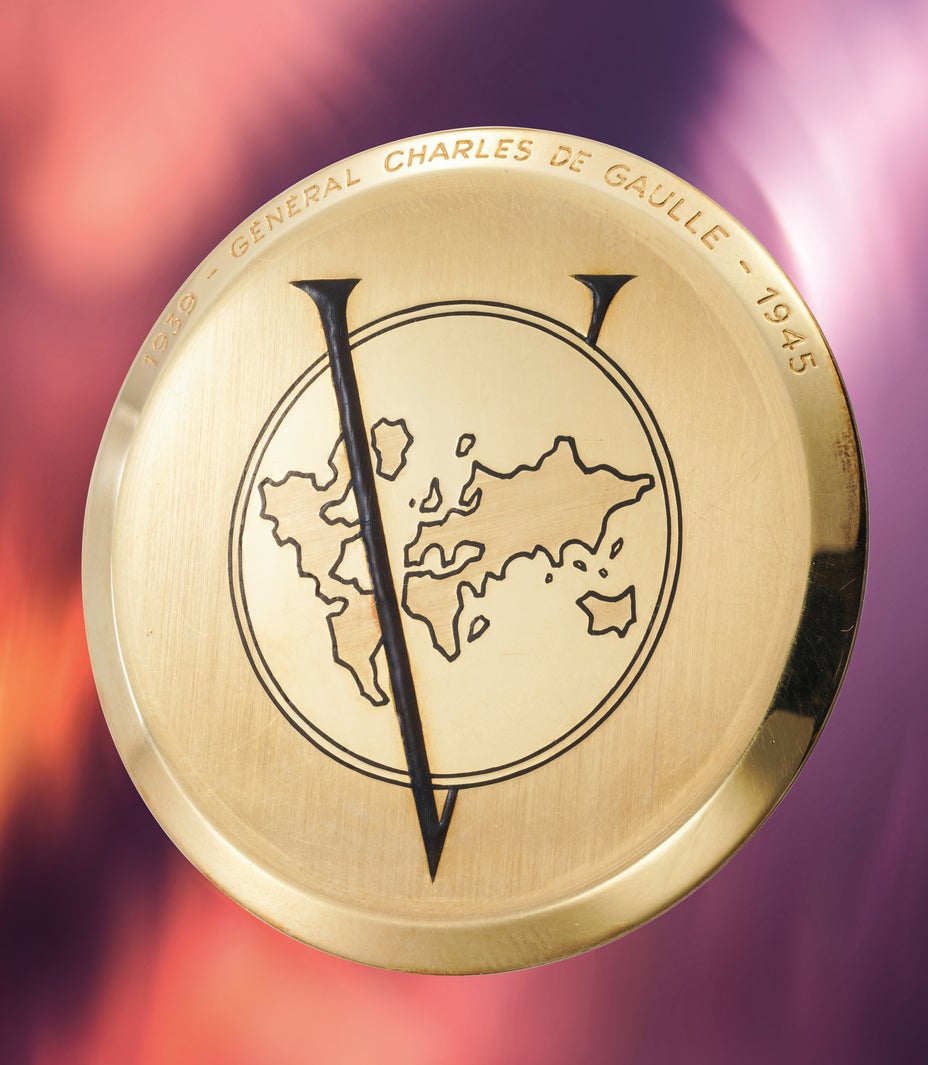
The back of the four watches is identical, but each bears a personal dedication (the present one reading: “1939 - General Charles De Gaulle - 1945”) engraved by master engraver Edgar Maerky. At the center of the back, a gargantuan V (obviously, for Victory) straddles the map of the entire globe. Truly a winner’s caseback if ever there was one.
Few watches (if any) encapsulate as much historical importance as these timepieces. The occurrence they were awarded for and the events they were subsequently witnesses to while in the hands of their owners can without a doubt be considered among the most relevant in the entire history of humanity. The present watch is more than a timepiece with a distinguished provenance, it is a true relic like few other objects in history. Some comparisons that come to mind could be Napoleon’s bicorne hat, the Wright brothers’ flyer or Galileo’s telescope.
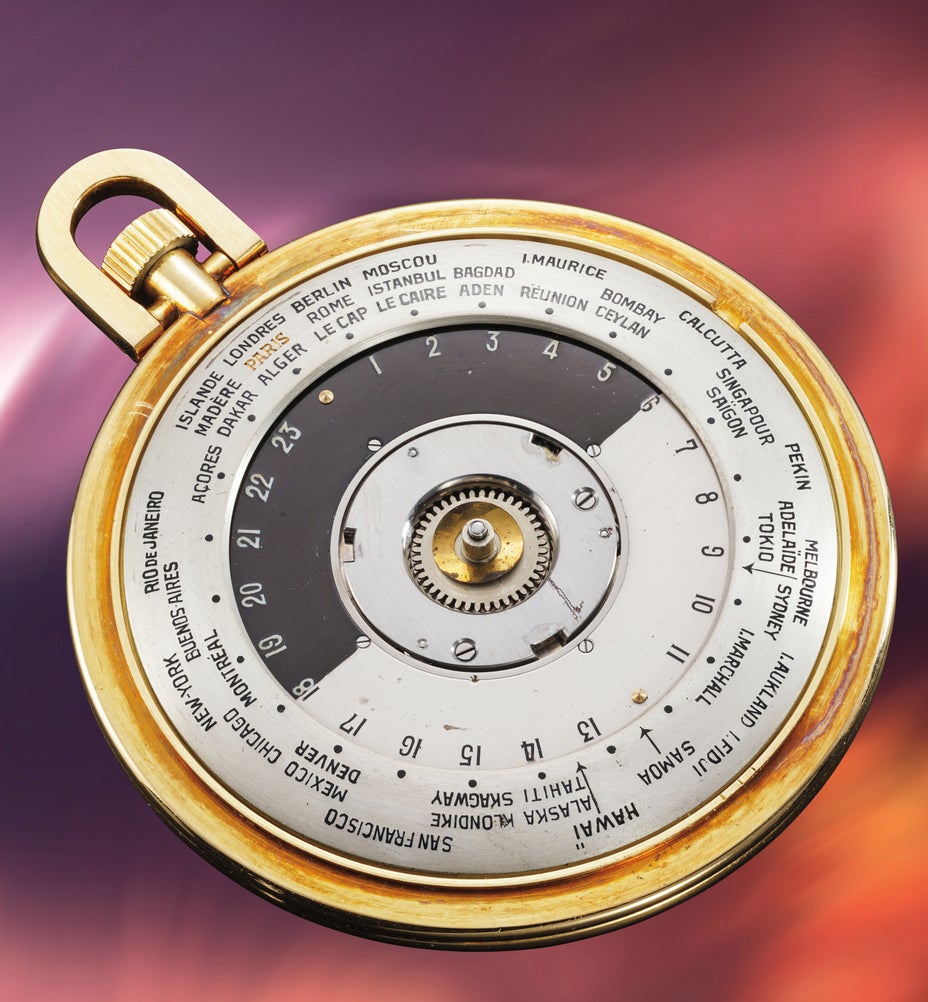
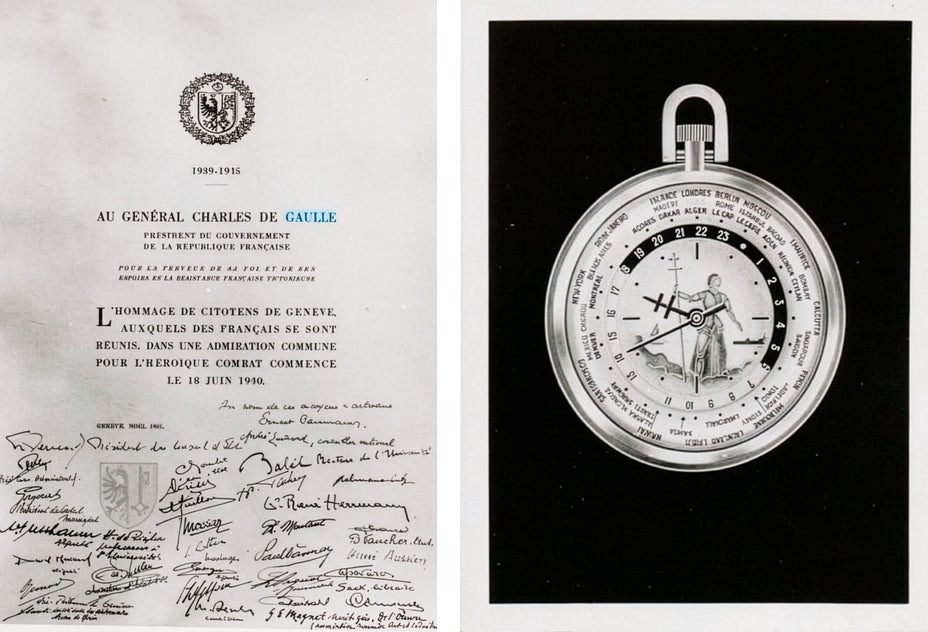
The genesis of the pieces stems from the generosity of a group of Geneva citizens (among them Louis Cottier himself, and led by the chairman of the initiative Ernest Baumann), who tasked Agassiz with the job. The world time complication was undoubtedly chosen due to the “global” scene the war prompted the countries of the world to move closer to, and also as a symbol of modernity - in fact the complication had been devised by Louis Cottier just a few years earlier (1931) and standardized with a day/night indication in the late 1930s/early 1940s.
The entire endeavour was kept secret - to the point that not even the casemaker Wenger knew for whom the watches were intended - and the watches were awarded to the recipients as Christmas gifts in 1945. Cottier officially started working on the pieces in August of the same year with a deadline of November 30th. The presence of the French import marks is a little detail the intellectual connoisseur will appreciate, as this is the piece awarded to French General de Gaulle.
As if the historical importance and technical refinement of the piece were not enough, one cannot avoid mentioning that it is preserved in absolutely remarkable condition, without a flaw on the dial, sporting perfectly preserved enameling and sharp engraving on the back, and with very few and minor surface marks.
- World time, polychrome cloisonné enamel dial, “Victory” caseback
- One of the most historically important watches ever made
- One of four unique pieces made to celebrate the victory in WWII - gifted to Charles de Gaulle
- Superb condition
It’s 1945, and the world is collectively gasping in relief as the most dramatic and global conflict the planet had ever seen (and has seen so far even today) dwindles to its tragic end. The moment is simply pivotal for the whole of humanity. The decisions taken at that time reverberate through history down to today. And, as it turns out, 4 pocket watches were made to celebrate this moment. Each of them features different details homaging the recipient and each was gifted to one of the four main statesmen responsible for the victory:
President of the United States Harry Truman received a piece representing the Statue of Liberty, the hour hand was in the shape of an olive branch for peace.
Marshal of the Soviet Union Joseph Stalin was gifted a piece representing a worker in front of a steel mill, the hour hand the communist 5-point star.
Prime Minister of the United Kingdom Winston Churchill was homaged with a depiction of St. George (the UK’s patron saint) slaying the dragon, the hour hand a trident.
General Charles de Gaulle was given the present piece depicting Joan of Arc with the hour hand in the shape of the Cross of Lorraine - which was the symbol of Free France during the resistance.
A fifth timepiece, a world time clock, was gifted to Roosevelt’s widow Eleanor.
According to the Stern archives, a variety of designs and techniques were produced before settling on the final designs - highlighting the enormous amount of work spent on these gifts. The enameling was executed by Michel Deville working for Maison Stern, and for De Gaulle’s watch the choice eventually fell on a polychrome cloisonné motif representing, as mentioned, Joan of Arc. The patron saint of France is depicted while planting a staff on a shore; a sailboat and warship (symbols of peace and war) are cruising peacefully in the distance. On the dial as well as for the hour hand, the Cross of Lorraine is present - at the tip of the staff.
The back of the four watches is identical, but each bears a personal dedication (the present one reading: “1939 - General Charles De Gaulle - 1945”) engraved by master engraver Edgar Maerky. At the center of the back, a gargantuan V (obviously, for Victory) straddles the map of the entire globe. Truly a winner’s caseback if ever there was one.
Few watches (if any) encapsulate as much historical importance as these timepieces. The occurrence they were awarded for and the events they were subsequently witnesses to while in the hands of their owners can without a doubt be considered among the most relevant in the entire history of humanity. The present watch is more than a timepiece with a distinguished provenance, it is a true relic like few other objects in history. Some comparisons that come to mind could be Napoleon’s bicorne hat, the Wright brothers’ flyer or Galileo’s telescope.
The genesis of the pieces stems from the generosity of a group of Geneva citizens (among them Louis Cottier himself, and led by the chairman of the initiative Ernest Baumann), who tasked Agassiz with the job. The world time complication was undoubtedly chosen due to the “global” scene the war prompted the countries of the world to move closer to, and also as a symbol of modernity - in fact the complication had been devised by Louis Cottier just a few years earlier (1931) and standardized with a day/night indication in the late 1930s/early 1940s.
The entire endeavour was kept secret - to the point that not even the casemaker Wenger knew for whom the watches were intended - and the watches were awarded to the recipients as Christmas gifts in 1945. Cottier officially started working on the pieces in August of the same year with a deadline of November 30th. The presence of the French import marks is a little detail the intellectual connoisseur will appreciate, as this is the piece awarded to French General de Gaulle.
As if the historical importance and technical refinement of the piece were not enough, one cannot avoid mentioning that it is preserved in absolutely remarkable condition, without a flaw on the dial, sporting perfectly preserved enameling and sharp engraving on the back, and with very few and minor surface marks.