183
Alexander Calder
Four Dots with Brass Tail
Estimate
$250,000–350,000
Sold For
$483,000
incised with the artist's initials "AC" on the brass element
sheet metal, brass, wire and paint, in 2 parts
6 1/4 x 9 1/2 x 3 in. (15.9 x 24.1 x 7.6 cm.)
Executed circa 1953, this work is registered in the archives of the Calder Foundation, New York under application number A19018.
Full-Cataloguing
"To most people who look at a mobile, it's no more than a series of flat objects that move. To a few though, it may be poetry." – Alexander Calder
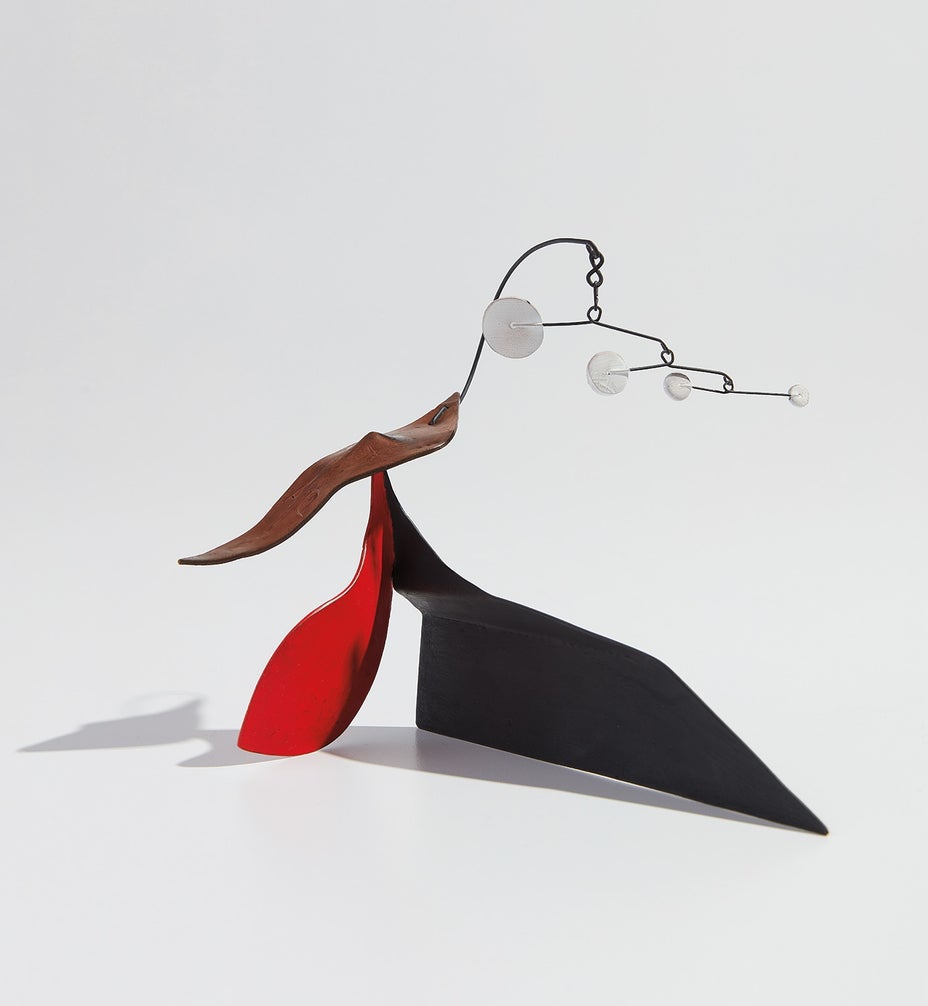
In Four Dots with Brass Tail, executed circa 1953, movement is central to this intimately scaled mobile from the artist’s prolific sculptural practice. Ever-changing in its form, the work does not remain constant within any moment in time. It is weighted both vertically and horizontally, with a brass pedestal lifting its fiery red and delicate wire limbs, which in turn allows for the piece to sway while staying grounded.
The early 1950s was an especially productive and exciting period for the artist. The present lot was executed while Calder’s works were being exhibited at the second Bienal de São Paulo in Brazil in 1953-54. Furthermore, Four Dots with Brass Tail was included in the exhibition Alexander Calder: Mobiles / Naum Gabo: Kinetic Constructions and Constructions in Space alongside a number of other wonderful kinetic constructions in a show at the Wadsworth Atheneum Museum of Art, Hartford in 1953.
The title of the present lot conveys the choreographed elegance that characterizes Calder’s dynamic mobiles, with the four circles suspended in space described as “Four Dots” and the subtly flowing brass form as a “Tail”. The artist crafted his sculptures using sheet metal, brass, and wire with pops of bold color intended to draw in the viewer’s eye as it shifts with the piece’s natural movement. Compounded with his interest in unexplored aspects of sculpture, Calder’s use of unconventional materials and vibrant hues makes Calder one of the most ground-breaking sculptors of the twentieth century.
In Four Dots with Brass Tail, executed circa 1953, movement is central to this intimately scaled mobile from the artist’s prolific sculptural practice. Ever-changing in its form, the work does not remain constant within any moment in time. It is weighted both vertically and horizontally, with a brass pedestal lifting its fiery red and delicate wire limbs, which in turn allows for the piece to sway while staying grounded.
The early 1950s was an especially productive and exciting period for the artist. The present lot was executed while Calder’s works were being exhibited at the second Bienal de São Paulo in Brazil in 1953-54. Furthermore, Four Dots with Brass Tail was included in the exhibition Alexander Calder: Mobiles / Naum Gabo: Kinetic Constructions and Constructions in Space alongside a number of other wonderful kinetic constructions in a show at the Wadsworth Atheneum Museum of Art, Hartford in 1953.
The title of the present lot conveys the choreographed elegance that characterizes Calder’s dynamic mobiles, with the four circles suspended in space described as “Four Dots” and the subtly flowing brass form as a “Tail”. The artist crafted his sculptures using sheet metal, brass, and wire with pops of bold color intended to draw in the viewer’s eye as it shifts with the piece’s natural movement. Compounded with his interest in unexplored aspects of sculpture, Calder’s use of unconventional materials and vibrant hues makes Calder one of the most ground-breaking sculptors of the twentieth century.
Alexander Calder
American | B. 1898 D. 1976Alexander Calder worked as an abstract sculptor and has been commonly referred to as the creator of the mobile. He employed industrious materials of wire and metal and transformed them into delicate geometric shapes that respond to the wind or float in air. Born into a family of sculptors, Calder created art from childhood and moved to Paris in 1926, where he became a pioneer of the international avant-garde. In addition to his mobiles, Calder produced an array of public constructions worldwide as well as drawings and paintings that feature the same brand of abstraction. Calder was born in Lawnton, Pennsylvania.