15
Alfred Stieglitz
The Terminal
Estimate
$120,000–180,000
1893
Gelatin silver print, printed 1920s, flush-mounted and mounted again.
3 5/8 x 4 5/8 in. (9.2 x 11.7 cm)
Full-Cataloguing
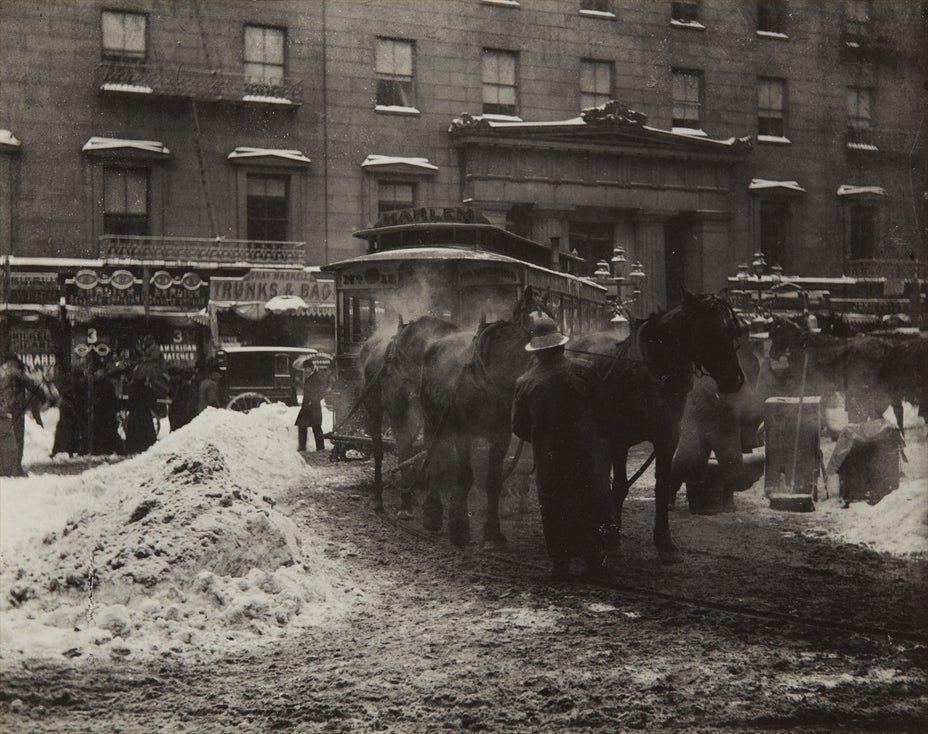
Taken in 1893, The Terminal was an important image for Alfred Stieglitz, one that evolved in concept and execution throughout his career. Roaming New York with a hand-held camera, the photographer first made The Terminal as one of a number of views of the city in snow, rain, and evening light that were perfect for the soft-focus, matte surface prints of the time. It was exhibited widely, at the Royal Photographic Society in London in 1894, the International Exhibition of Pictorial Photography in Buffalo in 1910, and many other venues. Stieglitz included it as a photogravure in the 1911 issue of Camera Work devoted exclusively to his work and also published it as a large-format photogravure (see Lot 82). Although made when Pictorialism was the dominant trend in photography, The Terminal possesses a modern sensibility distinct from much of Stieglitz’s work of the time. And when he exhibited the image as a carbon print in London in 1894, the photograph earned no praise at all, so accustomed were his peers to more picturesque or sentimental views. Regardless, Stieglitz continued to consider The Terminal a significant photograph within in his oeuvre.
Beginning in the 1920s, Stieglitz undertook a review of his early work and reincorporated selected images into his modern exhibition repertoire. The Terminal, with its clear-eyed view of an urban setting, was a perfect choice for this re-evaluation, and the print offered here dates to that time, as does the print of November Days in Lot 70. He chose to make prints of these images once again, but on gelatin silver paper, and gave them the same presentation as his Equivalents and other work from the time: flush-mounted, then mounted again to larger board.
Realized as a gelatin silver print, The Terminal is a modern image that captures the gritty realism of the street. In the photograph offered here, Stieglitz has also expanded the cropping from earlier versions, showing far more of the area surrounding the streetcar and its horses, and including the optometrist’s shop sign on the left.
In Alfred Stieglitz: The Key Set, Sarah Greenough locates gelatin silver prints of this image in the following institutional collections: the National Gallery of Art; Art Institute of Chicago; Carl van Vechten Gallery, Fisk University; The Metropolitan Museum of Art; and Museum of Fine Arts, Boston.
Beginning in the 1920s, Stieglitz undertook a review of his early work and reincorporated selected images into his modern exhibition repertoire. The Terminal, with its clear-eyed view of an urban setting, was a perfect choice for this re-evaluation, and the print offered here dates to that time, as does the print of November Days in Lot 70. He chose to make prints of these images once again, but on gelatin silver paper, and gave them the same presentation as his Equivalents and other work from the time: flush-mounted, then mounted again to larger board.
Realized as a gelatin silver print, The Terminal is a modern image that captures the gritty realism of the street. In the photograph offered here, Stieglitz has also expanded the cropping from earlier versions, showing far more of the area surrounding the streetcar and its horses, and including the optometrist’s shop sign on the left.
In Alfred Stieglitz: The Key Set, Sarah Greenough locates gelatin silver prints of this image in the following institutional collections: the National Gallery of Art; Art Institute of Chicago; Carl van Vechten Gallery, Fisk University; The Metropolitan Museum of Art; and Museum of Fine Arts, Boston.