156
Bulgari
Ref. 55 - 7471
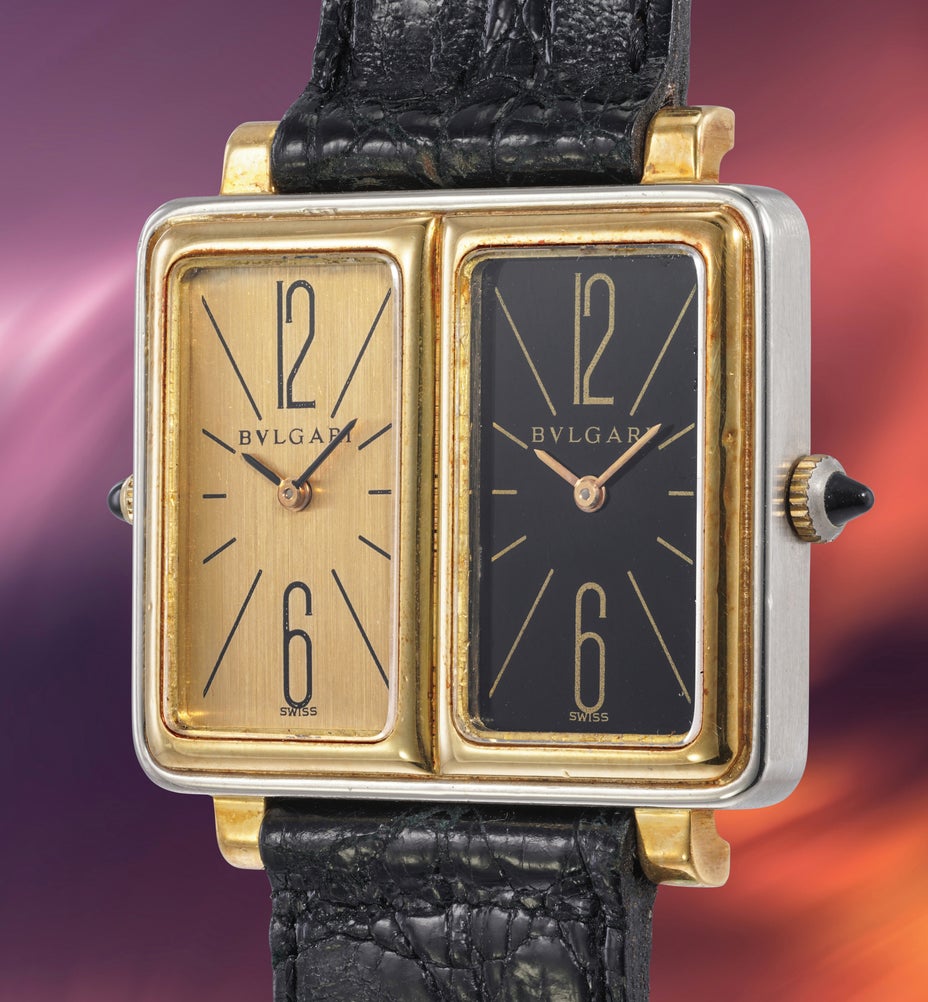
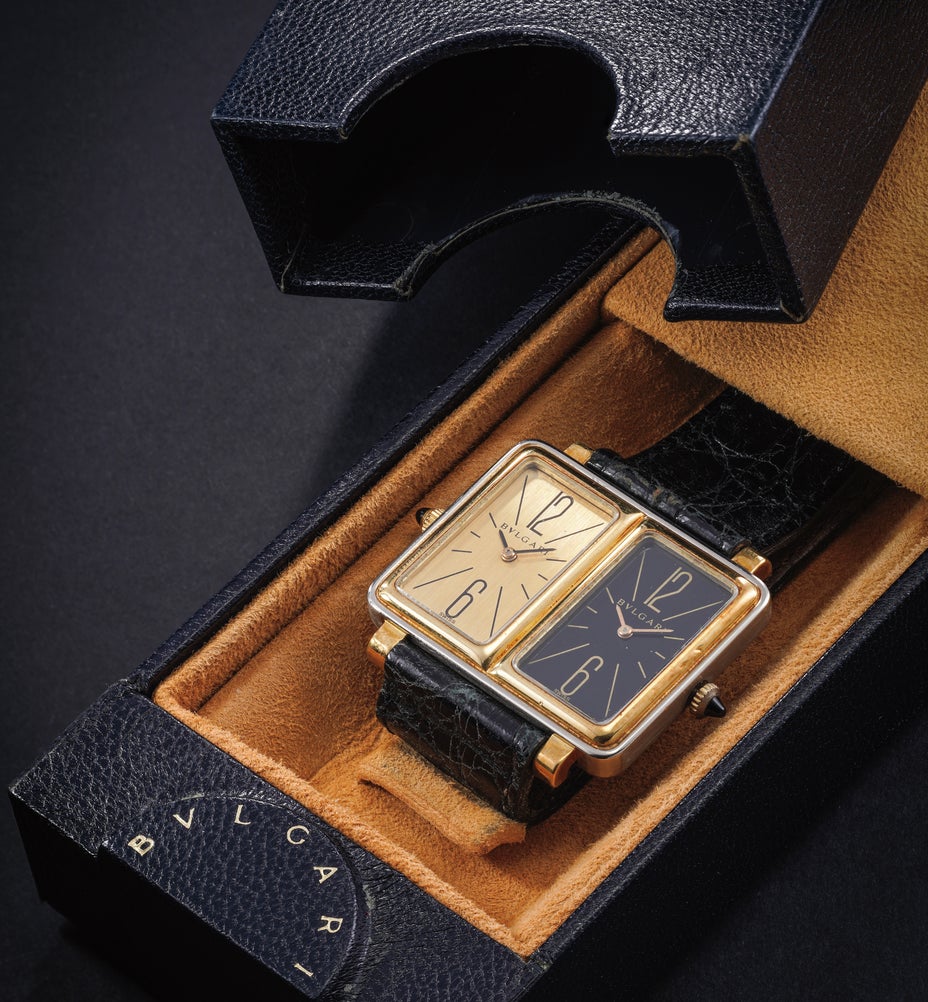
An unusual and attractive yellow gold and steel dual-time wristwatch with two dials and two manual-wind movements signed Ebel and Gérald Genta, with Bulgari presentation box
Full-Cataloguing
- Dual time, with two independent movements
- Two-tone yellow gold and steel case
- Movements signed by Ebel and Gérald Genta
In the 1970s and 1980s, as Bulgari expanded its watchmaking ambitions, the brand experimented with a number of unconventional wristwatch designs that blended Roman jewelry sensibility with Swiss horological practicality. Among the most intriguing were dual-time models featuring two independent dials and movements, allowing the wearer to track two time-zones simultaneously. Several early examples of this concept are closely associated with the celebrated designer Gérald Genta, whose work for Bulgari during the era helped shape the brand’s early watchmaking identity and led to unusual creations such as the so-called Gemini dual-time pieces.
The present watch reflects that same spirit of inventive design. Its horizontally oriented rectangular case houses two separate time displays, each regulated by its own cabochon-set crown and manual-wind movement, all framed within a striking two-tone case construction. The warm champagne dial on the left contrasts elegantly with the black dial on the right, creating a balanced visual composition while keeping each time indication immediately legible. Both dials feature elongated Arabic numerals at twelve and six o'clock along with minimalist baton indexes, reinforcing the watch’s clean, architectural aesthetic.
Opening the case reveals two manual-wind movements signed by Ebel and Gérald Genta, with the inner caseback further bearing the Gérald Genta signature. These details confirm the watch’s connection to the celebrated designer, his workshop, and the collaborative ecosystem of Swiss suppliers that supported Bulgari’s early watchmaking efforts. With its distinctive twin-movement architecture, contrasting dial configuration, and sophisticated two-tone construction, the watch stands as an appealing example of Bulgari’s inventive approach to functional elegance during the late 20th century.
Bulgari
ItalianOriginally from Kalarites, Greece, Sotirios Voulgaris emigrated to Rome because of Greece's rising poverty and difficulty separating from the Ottoman Empire. He set foot on Italian soil in 1880 with little money in his pocket and spent the next four years preparing what would go on to become Italy's oldest jewelry company.
In 1884, Bulgari opened its doors to the Italian people with its offering of jewelry and accessories. Bulgari's style takes from traditions in Greek and Roman craftsmanship to elegantly balance volume and subtlety. Later, in the late 1960s, Bulgari bridged classicism and modernity by introducing its seductive, now-iconic Serpenti collection of snake-shaped coil bracelets and watches. It is through its meticulous combination of influences that Bulgari has garnered an international and loyal high-profile clientele, which included Elizabeth Taylor and Audrey Hepburn. These Hollywood stars have immortalized the house's unique gem-adorned bracelets, necklaces and earrings in rounded forms.