
Property from an Important European Collection
12
Carlo Scarpa
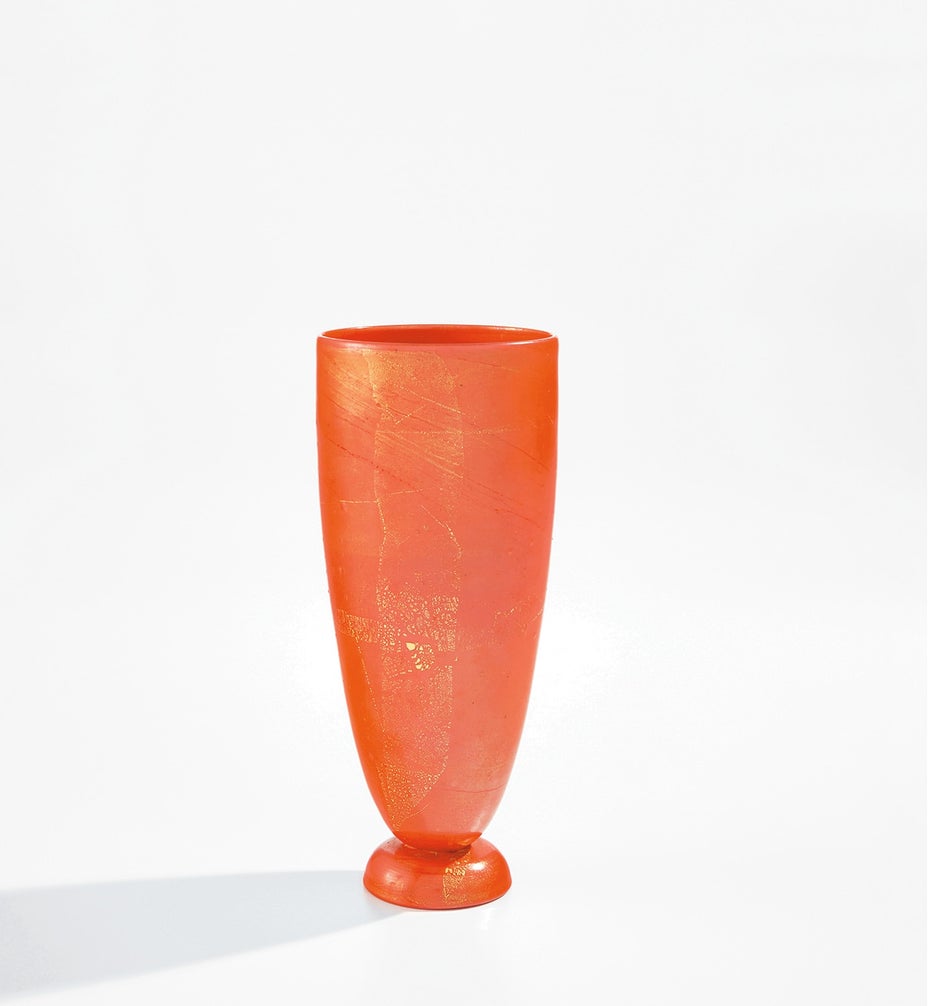
Vase, model no. 5948
- Estimate
- $12,000 - 18,000
$25,200
Lot Details
Pasta vitrea glass with applied gold leaf.
circa 1929
8 3/4 in. (22.2 cm) high
Produced by M.V.M Cappellin & C., Murano, Italy. Underside acid-etched with partially obscured manufacturer's mark.
Specialist
Full-Cataloguing
Catalogue Essay
The present model was exhibited at the IV Monza Triennale, 1930.
Provenance
Literature
Carlo Scarpa
Italian | B. 1906 D. 1978Phillips Design has a deep-rooted passion for the work of Carlo Scarpa, one of the twentieth century's great poets, whose rhythms, lines and materials — a grammar of space — appeal both as a local response to the architect's birth city, Venice, and a universal language of ordered dynamism.
Carlo Scarpa graduated with a degree in architectural drawing from the Accademia di Belle Arti in Venice in 1926. In the years that followed, he worked as a teaching assistant for a former professor, ran his own architectural practice in Venice and worked as a freelance artist for M.V.M. Cappellin glassworks. When M.V.M. Cappellin went bankrupt in 1932, Scarpa joined Venini & C. in Murano, where he served as artistic director until 1947. During his tenure at Venini, Scarpa developed a host of new techniques — in particular, mezza filigrano, a bollicine and corroso — that catapulted the centuries-old tradition of Venetian glassblowing to the forefront of modernist design.
Browse ArtistCarlo Scarpa graduated with a degree in architectural drawing from the Accademia di Belle Arti in Venice in 1926. In the years that followed, he worked as a teaching assistant for a former professor, ran his own architectural practice in Venice and worked as a freelance artist for M.V.M. Cappellin glassworks. When M.V.M. Cappellin went bankrupt in 1932, Scarpa joined Venini & C. in Murano, where he served as artistic director until 1947. During his tenure at Venini, Scarpa developed a host of new techniques — in particular, mezza filigrano, a bollicine and corroso — that catapulted the centuries-old tradition of Venetian glassblowing to the forefront of modernist design.