

127Σ
Cartier
Cintrée
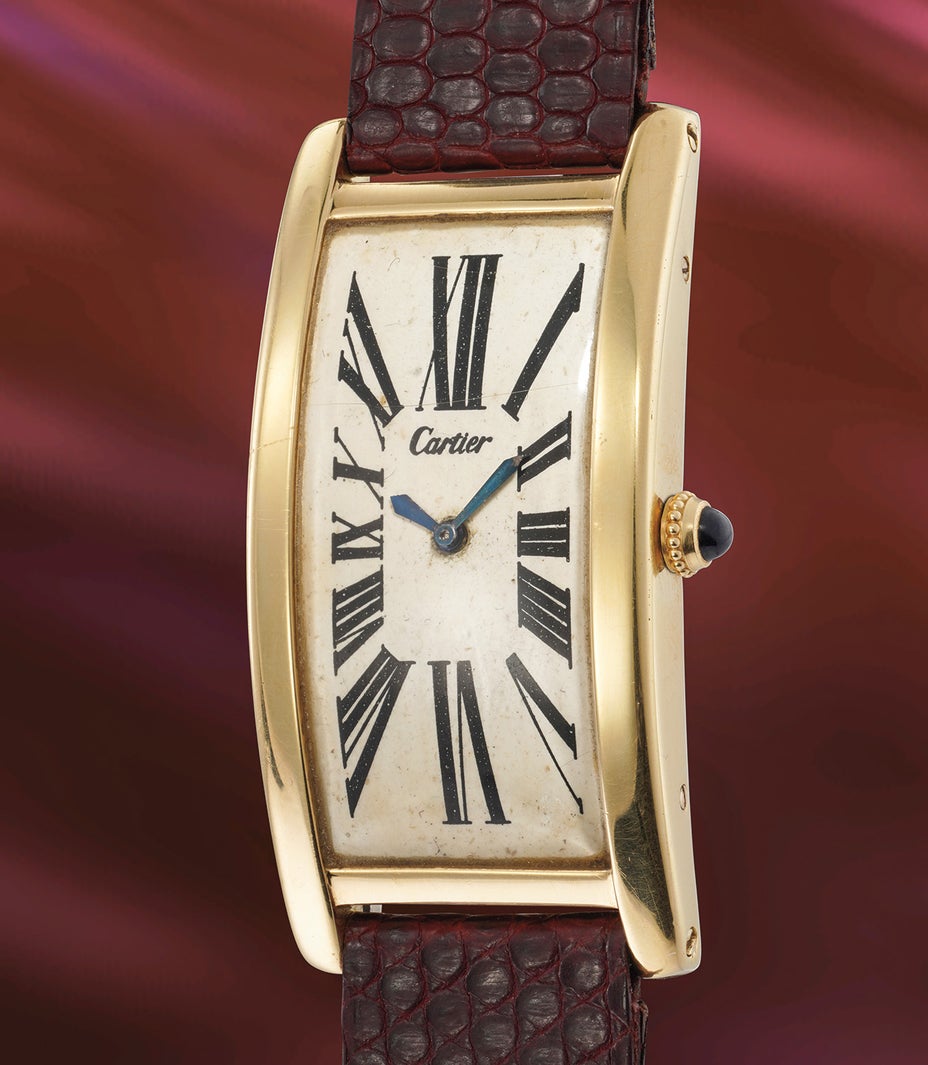
A rare and attractive yellow gold curved wristwatch with Roman numerals
- Estimate
- CHF40,000 - 80,000€42,600 - 85,100$46,500 - 93,000
CHF76,200
Lot Details
- Manufacturer
- Cartier
- Year
- Circa 1925
- Movement No
- 278'941
- Case No
- 26767, 14273 and 7096
- Model Name
- Cintrée
- Material
- 18K yellow gold
- Calibre
- Manual, cal. 460-1B, 17 jewels
- Bracelet/Strap
- Lizard
- Clasp/Buckle
- 18K yellow gold Cartier deployant clasp stamped "7096"
- Dimensions
- 22.5mm Length and 45.5mm Width
- Signed
- Case, dial movement and clasp signed, case and clasp with matching Cartier hand stamped numbers
Specialist
Full-Cataloguing
Catalogue Essay
Introduced in 1921, the Tank Cintrée model was the largest and boldest variation of Cartier’s Tank line. With its long, slender, and gracefully arching case, the Cintrée is without a doubt one of the most beautiful watches made during the 20th century. The Cintrée’s highly curved case was designed to hug the curves of the wrist. The expansive dial and case combine straight lines, sensual curves, and crisp angles, resulting in a ‘modern’ wristwatch with a design far ahead of its time - so much so, in fact, that the design has spawned multiple re-editions; the latest one, released in 2021, being a virtually perfect replica of the vintage model.
The case is particularly large for a 1920s watch, with the rectangular curved case sitting incredibly well on the wrist, showcasing Cartier's eye for design and proportions. Even the clasp displays the same number as the case, attesting to the fact it was delivered to the watch.
Interestingly, it is most probable that the timepiece was made in France and sold in London, as seen by the French hallmarks on the case and the two dots flanking the outside case number, which is a sign the watch was retailed in London. Yet the design of the dial remains firmly "London" with the exploding Roman numerals and the absence of the outer track on the dial. This shows that during the early part of the 20th century, the different branches of Cartier (London, New York and France) were working with each other and not operating in silos, whether it be by sharing designs, stock and production among the three Cartier brothers.
The case is particularly large for a 1920s watch, with the rectangular curved case sitting incredibly well on the wrist, showcasing Cartier's eye for design and proportions. Even the clasp displays the same number as the case, attesting to the fact it was delivered to the watch.
Interestingly, it is most probable that the timepiece was made in France and sold in London, as seen by the French hallmarks on the case and the two dots flanking the outside case number, which is a sign the watch was retailed in London. Yet the design of the dial remains firmly "London" with the exploding Roman numerals and the absence of the outer track on the dial. This shows that during the early part of the 20th century, the different branches of Cartier (London, New York and France) were working with each other and not operating in silos, whether it be by sharing designs, stock and production among the three Cartier brothers.
Cartier
FrenchWith the Constitution of 1848 came a new standard for luxury in France. Founded one year prior by Louis-Francois Cartier, the house of Cartier was one of the first to use platinum in jewelry making. This incredibly expensive material became the stepping-stone for Cartier to experiment in form, mechanisms and attitude. It helped men move from pocket watches to wristwatches, effectively making the watch much more functional and prominent in a man's overall wardrobe.Cartier did not only touch on functionality. Inspired by a commissioned painting by George Barbier featuring a black panther at the feet of an elegantly bejeweled woman, Cartier began incorporating wild animals in his designs—most notably, Cartier Panthère rings, bangle bracelets and watches. Yet it wasn't until the late 1960s that the house of Cartier debuted their iconic yellow and rose gold LOVE collection, which includes the famous bracelet that only a special screwdriver can open.
Browse Maker