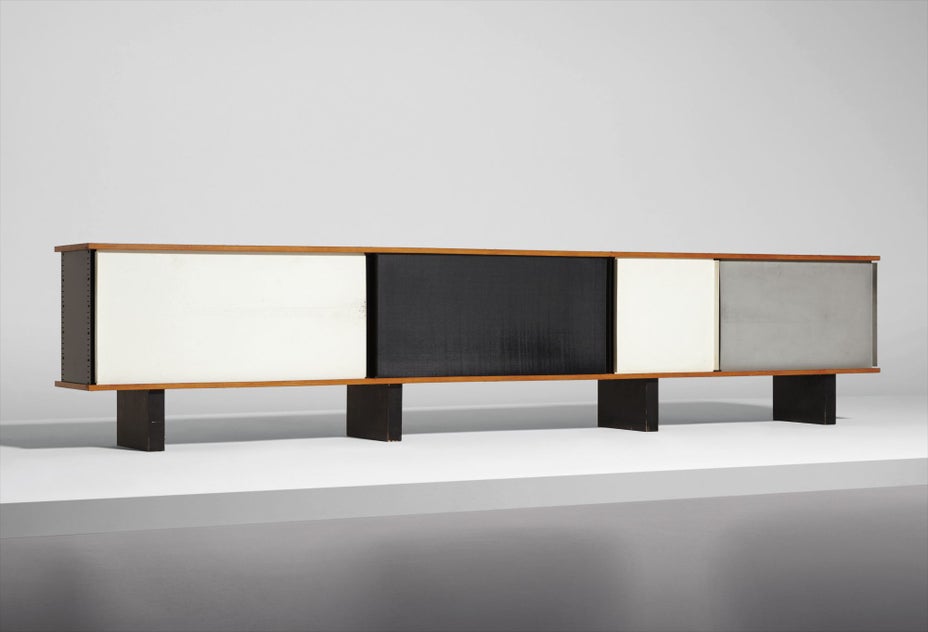

Property of an American Collector
323
Charlotte Perriand
Large unique sideboard
- Estimate
- $180,000 - 240,000
$245,000
Lot Details
Oak-veneered wood, oak-veneered plywood, painted wood, painted steel, plastic, glass, aluminum.
1959
32 1/8 x 155 1/2 x 18 7/8 in. (81.6 x 395 x 47.9 cm)
Produced by Galerie Steph Simon, Paris, France. Each drawer molded with MODELE CHARLOTTE PERRIAND/BREVETE S.G.D.G., each shelf inscribed with FERRAN. Together with the original Steph Simon invoice and preparatory drawing plan no. 28825.
Specialist
Full-Cataloguing
Catalogue Essay
The present sideboard was a special order placed by Dr. Georges Ferran in 1959 for his home in Savigny-sur-Orge, and which he later brought to his residence in Cully, Calvados.
Provenance
Literature
Charlotte Perriand
French | B. 1903 D. 1999Trailblazer Charlotte Perriand burst onto the French design scene in her early 20s, seemingly undeterred by obstacles in an era when even the progressive Bauhaus school of design barred women from architecture and furniture design courses. She studied under Maurice Dufrêne at the École de l'Union Centrale des art Décoratifs, entering into a competition at the 1925 Expo des Arts Décoratifs by age 22 and gaining critical acclaim for her exhibition at the Salon d'Automne in 1927.
On the heels of this success, that same year she joined the Paris design studio of Le Corbusier and his cousin Pierre Jeanneret. For ten years the three collaborated on "equipment for living," such as the iconic tubular steel B306 Chaise Longue (1928). After World War II, Perriand joined forces with Jean Prouvé to create modernist furniture that combined the precise lines of Prouvé's bent steel with the soft, round edges and warmth of natural wood.
Browse ArtistOn the heels of this success, that same year she joined the Paris design studio of Le Corbusier and his cousin Pierre Jeanneret. For ten years the three collaborated on "equipment for living," such as the iconic tubular steel B306 Chaise Longue (1928). After World War II, Perriand joined forces with Jean Prouvé to create modernist furniture that combined the precise lines of Prouvé's bent steel with the soft, round edges and warmth of natural wood.