Priority Bidding is here! Secure a lower Buyer’s Premium today (excludes Online Auctions and Watches). Learn More

133

Gio Ponti

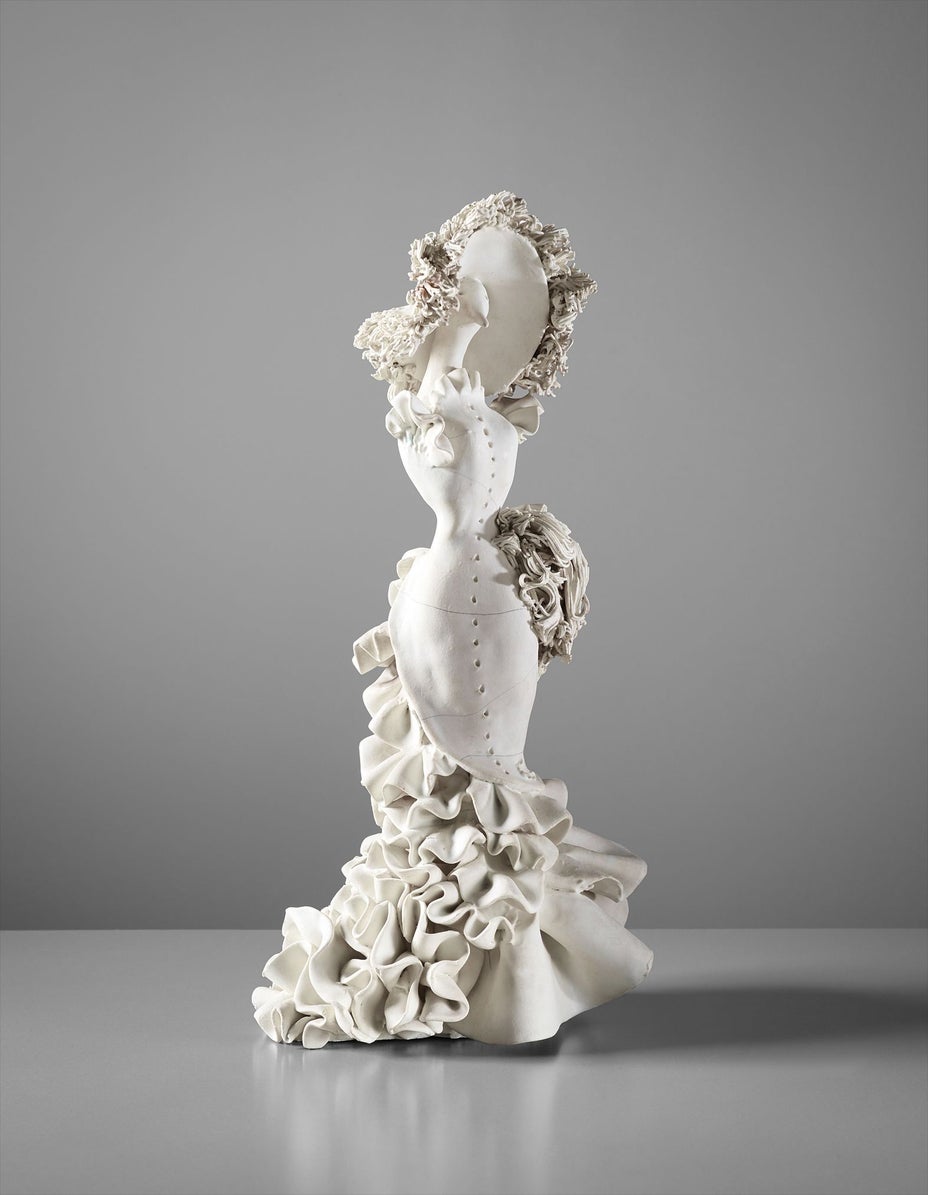
'Clothilde'

Estimate
£6,000 - 8,000
£7,500
Lot Details
Porcelain.
circa 1951
33.2 x 15.9 x 12 cm (13 1/8 x 6 1/4 x 4 3/4 in.)
Produced by Gabbianelli, Milan, Italy. Incised CLOTHILDE and underside with painted mark. Together with a certificate of authenticity from the Gio Ponti Archives.
Catalogue Essay
The present lot, a porcelain figure bearing the name of the medieval Saint Clothilde, has deep precedent within Gio Ponti’s œuvre and further calls upon a multiplicity of art historical references. Stylistically, her origins are in the Pittura Metafisica (metaphysical art) that was influential to Gio Ponti at various points in his career. Formally the work relates to several of his designs for porcelain and glass figures, most notably his Etruscan stilemes for Richard Ginori in the 1920s, and his Kings and Queens exhibited at The Brooklyn Museum in Italy at Work in 1950. Clothilde also owes much to the Western traditions of three-dimensional figural representation: specifically her twisting posture to the figura serpentinatas of Mannerist sculptures.

Gio Ponti

Italian | B. 1891 D. 1979
Among the most prolific talents to grace twentieth-century design, Gio Ponti defied categorization. Though trained as an architect, he made major contributions to the decorative arts, designing in such disparate materials as ceramics, glass, wood and metal. A gale force of interdisciplinary creativity, Ponti embraced new materials like plastic and aluminum but employed traditional materials such as marble and wood in original, unconventional ways.In the industrial realm, he designed buildings, cars, machinery and appliances — notably, the La Cornuta espresso machine for La Pavoni — and founded the ADI (Industrial Designer Association). Among the most special works by Gio Ponti are those that he made in collaboration with master craftsmen such as the cabinetmaker Giordano Chiesa, the illustrator Piero Fornasetti and the enamellist Paolo de Poli.
Browse Artist