35
Henri Cartier-Bresson
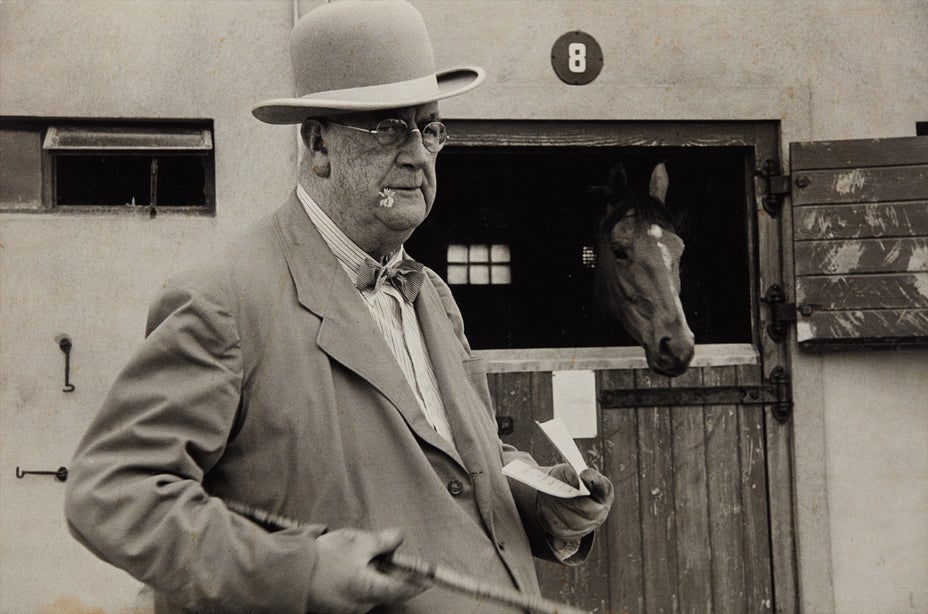
At the Curragh Racecourse Near Dublin
Full-Cataloguing
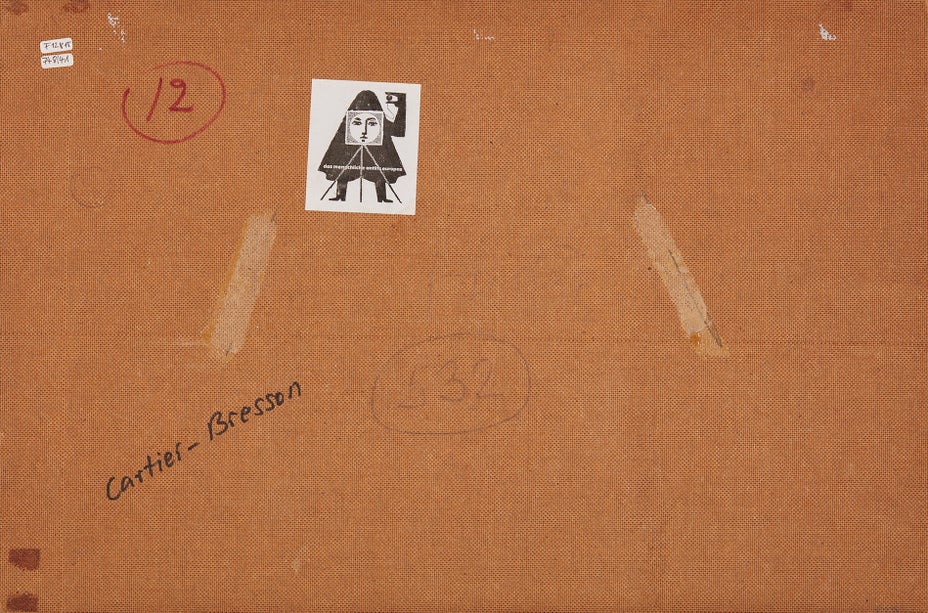
The photograph offered here is a rare, oversized exhibition print that was featured in the 1959 Das Menschliche Antlitz Europas (The Human Face of Europe), a show organized by Dr. Tas Toth. The goal of the exhibition was to foster a sense of European unity in the difficult decades following World War II. In much the same way that Edward Steichen’s Family of Man had done some years before, The Human Face of Europe stressed the commonality of human experience, focusing specifically, in this case, on Europe. Dr. Toth believed that photography was the ideal medium to carry out this goal. The introduction to the exhibition's catalogue states,
“a genuine, living Europe does exist. . . Yet it is hard to define the concept ‘Europe.’ When we try, the things that divide seem just as strong as the things that unite. Nevertheless, we feel what we cannot express in words. Here, pictures must come to our aid. Pictures express without words what has to be said.”
In addition to Cartier-Bresson, The Human Face of Europe included works by Edward Steichen, Robert Doisneau, Werner Bischoff, David Seymour, Robert Capa, and many other top photographers of the day. The image offered here was also reproduced in Cartier-Bresson’s book of his own photographs of Europe and its people, The Europeans, published in 1955.
Henri Cartier-Bresson
French | B. 1908 D. 2004Candidly capturing fleeting moments of beauty among the seemingly ordinary happenings of daily life, Henri Cartier-Bresson's work is intuitive and observational. Initially influenced by the Surrealists' "aimless walks of discovery," he began shooting on his Leica while traveling through Europe in 1932, revealing the hidden drama and idiosyncrasy in the everyday and mundane. The hand-held Leica allowed him ease of movement while attracting minimal notice as he wandered in foreign lands, taking images that matched his bohemian spontaneity with his painterly sense of composition.
Cartier-Bresson did not plan or arrange his photographs. His practice was to release the shutter at the moment his instincts told him the scene before him was in perfect balance. This he later famously titled "the decisive moment" — a concept that would influence photographers throughout the twentieth century.