Property from an Important European Collection
14
Irving Penn
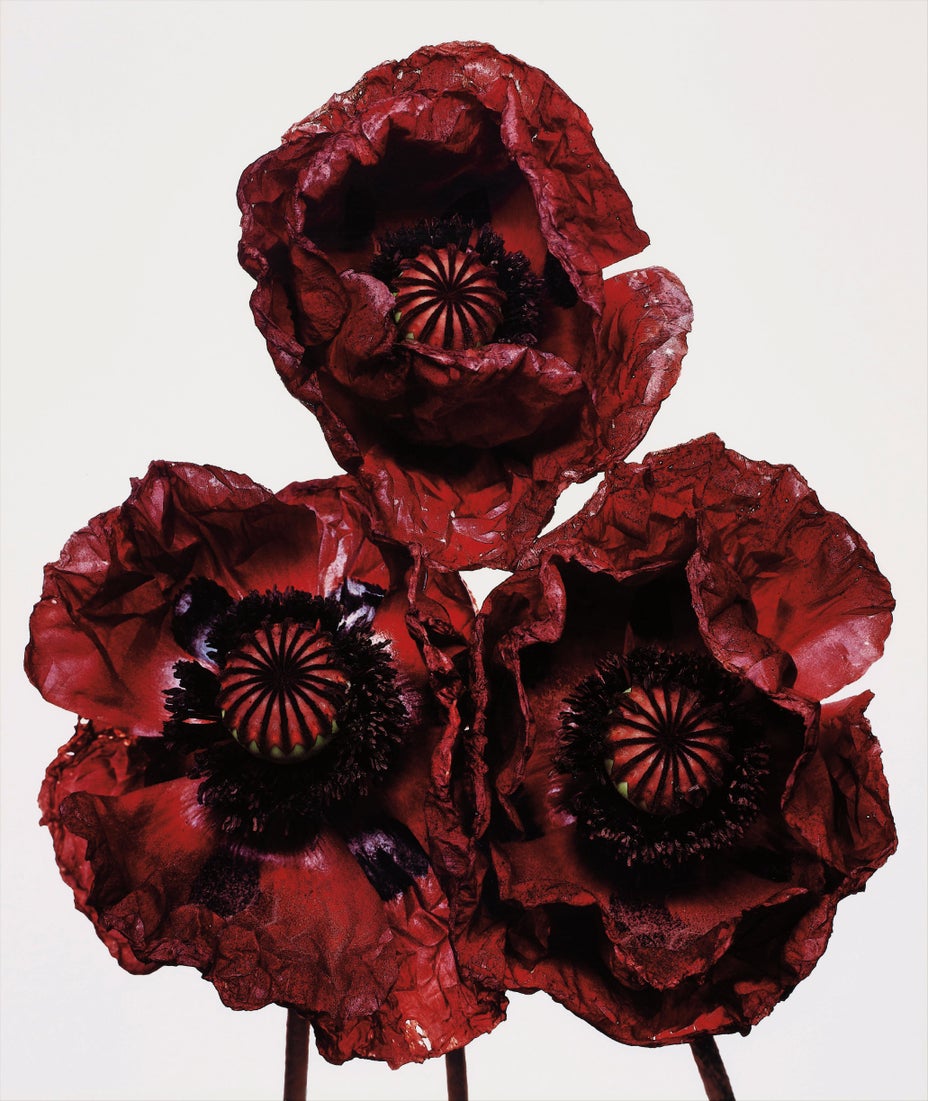
Three Poppies, Arab Chief, New York
This image was realised only in a dye transfer edition of 27.
Full-Cataloguing
Anthony West, American Vogue, December 1969
Irving Penn captures the exquisite Three Poppies with elegance and minimalism against his signature white backdrop. His seemingly uncomplicated composition places emphasis on the form, detail and structure of this opulent trio of ‘Arab Chief’ poppies, a variety that boasts massive nine-inch blooms of intense ruby red. Penn's flowers graced the pages of the holiday issues of American Vogue from 1967-73 with each year’s issue celebrating a specific flower. Poppies defined 1969.
The culmination of this body of work was carefully compiled in his 1980 publication Flowers, which contained photographs not published by Vogue. As Penn notes in the introduction, he found liberty in working with a subject that was so foreign to him: ‘It has left me free to react with simple pleasure just to form and colour, without being diverted by considerations of rarity or tied to the convention that a flower must be photographed at its moment of unblemished, nubile perfection.’ The knowledge Penn may have lacked in his subject matter is more than compensated by his mastery over every detail from the billowing edges of the poppy to the intricate rings of its stamen meticulously captured by his lens.
Irving Penn
American | B. 1917 D. 2009Irving Penn was one of the 20th century’s most significant photographers, known for his arresting images, technical mastery, and quiet intensity. Though he gained widespread acclaim as a leading Vogue photographer for over sixty years, Penn remained a private figure devoted to his craft. Trained under legendary art director Alexey Brodovitch in Philadelphia, he began his career assisting at Harper’s Bazaar before joining Vogue in 1943, where editor and artist Alexander Liberman recognized Penn’s distinctive eye and encouraged him to pursue photography. Penn’s incomparably elegant fashion studies reset the standard for the magazine world, and his portraits, still lifes, and nude studies broke new ground. His 1960 book Moments Preserved redefined the photographic monograph with its dynamic layout and high-quality reproductions. In 1964, Penn began printing in platinum and palladium, reviving this 19th-century process to serve his own distinct vision. An innovator in every sense, Penn’s approach to photography was endlessly adventurous. Few photographers of his generation experimented as widely with both conventional and historic print processes, and none achieved Penn’s level of excellence in all.