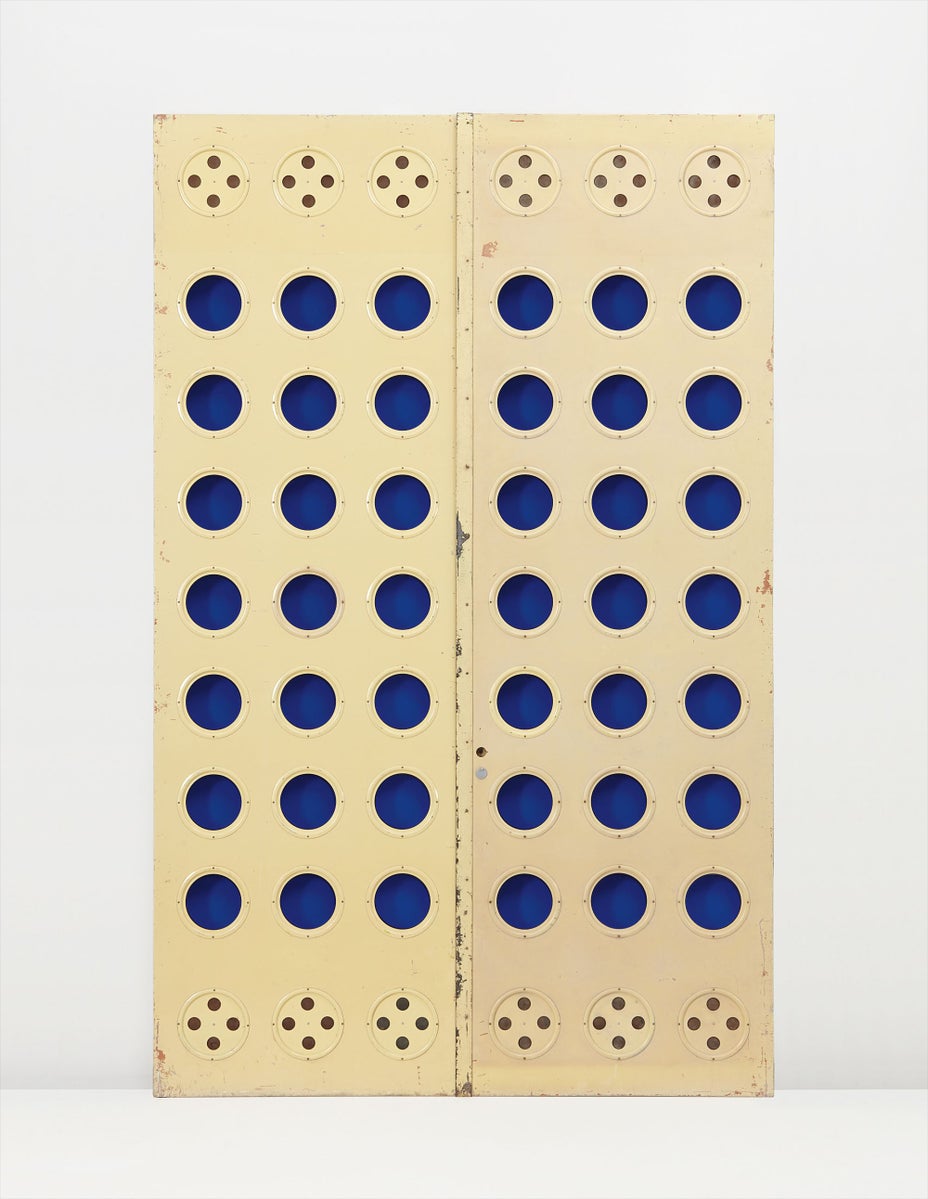

Property from a Corporate Collection
46
Jean Prouvé
Pair of doors designed for the Maisons Tropicales
- Estimate
- $80,000 - 120,000
$149,000
Lot Details
Painted steel, aluminum, colored glass, clear glass, wood.
circa 1949
Each door: 116 x 37 5/8 x 2 in. (294.6 x 95.6 x 5.1 cm)
Manufactured by Les Ateliers Jean Prouvé, France.
Specialist
Full-Cataloguing
Catalogue Essay
Between 1949 and 1951 Jean Prouvé produced three pre-fabricated houses for the French colonies in West Africa. The French government commissioned these designs following World War II, partly out of support for the aluminum industry, and also in keeping with the tradition of sending pre-fabricated structures to the colonies. These “Maisons Tropicales” were designed differently than his earlier pre-fabricated structures intended for a European climate. The “Maison Tropicales” were intended to shelter against the extreme weather of the region with roofs that extended from the exterior walls to shelter a patio ventilated with retractable shutters. The façades were made up of four types of components: solid panels, window panels, glass panels and door panels with portholes. The present two door panels were produced for a Maisons Tropicale, though they were never used. Ultimately, only three Maison Tropicales were ever built and shipped, partly as a result of the time and expense involved in their production, but also because they did not suit the taste of French bureaucrats living in the colonies. It is likely for this reason that the present doors were still at the Maxéville factory when it closed in 1953.
Provenance
Literature
Jean Prouvé
French | B. 1901 D. 1984Jean Prouvé believed in design as a vehicle for improvement. His manufactory Les Ateliers Jean Prouvé, located in Nancy, France, produced furniture for schools, factories and municipal projects, both within France and in locations as far flung as the Congo. Though he designed for the masses, pieces such as his "Potence" lamps and "Standard" chairs are among the most iconic fixtures in sophisticated, high-design interiors today. Collectors connect with his utilitarian, austere designs that strip materials down to the bare minimum without compromising on proportion or style.
Prouvé grew up in Nancy, France, the son of Victor Prouvé, an artist and co-founder of the École de Nancy, and Marie Duhamel, a pianist. He apprenticed to master blacksmiths in Paris and opened a small wrought iron forge in Nancy. However it was sheet steel that ultimately captured Prouvé's imagination, and he ingeniously adapted it to furniture, lighting and even pre-fabricated houses, often collaborating with other design luminaries of the period, such as Robert Mallet-Stevens, Le Corbusier and Charlotte Perriand.
Browse ArtistProuvé grew up in Nancy, France, the son of Victor Prouvé, an artist and co-founder of the École de Nancy, and Marie Duhamel, a pianist. He apprenticed to master blacksmiths in Paris and opened a small wrought iron forge in Nancy. However it was sheet steel that ultimately captured Prouvé's imagination, and he ingeniously adapted it to furniture, lighting and even pre-fabricated houses, often collaborating with other design luminaries of the period, such as Robert Mallet-Stevens, Le Corbusier and Charlotte Perriand.