114
Joe Colombo
Interior, from Casa Zancopé, via San Francesco, Milan
Estimate
£80,000–120,000
Sold For
£146,500
1962-1967
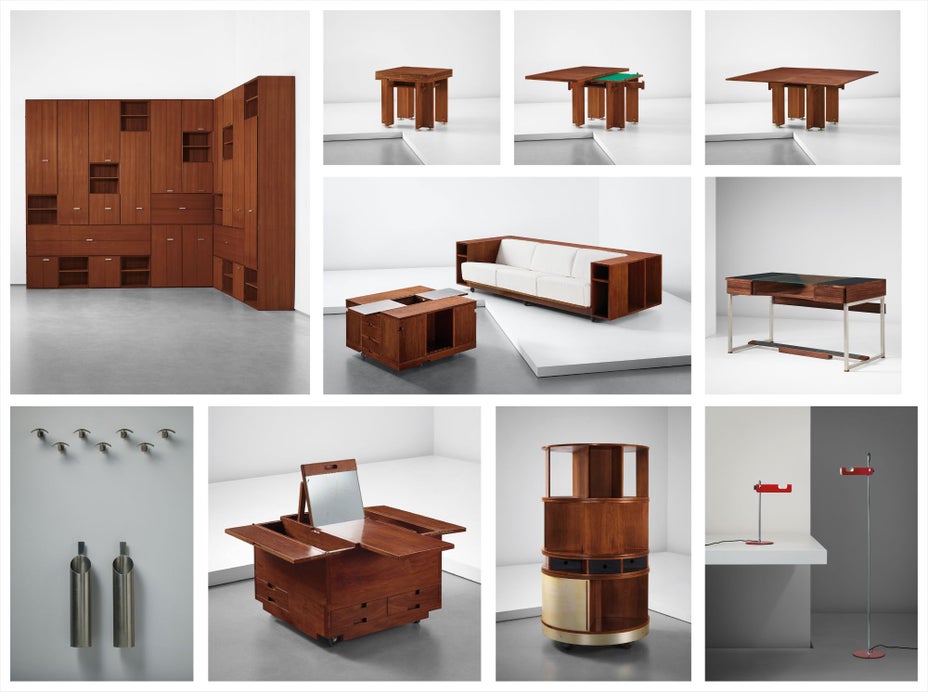
Comprising bookcase: ash, ash-veneered wood, nickel-plated metal, glass; desk: East Indian rosewood, East Indian rosewood-veneered wood, plastic-laminated wood, nickel-plated metal, glass; extendable dining table: oak, nickel-plated metal; sofa: walnut, fabric; ‘Combi centre’: walnut, aluminium; drinks cabinet: walnut, stainless steel plate, acrylic (interior drawer with manufacturer’s logo paper label BERNINI/ Made in Italy); folding dressing table: walnut, mirrored glass, acrylic (interior drawer with manufacturer’s logo paper label BERNINI/ Made in Italy); umbrella stands and coat hooks: nickel-plated brass. Each work manufactured by Berini, Milan, Italy. ‘Spider’ desk and standard lamps: painted aluminium, chromium-plated tubular metal, painted metal. Both lights manufactured by O-Luce, Milan, Italy.
Each work together with a certificate of authenticity from Studio Joe Colombo.
Each work together with a certificate of authenticity from Studio Joe Colombo.
Bookcase: 287 x 334 x 228 cm (112 7/8 x 131 1/2 x 89 3/4 in.); desk: 77.5 x 139.5 x 74.1 cm (30 1/2 x 54 7/8 x 29 1/8 in.); extendable dining table: 68.8 x 160.1 x 160.2 cm (27 1/8 x 63 x 63 1/8 in.) fully extended; sofa: 65.7 x 251.7 x 114 cm (25 7/8 x 99 1/8 x 44 7/8 in.); ‘Combi centre’: 151.4 cm (59 5/8 in.) high, 82.5 cm (32 1/2 in.) diameter; drinks cabinet: 50.8 x 116.7 x 88.2 cm (20 x 45 7/8 x 34 3/4 in.) fully extended; folding dressing table: 76.5 x 65.1 x 104.3 cm (30 1/8 x 25 5/8 x 41 1/8 in.) fully extended; each umbrella stand: 69.2 x 14 x 17.1 cm (27 1/4 x 5 1/2 x 6 3/4 in.); each coat hooks: 4.2 x 11.7 x 13 cm (1 5/8 x 4 5/8 x 5 1/8 in.); ‘Spider’ standard lamp: 145.2 cm (57 1/8 in.) high; ‘Spider’ desk lamp: 40 x 18 x 27.5 cm (15 3/4 x 7 1/8 x 10 7/8 in.) fully extended
Full-Cataloguing
Phillips wishes to thank Arch. Ignazia Favata and Arch. Elisabetta Borgatti for their assistance with cataloguing the present lot.
THE ZANCOPÉ APARTMENT
Joe Colombo designed several interiors for the Zancopé family, always with innovative and unique approaches. One of the first apartments, on Via San Francesco, Milan, was characterised by a well-articulated floor plan designed to accommodate the specific needs of the family. The different areas with clearly defined functions retain a spatial fluidity and ease of accessibility achieved through the use of sliding doors and slim furnishings that serve as room dividers, like the library, which separates the room in dining and living area with sofa and armchairs.
To create continuity between different environments, Joe Colombo used wooden strips to panel both the walls and the lowered ceiling in the entrance in contrast to other spaces such as the exposed brickwork in the living room and the dining area. The attention paid to the distribution of space is accompanied by an even more detailed study of the furniture plan, as the desk, the library and modular cabinets were intended for serialised production. They are all modular, adjustable, flexible, like the elements composing the entrance: a full height wooden panel is equipped with hooks, coat hangers and umbrella stands that can be adjusted and repositioned in different configurations and height levels.
The low ceilings and lighting fixtures in different colours anticipate new formal solutions such as those conceived four years later, once again for a Zancopè family’s apartment, on Via Sismondi, characterised by the alternation of volumes, and studied use of lights and contrasting colours. For Joe Colombo space must guarantee not only functionality and flexibility, but must also accommodate new ways of living. His research allowed him to surpass the concept of the building as a ‘container’ and to define its contents as multifunctional units capable of providing all the necessary functions for living, such as designs like the Rotoliving and the Cabriolet Bed, both realised for his own apartment in 1969.
For Joe Colombo "The search for a methodology of an architectural design is implemented through the studies of ecology, psychology, ergonomics, etc. according to and in relation with the dimension in which a modern man lives, i.e. to provide the space immediately surrounding him and the equipment he needs to live in a coherent manner with the outside world. The challenge is providing equipment that will be autonomous, disconnected from the ‘architectural contain(er)’, in an adjustable and programmable way, so that they can adapt to any situation of space, present and future. The interaction between time and space is the concept on which all our research is based on and, because of the increasingly rapid evolution of mankind, it requires house furnishing that are flexible, that can always be used in different ways adapting to the user needs” (‘Design la fine di un mito’, Ottagono, no. 19, December 1970).
Arch. IGNAZIA FAVATA
Studio Joe Colombo
Milan, March 2015
THE ZANCOPÉ APARTMENT
Joe Colombo designed several interiors for the Zancopé family, always with innovative and unique approaches. One of the first apartments, on Via San Francesco, Milan, was characterised by a well-articulated floor plan designed to accommodate the specific needs of the family. The different areas with clearly defined functions retain a spatial fluidity and ease of accessibility achieved through the use of sliding doors and slim furnishings that serve as room dividers, like the library, which separates the room in dining and living area with sofa and armchairs.
To create continuity between different environments, Joe Colombo used wooden strips to panel both the walls and the lowered ceiling in the entrance in contrast to other spaces such as the exposed brickwork in the living room and the dining area. The attention paid to the distribution of space is accompanied by an even more detailed study of the furniture plan, as the desk, the library and modular cabinets were intended for serialised production. They are all modular, adjustable, flexible, like the elements composing the entrance: a full height wooden panel is equipped with hooks, coat hangers and umbrella stands that can be adjusted and repositioned in different configurations and height levels.
The low ceilings and lighting fixtures in different colours anticipate new formal solutions such as those conceived four years later, once again for a Zancopè family’s apartment, on Via Sismondi, characterised by the alternation of volumes, and studied use of lights and contrasting colours. For Joe Colombo space must guarantee not only functionality and flexibility, but must also accommodate new ways of living. His research allowed him to surpass the concept of the building as a ‘container’ and to define its contents as multifunctional units capable of providing all the necessary functions for living, such as designs like the Rotoliving and the Cabriolet Bed, both realised for his own apartment in 1969.
For Joe Colombo "The search for a methodology of an architectural design is implemented through the studies of ecology, psychology, ergonomics, etc. according to and in relation with the dimension in which a modern man lives, i.e. to provide the space immediately surrounding him and the equipment he needs to live in a coherent manner with the outside world. The challenge is providing equipment that will be autonomous, disconnected from the ‘architectural contain(er)’, in an adjustable and programmable way, so that they can adapt to any situation of space, present and future. The interaction between time and space is the concept on which all our research is based on and, because of the increasingly rapid evolution of mankind, it requires house furnishing that are flexible, that can always be used in different ways adapting to the user needs” (‘Design la fine di un mito’, Ottagono, no. 19, December 1970).
Arch. IGNAZIA FAVATA
Studio Joe Colombo
Milan, March 2015