90Σ︎
Paolo Buffa
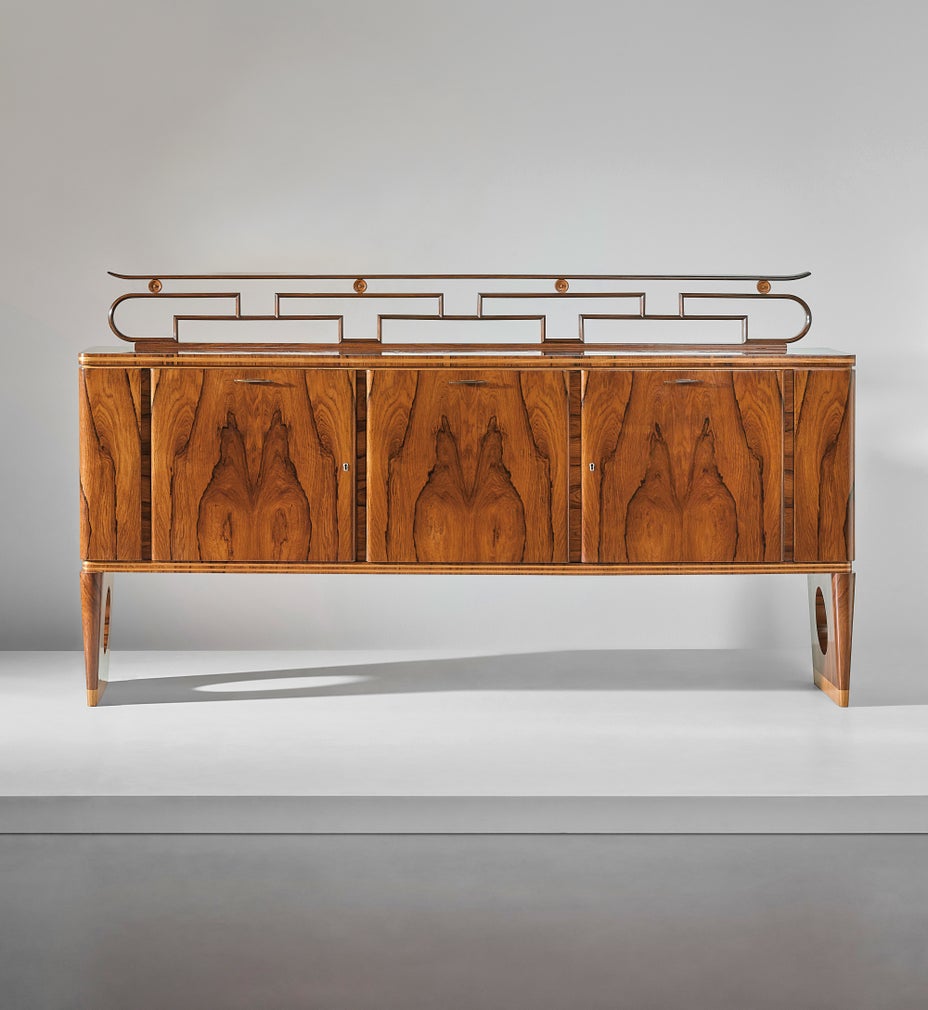
Rare sideboard
Estimate
HK$108,000–150,000
€12,200–16,900
$13,800–19,200
Sold For
HK$162,500
Brazilian rosewood-veneered wood, walnut-veneered wood, brass
123.5 x 220.2 x 50 cm (48 5/8 x 86 3/4 x 19 5/8 in.)
Manufactured by Serafino Arrighi, Italy. Together with a certificate of expertise from the Paolo Buffa Archive. Produced circa 1934.
Full-Cataloguing
Having trained in the studio of Gio Ponti and Emilio Lancia, in 1928 Paolo Buffa opened his own practice in Milan with Antonio Cassi Ramelli. Towards the end of the 1920s, the architect had started to incorporate oriental stylistic elements to his work, pairing them with the formal and sophisticated features of Neoclassicism, which was the preferred style favoured by a group of architects from Lombardy including Ponti, Lancia and Tomaso Buzzi. The present sideboard exemplifies the combination of the two styles. In the present work, Buffa enriches his Classicist repertoire, emphasising uniform and rigorous shapes with new exotic forms, as evidenced by the brass decorative unit placed at the top of the sideboard, recalling the Chinese labyrinths. This sideboard features additional recurring characteristics in Buffa’s work, notably the use of precious materials and the architect's ability to create works with balanced composition and great elegance, enabled by the experienced craftsmen he worked with, including Serafino Arrighi. Similar characteristics can be found in another sideboard designed by Buffa and published in Domus in 1930 (Domus, no. 31, July 1930, p. 1331), which features curved sides imitating the roofs of the pagodas.
Buffa’s production, although varied, was based on the use of recurrent themes, for example, specific elements of connection between the legs and the decorative treatment of surfaces. Buffa constantly experimented with these typologies until reaching a final synthesis, simultaneously measured in proportion, and balanced in the decorative and constructive details.
Buffa’s production, although varied, was based on the use of recurrent themes, for example, specific elements of connection between the legs and the decorative treatment of surfaces. Buffa constantly experimented with these typologies until reaching a final synthesis, simultaneously measured in proportion, and balanced in the decorative and constructive details.