
50
Piaget
Ref. 14105
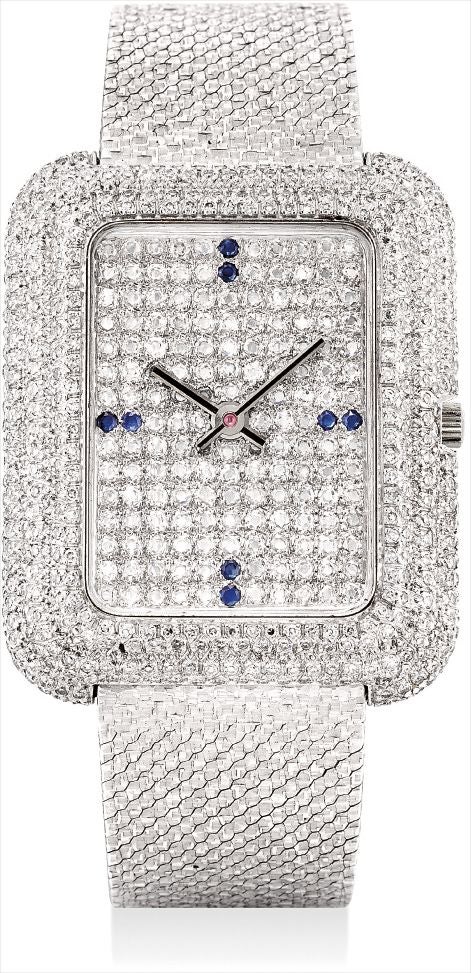
A fine and very rare white gold, diamond and sapphire-set rectangular bracelet watch with 'Beta 21' movement and fitted presentation box
- Estimate
- HK$230,000 - 400,000
Lot Details
- Manufacturer
- Piaget
- Year
- 1972
- Reference No
- 14105
- Movement No
- 721'566
- Case No
- 214'179
- Material
- 18k white gold, diamonds and sapphires
- Calibre
- Quartz, Beta 21
- Bracelet/Strap
- 18k white gold <em>Piaget</em> bracelet, 140 mm. maximum length
- Clasp/Buckle
- 18k white gold<em> Piaget </em>folding clasp stamped <em>Piaget </em>
- Dimensions
- 34 mm. width
- Signed
- <em>Case and movement signed </em>
- Accessories
- With <em>Piaget</em> fitted presentation box.
Specialist
Full-Cataloguing
Catalogue Essay
The Quartz movement was first invented in 1928 by Bell Labs, and was mainly used for practical purposes such as time keeping in laboratories. It was only until the 1970s that Quartz movements were regularly used in wristwatches.
The Beta-21 was first created in 1969, and made its debut during Basel later that year. At the time, the Beta-21 was revolutionary as it was the most accurate quartz movement to be offered on the market - the movement was accurate to 5 seconds per month. Due to the movement's large and bulky size, watchmakers soon developed their own in house movements and gradually moved away from the Beta-21.
Today, watches fitted with the Beta-21 have increased in popularity and collectability as they represent a very important moment in the history of watchmaking. The present watch by Piaget houses the Beta-21 in its substantial watch case. Embellished with sapphires and over 156 brilliant-cut diamonds, the watch also features a beautiful textured bracelet - a hallmark of Piaget's great craftsmanship.
The Beta-21 was first created in 1969, and made its debut during Basel later that year. At the time, the Beta-21 was revolutionary as it was the most accurate quartz movement to be offered on the market - the movement was accurate to 5 seconds per month. Due to the movement's large and bulky size, watchmakers soon developed their own in house movements and gradually moved away from the Beta-21.
Today, watches fitted with the Beta-21 have increased in popularity and collectability as they represent a very important moment in the history of watchmaking. The present watch by Piaget houses the Beta-21 in its substantial watch case. Embellished with sapphires and over 156 brilliant-cut diamonds, the watch also features a beautiful textured bracelet - a hallmark of Piaget's great craftsmanship.
Literature
Piaget
Swiss | 1874Creativity, audacity and know-how are the values that gave Piaget its international reputation and allowed the brand to distinguish itself in the world of fine watchmaking and precision. Founder Georges Edouard Piaget established the company in 1874 and manufactured watch movements. While Piaget is famously recognized today for their elaborate wristwatch and bangle designs, they also mastered the marriage of their high-quality, in-house-produced wristwatches and stunning pieces of jewelry.
Collectors consider the 1970s as Piaget's era of superb creativity and unbounded designs. During this highly creative period, the brand designed an impressive range of cuff and bracelet watches carved in gold and adorned with exotic hard stones. Admired by most as not only jewelry but also true works of art, the firm's hard stone dial watches remain the most iconic, recognizable and desirable among collectors.
Browse MakerCollectors consider the 1970s as Piaget's era of superb creativity and unbounded designs. During this highly creative period, the brand designed an impressive range of cuff and bracelet watches carved in gold and adorned with exotic hard stones. Admired by most as not only jewelry but also true works of art, the firm's hard stone dial watches remain the most iconic, recognizable and desirable among collectors.