141Δ︎Σ︎
Pierre Chareau
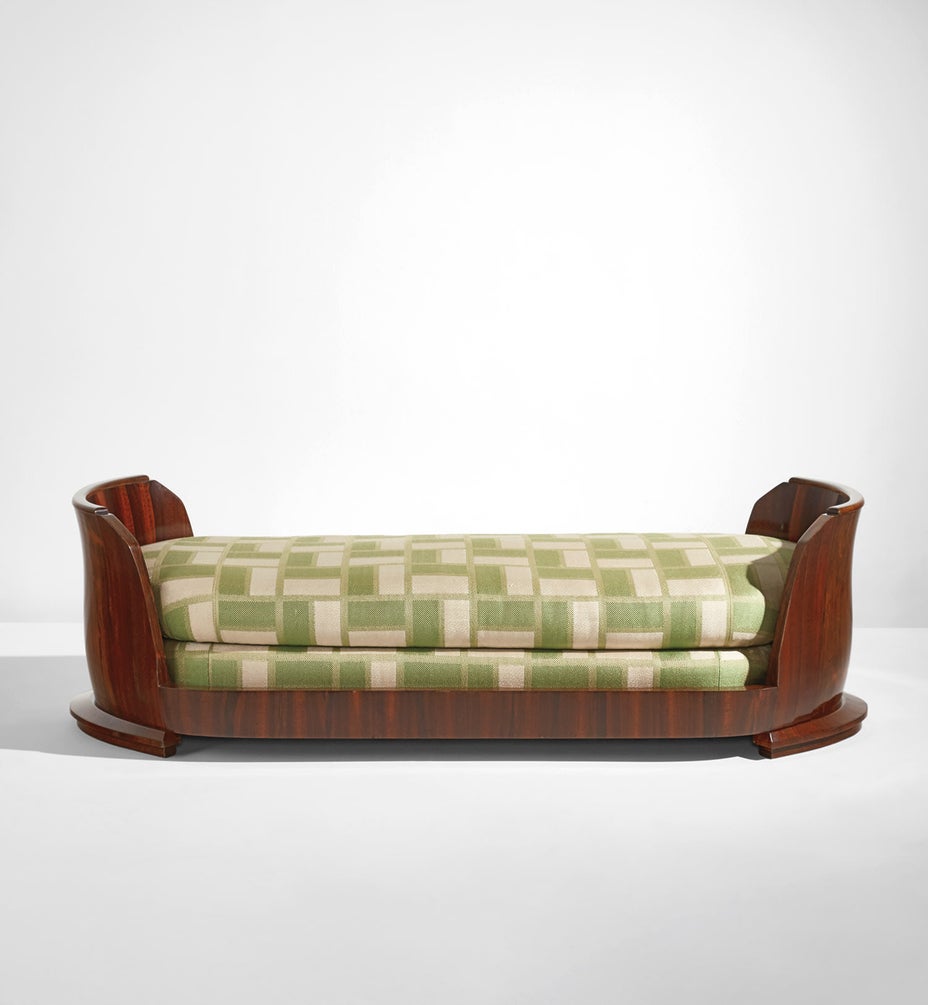
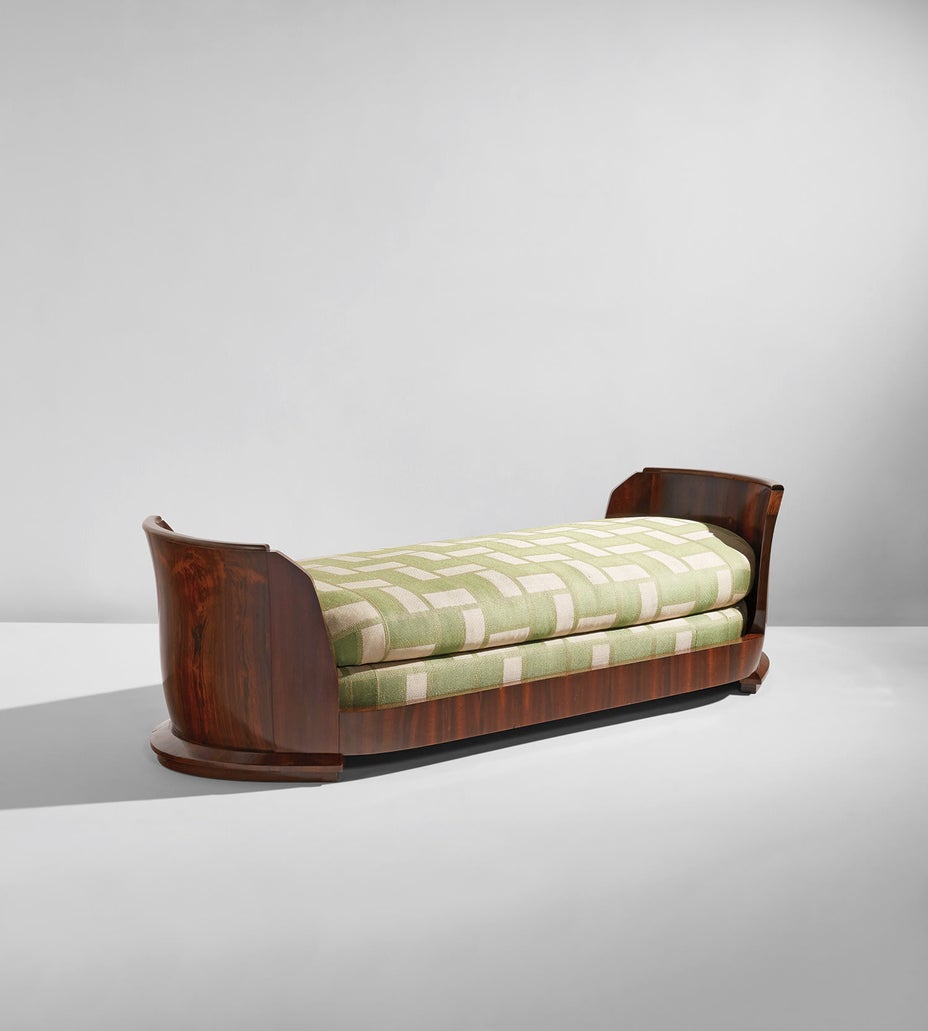
"Tulip" daybed, model no. MP 102
Estimate
$60,000–80,000
Sold For
$69,300
circa 1923
Rosewood, rosewood-veneered wood, fabric.
24 1/4 x 81 1/4 x 33 7/8 in. (61.6 x 206.4 x 86 cm)
Produced by Chanaux & Pelletier, Paris, France. Fabric designed by Hélène Henry, Paris, France. Underside impressed four times with manufacturer's mark CP.
Full-Cataloguing
The present model daybed was exhibited at the 1923 Salon d'Automne, Paris.
For an all-too-brief period spanning approximately a dozen years, Pierre Chareau designed exquisite interiors for the progressive bourgeoisie of interwar Paris. Chareau and his wife Dollie belonged to this cultivated set, who were as forward-thinking in their taste for art, music, theater, and film as they were in their politics. Though best remembered for the Maison de Verre, the home and medical office he completed for Jean Dalsace and his wife Annie Bernheim Dalsace in Paris in 1932, Chareau’s creative output extended to furniture, lighting, and even film sets. The marvelous Maison de Verre still stands, but no other original interiors survive. The few objects that remain (many having been scattered due to the circumstances of World War II) are the only artifacts left from this brilliant, yet short-lived career.
Beginning in 1923, Chareau belonged to the Société des Artistes Décorateurs, which also included Maurice Dufrène, René Herbst, and André Groult. Chareau distinguished himself from this cohort of extraordinary talent through his penchant for combining forged iron (executed by the ironsmith Louis Dalbet) with fine exotic woods, often incorporating ingeniously devised moving parts, and always favoring flat, unadorned surfaces that highlighted the natural beauty of the wood. Although this was precious, hand-crafted furniture for distinguished clients, Chareau was also a modernist working in the same time and place as Le Corbusier, who declared that "A house is a machine for living in," a statement which certainly applies to the Maison de Verre. Chareau’s avant-garde designs embodied modernism, yet remained luxurious, tied to the high-quality, labor-intensive craftsmanship that had set French decorative arts apart since the eighteenth century.
For an all-too-brief period spanning approximately a dozen years, Pierre Chareau designed exquisite interiors for the progressive bourgeoisie of interwar Paris. Chareau and his wife Dollie belonged to this cultivated set, who were as forward-thinking in their taste for art, music, theater, and film as they were in their politics. Though best remembered for the Maison de Verre, the home and medical office he completed for Jean Dalsace and his wife Annie Bernheim Dalsace in Paris in 1932, Chareau’s creative output extended to furniture, lighting, and even film sets. The marvelous Maison de Verre still stands, but no other original interiors survive. The few objects that remain (many having been scattered due to the circumstances of World War II) are the only artifacts left from this brilliant, yet short-lived career.
Beginning in 1923, Chareau belonged to the Société des Artistes Décorateurs, which also included Maurice Dufrène, René Herbst, and André Groult. Chareau distinguished himself from this cohort of extraordinary talent through his penchant for combining forged iron (executed by the ironsmith Louis Dalbet) with fine exotic woods, often incorporating ingeniously devised moving parts, and always favoring flat, unadorned surfaces that highlighted the natural beauty of the wood. Although this was precious, hand-crafted furniture for distinguished clients, Chareau was also a modernist working in the same time and place as Le Corbusier, who declared that "A house is a machine for living in," a statement which certainly applies to the Maison de Verre. Chareau’s avant-garde designs embodied modernism, yet remained luxurious, tied to the high-quality, labor-intensive craftsmanship that had set French decorative arts apart since the eighteenth century.