811
Rolex
Ref. 6542, inside case back stamped 6542
GMT-Master
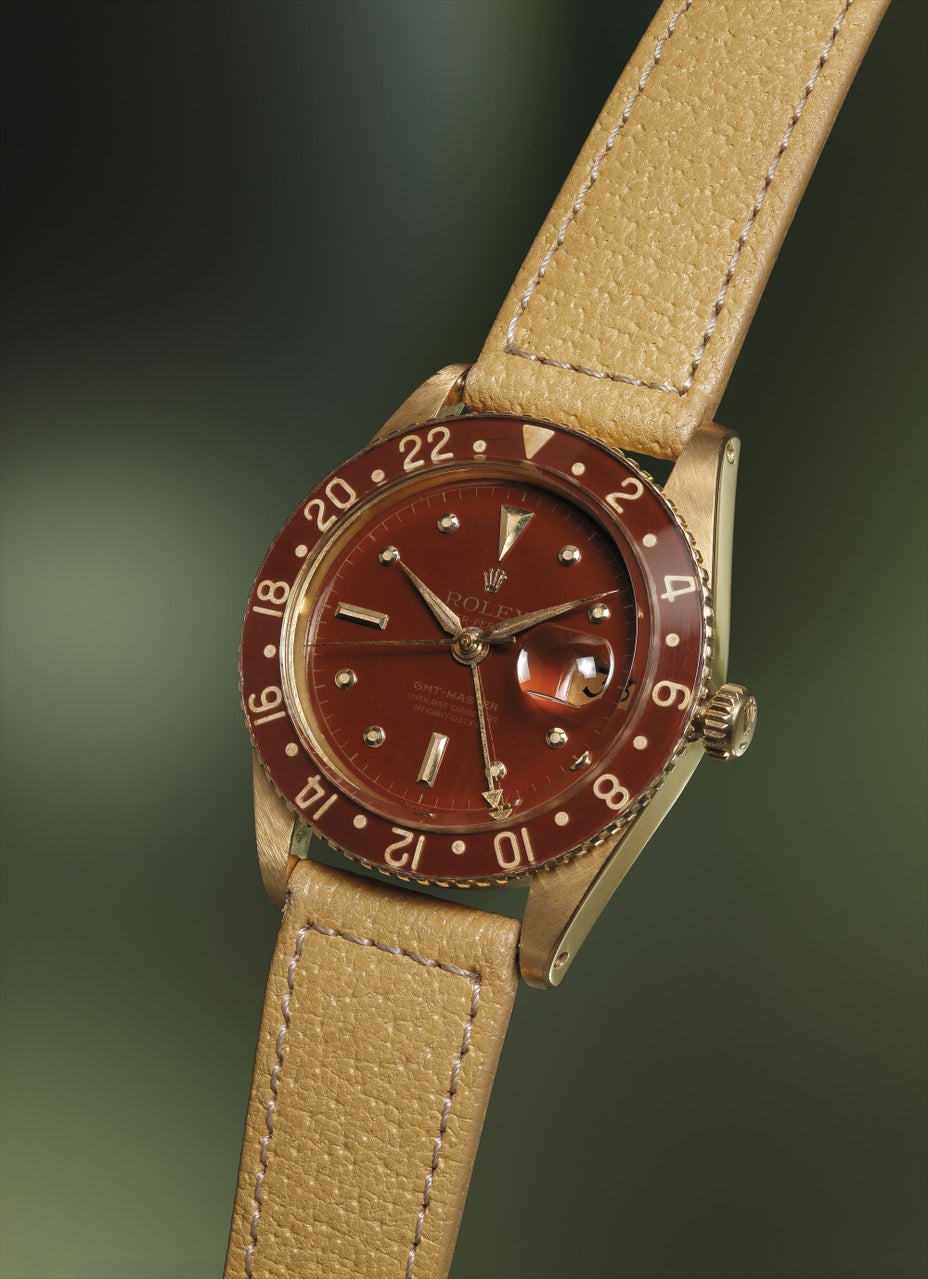
A fine and rare yellow gold dual time wristwatch with sweep center seconds, date, brown lacquer dial and bakelite bezel
Full-Cataloguing
Given that the GMT-Master was created for specific, work-related purposes, most examples were cased in stainless steel. These watches were worn in the most practical sense and made to withstand the elements. Yet, Rolex also manufactured a very limited number of watches cased in yellow gold, and fitted with a brown bakelite bezel. Due to the immense fragility of these watches, it is incredibly rare to find examples fitted with their original bakelite insert. The fact is even more pertinent as most of the bakelite bezels were recalled by Rolex due to their radium content. The original GMT-Master eventually ceased production in 1959.
John Goldberger's Opinion
The watch illustrated in these pages, among the last batch of reference 6542s to be released, is presented in excellent and astounding condition. The bakelite bezel is intact, with hardly any blemishes and the radium is without losses. The brown lacquer dial displays rich tones, and the case is incredibly crisp, with a sharp milled finish to the top of the lugs and a sharp hallmark to the back of the lug.
Rolex
Swiss | 1905Founded in 1905 England by Hans Wilsdorf and Alfred Davis as Wilsdorf & Davis, it soon became known as the Rolex Watch Company in 1915, moving its headquarters to Geneva in 1919. Like no other company, the success of the wristwatch can be attributed to many of Rolex's innovations that made them one of the most respected and well-known of all luxury brands. These innovations include their famous "Oyster" case — the world's first water resistant and dustproof watch case, invented in 1926 — and their "Perpetual" — the first reliable self-winding movement for wristwatches launched in 1933. They would form the foundation for Rolex's Datejust and Day-Date, respectively introduced in 1945 and 1956, but also importantly for their sports watches, such as the Explorer, Submariner and GMT-Master launched in the mid-1950s.
One of its most famous models is the Cosmograph Daytona. Launched in 1963, these chronographs are without any doubt amongst the most iconic and coveted of all collectible wristwatches. Other key collectible models include their most complicated vintage watches, including references 8171 and 6062 with triple calendar and moon phase, "Jean Claude Killy" triple date chronograph models and the Submariner, including early "big-crown" models and military-issued variants.