

117
Rolex
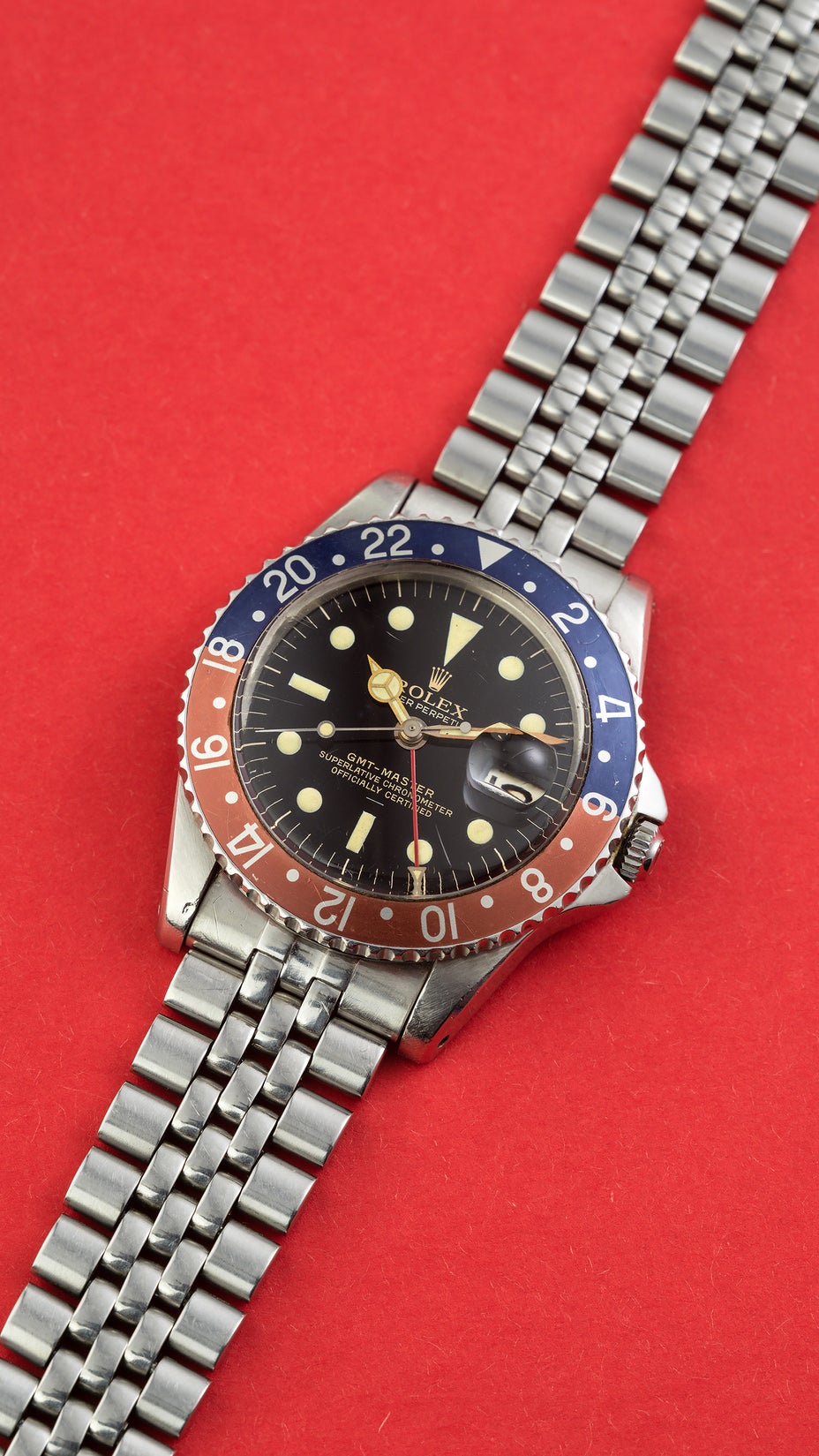
Ref. 1675
GMT-Master
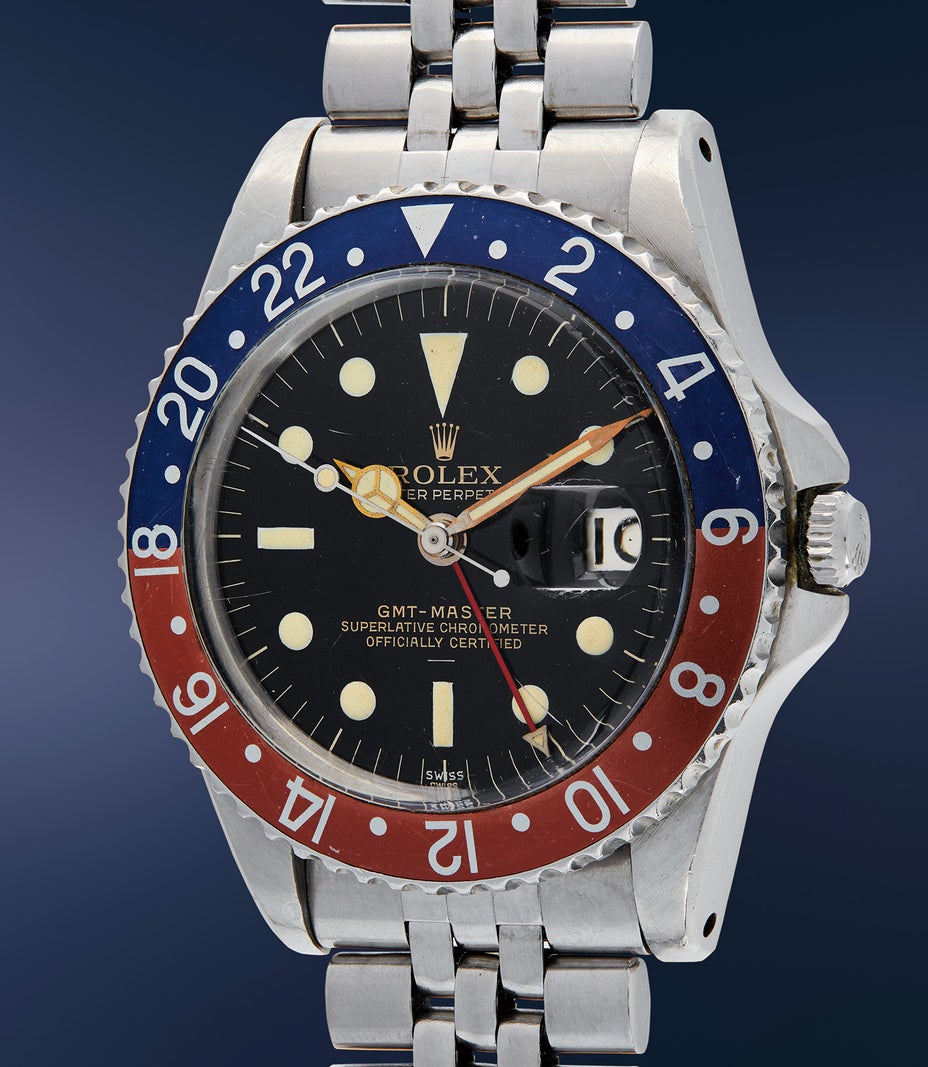
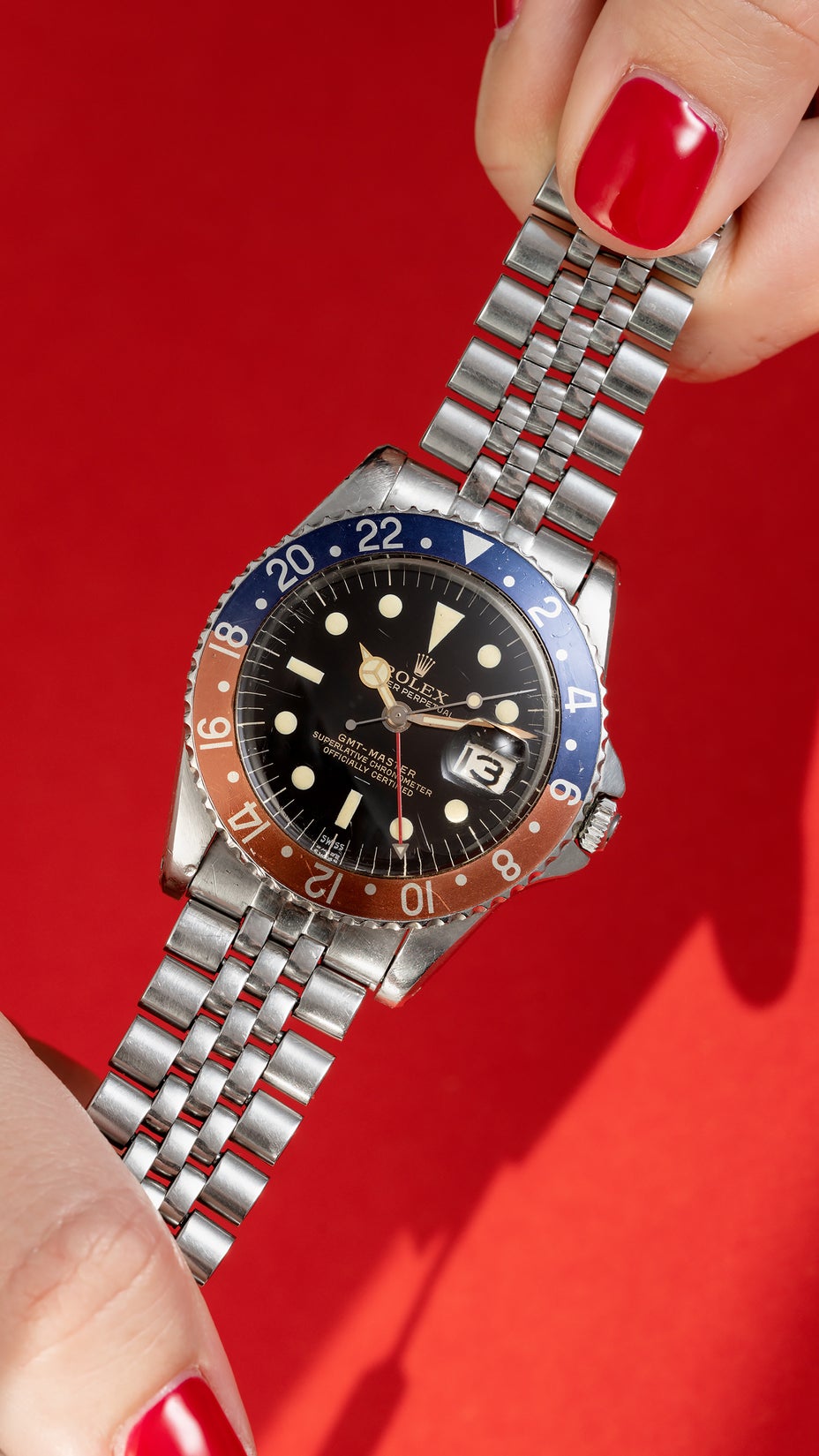
An extremely rare and well-preserved stainless-steel dual-time wristwatch with black lacquer “double Swiss underline” dial, pointed crown guards, date, and bracelet, with original guarantee, chronometer certificate, sales invoice, and presentation box
- Estimate
- $30,000 - 60,000
$69,300
Lot Details
- Manufacturer
- Rolex
- Year
- 1963
- Reference No
- 1675
- Movement No
- 14’349
- Case No
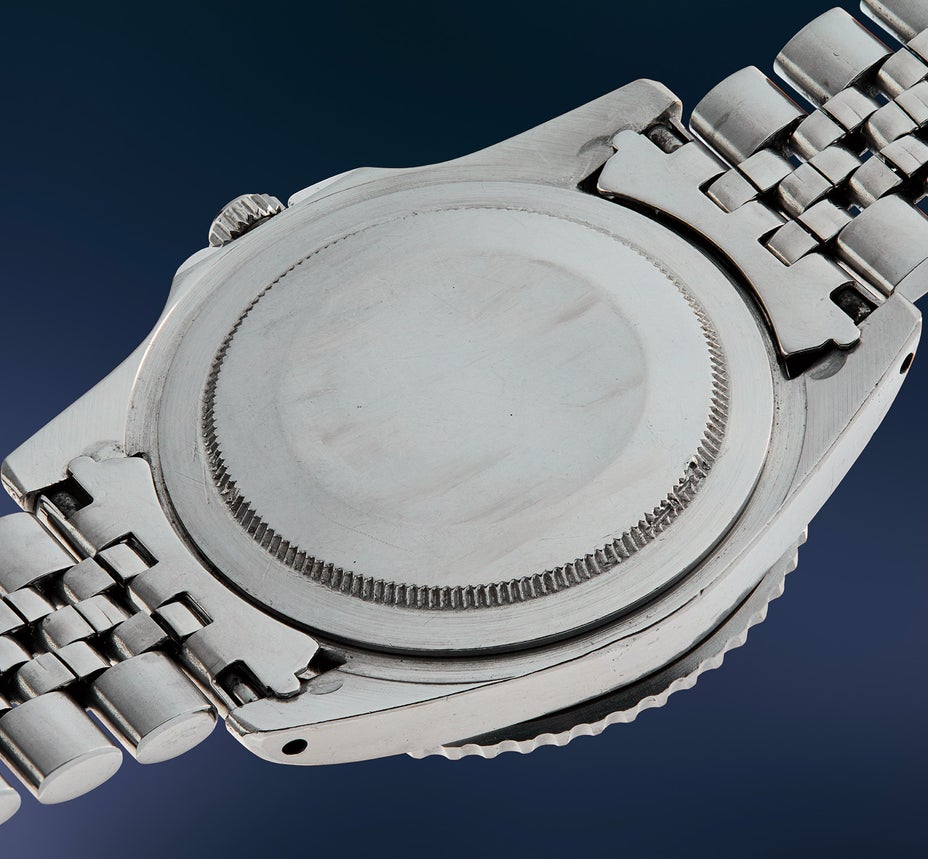
- 876’830, inside caseback interior stamped i.63
- Model Name
- GMT-Master
- Material
- Stainless steel
- Calibre
- Automatic, cal. 1560, 26 jewels
- Bracelet/Strap
- Stainless-steel Rolex Jubilee bracelet, endlinks stamped 50
- Clasp/Buckle
- Stainless steel Rolex clasp stamped USA 8-70
- Dimensions
- 39.5mm Diameter
- Signed
- Case, dial, movement and clasp signed
- Accessories
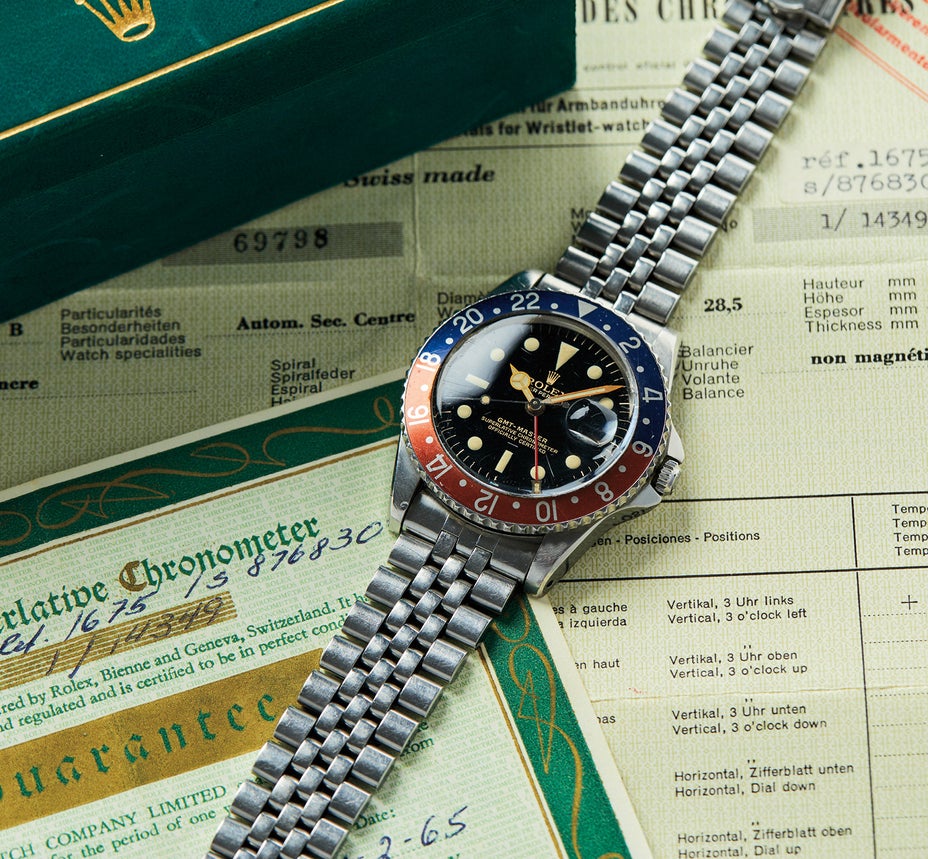
- Accompanied by Rolex guarantee dated February 1, 1965, green leather Rolex presentation box, original sales invoice dated and stamped similar to the guarantee, Contrôle Officiel de la Marches des Chronomètres dated March 13, 1964, product literature and outer packaging.
Specialist
Full-Cataloguing
Catalogue Essay
Rolex introduced the now iconic GMT-Master dual time wristwatch in 1954 with the reference 6542, which they developed in conjunction with Pan American airways so their personnel could tell both “local” and “home” time while traveling. With the introduction of the jet engine, intercontinental travel became more common and commercially available thus both flight staff and traveling executives needed a means to monitor time as they traveled across multiple time zones. Rolex created an ingenious method using a rotating Bakelite bezel that worked in conjunction with a fourth, 24-hour center hand permitting the wearer to clearly keep track of two time zones. By 1959, Rolex upgraded the model and introduced the new reference 1675, which now had crown guards to prevent damage to the crown, and the fragile Bakelite bezel insert was replaced with a more resilient metal insert.
The present, fresh-to-market example with serial number 876’830 from 1963 is one of the rarest, most complete, and best-preserved variations of the reference 1675 to appear publicly. Its stunning, gilt black lacquer dial features both the extremely rare “underline” and “double Swiss” signature. Rolex collectors and historians hypothesize the underline and double Swiss signature denoted a transitional period, signifying Rolex's use of tritium on the dial instead of radium. Furthermore, the early case was designed with pointed crown guards frequently called “Cornino” by collectors, which is correct for early examples.
This early GMT-Master is in excellent overall condition, with perfectly intact luminous hour markers and hands that have aged to a lovely warm yellowish hue. Further enhancing its desirability, the watch is accompanied with its original guarantee, chronometer certificate, sales invoice, and presentation box. It is a lovely example of these transitional timepieces, and a representation of the evolution of one of Rolex’s most iconic tool watches, which is still manufactured today.
The present, fresh-to-market example with serial number 876’830 from 1963 is one of the rarest, most complete, and best-preserved variations of the reference 1675 to appear publicly. Its stunning, gilt black lacquer dial features both the extremely rare “underline” and “double Swiss” signature. Rolex collectors and historians hypothesize the underline and double Swiss signature denoted a transitional period, signifying Rolex's use of tritium on the dial instead of radium. Furthermore, the early case was designed with pointed crown guards frequently called “Cornino” by collectors, which is correct for early examples.
This early GMT-Master is in excellent overall condition, with perfectly intact luminous hour markers and hands that have aged to a lovely warm yellowish hue. Further enhancing its desirability, the watch is accompanied with its original guarantee, chronometer certificate, sales invoice, and presentation box. It is a lovely example of these transitional timepieces, and a representation of the evolution of one of Rolex’s most iconic tool watches, which is still manufactured today.
Rolex
Swiss | 1905Founded in 1905 England by Hans Wilsdorf and Alfred Davis as Wilsdorf & Davis, it soon became known as the Rolex Watch Company in 1915, moving its headquarters to Geneva in 1919. Like no other company, the success of the wristwatch can be attributed to many of Rolex's innovations that made them one of the most respected and well-known of all luxury brands. These innovations include their famous "Oyster" case — the world's first water resistant and dustproof watch case, invented in 1926 — and their "Perpetual" — the first reliable self-winding movement for wristwatches launched in 1933. They would form the foundation for Rolex's Datejust and Day-Date, respectively introduced in 1945 and 1956, but also importantly for their sports watches, such as the Explorer, Submariner and GMT-Master launched in the mid-1950s.One of its most famous models is the Cosmograph Daytona. Launched in 1963, these chronographs are without any doubt amongst the most iconic and coveted of all collectible wristwatches. Other key collectible models include their most complicated vintage watches, including references 8171 and 6062 with triple calendar and moon phase, "Jean Claude Killy" triple date chronograph models and the Submariner, including early "big-crown" models and military-issued variants.
Browse Maker