31
Takashi Murakami
Cosmic Power
Full-Cataloguing
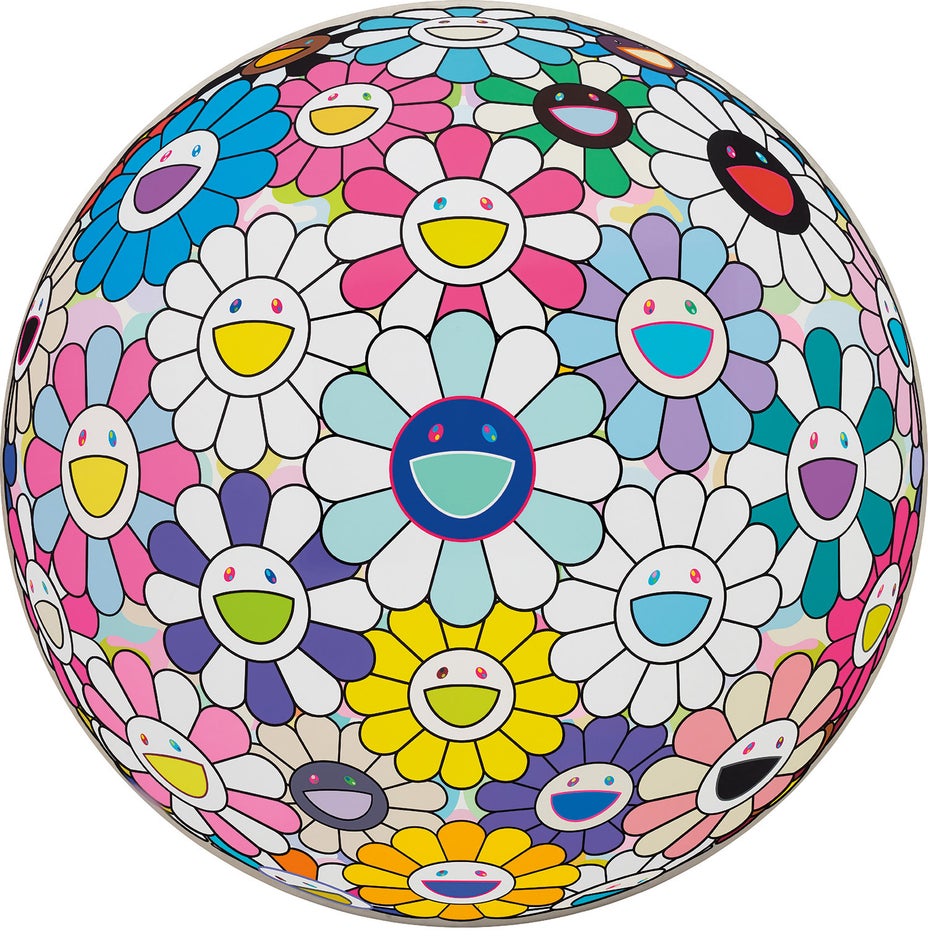
Having graduated from the Tokyo University of Fine Arts with a PhD in Nihonga painting, Murakami has always referenced the virtuous precision of traditional Japanese art in his contemporary creations. Despite eluding the aesthetic and conventional materials employed within Nihonga tradition, Murakami paired its painterly principles with cutting-edge techniques, additionally penetrating the cultural worlds of manga and anime to conjure seemingly timeless compositions. This amalgamated aesthetic – blending the ancient and the new – ultimately culminated in a concept he penned in 2001 entitled Superflat. Superflat, in its titular and constitutive quest for flatness, embodies a sense of smoothness – languor even – that nonetheless holds a paradoxical notion of dynamic force. ‘I’d been thinking about the reality of Japanese drawing and painting and how it is different from Western art’, Murakami said. ‘What is important in Japanese art is the feeling of flatness. Our culture doesn’t have 3-D’ (Takashi Murakami, quoted in Hunter Drohojowska-Philp, ‘Superflat’, Artnet, January 2001, online). Moving beyond pure imagistic potential, Superflat also refers to the flattening and conflation of genres, namely the fusion of high and low art. The movement thus explores the evolution of Japan’s understanding of its modern condition, and the relationships tying vanguard art, manga, anime, and their woodblock predecessors in a total absence of perspective. These two discrete phenomena – visual and conceptual – are visibly intertwined in Cosmic Power, which presents the viewer with a convincing tableau shunning its support’s two-dimensionality. As a result, the myriad flowers atop its surface are propelled into the viewer’s physical environment, vibrant and alive.
Varying in size and colour, the countless smiling buds of the present work seem to bleed onto an invisible horizon, expanding beyond their visible sphere. Musing on the symbol of flowers and how they became an integral part of his work, Murakami declared: ‘When I was preparing for the entrance exams for the University of Fine Arts, I spent two years drawing flowers. I drew some every day. And the entrance exam in the Nihonga section also involved flower drawing. Afterwards, to earn a living, I spent nine years working in a preparatory school, where I taught the students to draw flowers. Once every two days, I would buy flowers for my lesson and make compositions for the students to work on. […] Each one seems to have its own feelings, its own personality’ (Takashi Murakami, quoted in Takashi Murakami, exh. cat., Fondation Cartier pour l'art contemporain, Paris, 2002, p. 84). Typically painted with proportional dimensions and great attention to detail, Murakami’s flowers became a leitmotif of his various artistic outputs – in painting, but also sculpture. For the present work, the artist’s technique is reminiscent of Andy Warhol’s within the context of his factory. Like Warhol, Murakami has employed the assistance of painters within his factory-sized studio in Miyoshi Kaikai Kiki Co. From a total of three hundred assistants in his company, fifty are dedicated exclusively to painting, very clearly and precisely materialising his painterly vision.
With its subtle colour gradations, its pristine white background, its superimposed chrysanthemums and its iconic circular shape, Cosmic Power is a superior example of Takashi Murakami’s ongoing flower series in painting. It captures the bold, bright and kawaii idiosyncrasies of Japanese pop culture, while at the same time recalling eminent Japanese masters such as Ogata Kōrin and Katsushika Hokusai, exquisitely encapsulating Murakami’s capacity to live between times, whilst remaining deeply rooted within the codes of our contemporary world.
Takashi Murakami
Japanese | 1962Takashi Murakami is best known for his contemporary combination of fine art and pop culture. He uses recognizable iconography like Mickey Mouse and cartoonish flowers and infuses it with Japanese culture. The result is a boldly colorful body of work that takes the shape of paintings, sculptures and animations.
In the 1990s, Murakami founded the Superflat movement in an attempt to expose the "shallow emptiness of Japanese consumer culture." The artist plays on the familiar aesthetic of mangas, Japanese-language comics, to render works that appear democratic and accessible, all the while denouncing the universality and unspecificity of consumer goods. True to form, Murakami has done collaborations with numerous brands and celebrities including Kanye West, Louis Vuitton, Pharrell Williams and Google.