18
Zhang Huan
Family Tree
Estimate
$150,000–200,000
Sold
2001
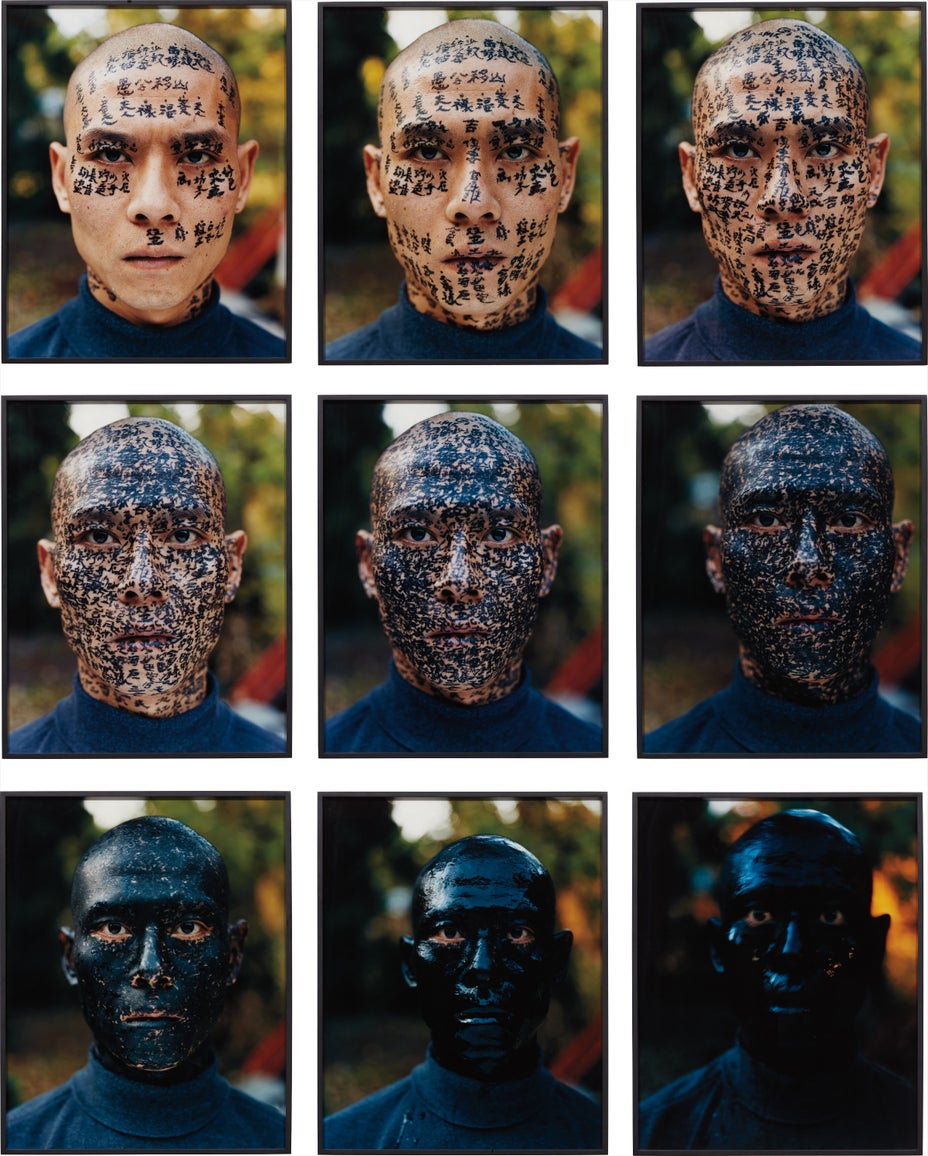
Nine chromogenic prints.
Each 49 1/2 x 39 in. (125.7 x 99.1 cm)
AP 2/2 from an edition of 8 plus 2 artist's proofs.
Full-Cataloguing
During the 1990s, Zhang Huan’s provocative conceptual performances, which tested his physical and spiritual endurance, established him as one of China’s most celebrated artists. Using his body as his medium, Zhang challenges notions of national and personal identity. When Zhang immigrated to New York in 1998, his understanding of his own identity was profoundly impacted. He saw himself no longer as simply an artist, but a Chinese artist whose heritage offered up an endless wealth of inspiration.
Family Tree is an exploration of culture and selfhood. Zhang hired three calligraphers to inscribe Chinese proverbs, family relations and histories, literary texts, and words deriving from the ancient practice of physiognomy onto his face over the course of several hours. Gradually obscuring Zhang’s discernible features, the calligraphy shifts from legibility into an obliterating mask. Using the camera to record the evolution of this ephemeral performance, Zhang delves into the correlation, and even arbitrariness, between his natural and constructed self. Ironically, the two practices in this work that are most deeply embedded in Chinese culture, calligraphy and physiognomy—or “face reading”—nullify each other. When they are applied as a visual lexicon to Zhang’s face, he is stripped of all his identifiable markers. The nine photographs of Family Tree transform viewers into participants, allowing them not only to engage with Zhang’s performance, but to reflect upon their own intrinsic and constructed identities.
Family Tree is an exploration of culture and selfhood. Zhang hired three calligraphers to inscribe Chinese proverbs, family relations and histories, literary texts, and words deriving from the ancient practice of physiognomy onto his face over the course of several hours. Gradually obscuring Zhang’s discernible features, the calligraphy shifts from legibility into an obliterating mask. Using the camera to record the evolution of this ephemeral performance, Zhang delves into the correlation, and even arbitrariness, between his natural and constructed self. Ironically, the two practices in this work that are most deeply embedded in Chinese culture, calligraphy and physiognomy—or “face reading”—nullify each other. When they are applied as a visual lexicon to Zhang’s face, he is stripped of all his identifiable markers. The nine photographs of Family Tree transform viewers into participants, allowing them not only to engage with Zhang’s performance, but to reflect upon their own intrinsic and constructed identities.