77
大平洋一
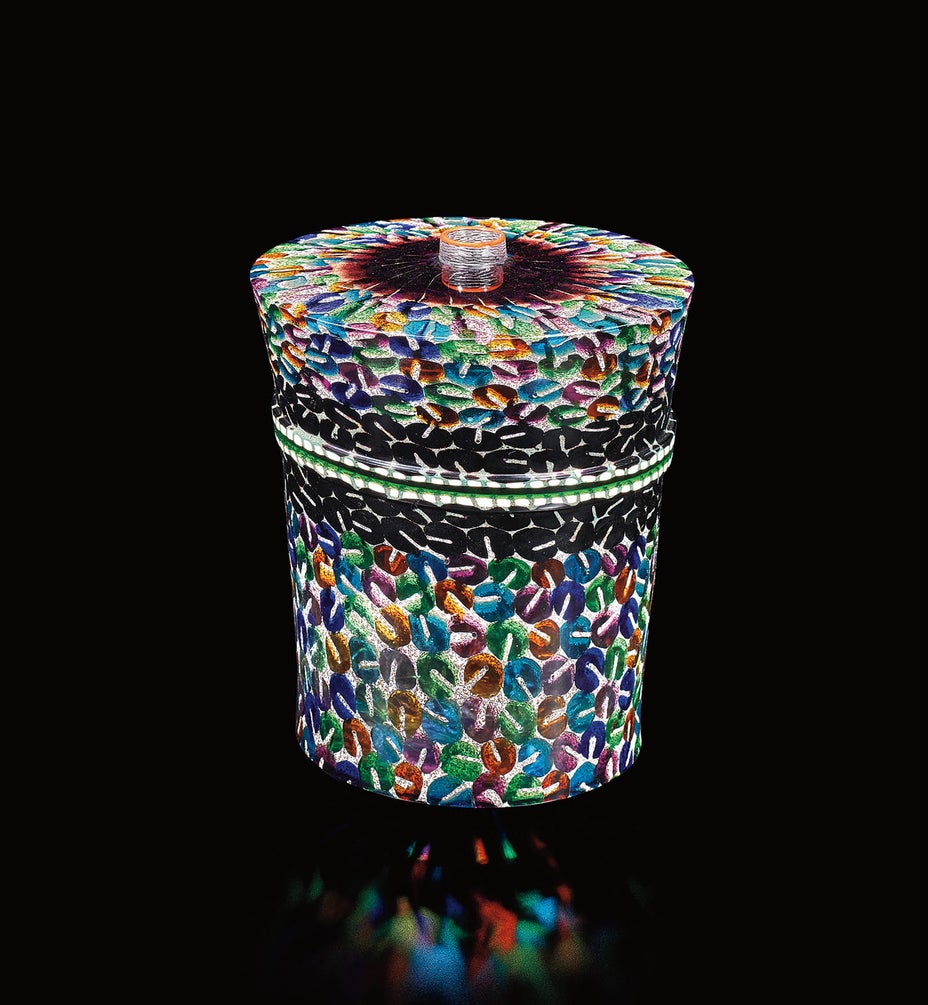
Unique 'Anello' vase, from the 'Foglie di Ninfee' series
完整圖錄內容
Several of the present lots are the product of the longstanding collaboration between Ohira and the soffiatore Livio ‘Maisasio’ Serena. Having met in 1992 at the Anfora furnace, the two would continue to work side-by-side for over a decade, later joined by a second maestro, the molatore Giacomo Barbini. This group of three, alongside the Anfora glassworks owner Renzo Ferro, was referred to affectionately by Ohira as the ‘Murano Quartet’.
This collaboration allowed Ohira to incorporate a plethora of traditional and modern techniques into his designs. Beginning with his own creation of murrine, powdered, and cane glass, Ohira would meticulously lay out the pieces for Serena to incorporate and blow them into a vessel, such as lot 78. Once cool, the piece would be carved by Barbini. Throughout these stages, Ohira oversaw every aspect of the process, continuously comparing the work to his plans. By observing how both the glass and the maestri behaved, Ohira’s designs were informed by a glassblower’s perspective and the skills of his collaborators. As the inscriptions on the present lots acknowledging Serena, Barbini and Andrea Zilio attest to, the works are undoubtedly the product of the entire workshop’s talents.
Ohira’s œuvre draws heavily on his own knowledge of Murano’s history, traditional techniques, as well as the living heritage that his collaborators embody. Each of his works, despite their undeniably contemporary appearance, are steeped in tradition and are the culmination of not just one individual’s expertise, but that of an entire community.
大平洋一
Japanese | 1946Glass art – hard, fragile, cold and often heavy – is not typically designed to be handled. Yoichi Ohira's luminous blown glass vessels, however, offer an exception to this trend. They are small and light enough to be turned in one's hands like a Wunderkammer specimen, inviting the viewer to admire his abstracted design vocabulary of gemstones, polished ivory, veined rocks, shimmering water, agate, moss and lichens. Ohira has been compared to Emile Gallé for his ability to emulate the natural world in glass. Comparisons may also be drawn to Jean Dunand's bronze vessels, Japanese rokusho patina and Otto Natzler's volcanic glazes – an impressive range of media to be translated into glass.
Yoichi Ohira graduated from the Kuwasawa Design School, Tokyo in 1969. Shortly thereafter he took up a glassblowing apprenticeship at the Kagami Crystal Company, Ltd. In 1973 Ohira moved to Venice to study at the Accademia di Belle Arti; he graduated in 1978 earning the highest possible grade for his thesis, "The Aesthetics of Glass." In the late 1980s Ohira began collaborating with Murano glassmakers, earning the "Premio Selezione" of the Premio Murano in 1987.