311
Jean Prouvé
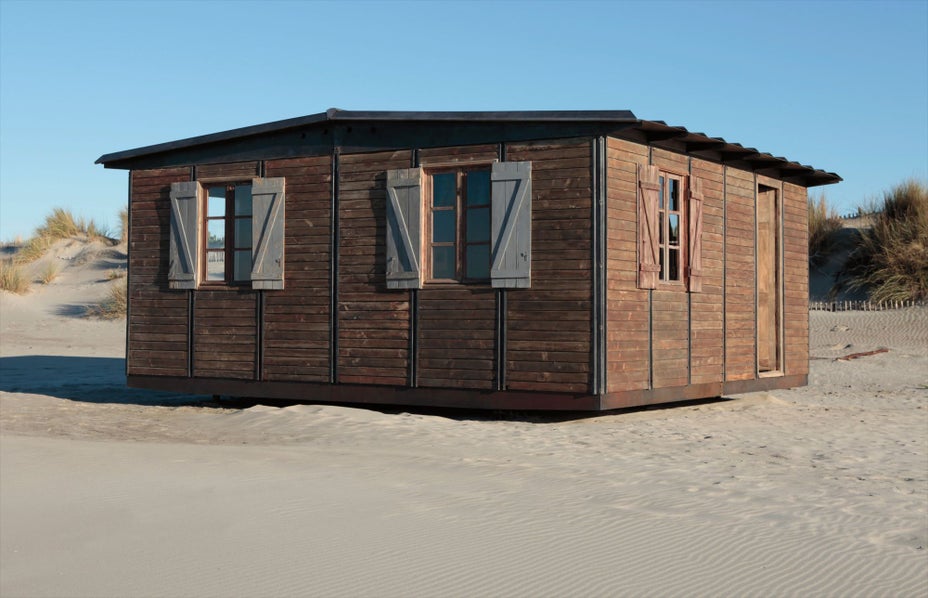
"6x6" demountable house
完整圖錄內容
Although Raoul Dautry, the French minister of Reconstruction and Urban Development, ordered 800 demountable houses, only about 400 were produced, of which a handful are known to have survived. The houses served as short-term shelters and production stopped when the French government chose to focus on permanent reconstruction efforts.
These houses represent the height of Prouvé’s rationalist and functionalist ideals: mass-production, logical material choices and consistent engineering. Prouvé was typically modest in describing his success with pre-fabricated housing: “I didn’t invent an architectural system, I made it. I didn’t invent forms, I made an architectural system that had forms. I made it using bent sheet steel because I had the steel and the presses to bend it with. It’s as simple as that.” Le Corbusier was more direct about his friend and colleague’s accomplishments, saying of Prouvé in 1954: “His postwar work has left its mark everywhere, decisively.”
Jean Prouvé
French | B. 1901 D. 1984Jean Prouvé believed in design as a vehicle for improvement. His manufactory Les Ateliers Jean Prouvé, located in Nancy, France, produced furniture for schools, factories and municipal projects, both within France and in locations as far flung as the Congo. Though he designed for the masses, pieces such as his "Potence" lamps and "Standard" chairs are among the most iconic fixtures in sophisticated, high-design interiors today. Collectors connect with his utilitarian, austere designs that strip materials down to the bare minimum without compromising on proportion or style.
Prouvé grew up in Nancy, France, the son of Victor Prouvé, an artist and co-founder of the École de Nancy, and Marie Duhamel, a pianist. He apprenticed to master blacksmiths in Paris and opened a small wrought iron forge in Nancy. However it was sheet steel that ultimately captured Prouvé's imagination, and he ingeniously adapted it to furniture, lighting and even pre-fabricated houses, often collaborating with other design luminaries of the period, such as Robert Mallet-Stevens, Le Corbusier and Charlotte Perriand.