69
Charlotte Perriand
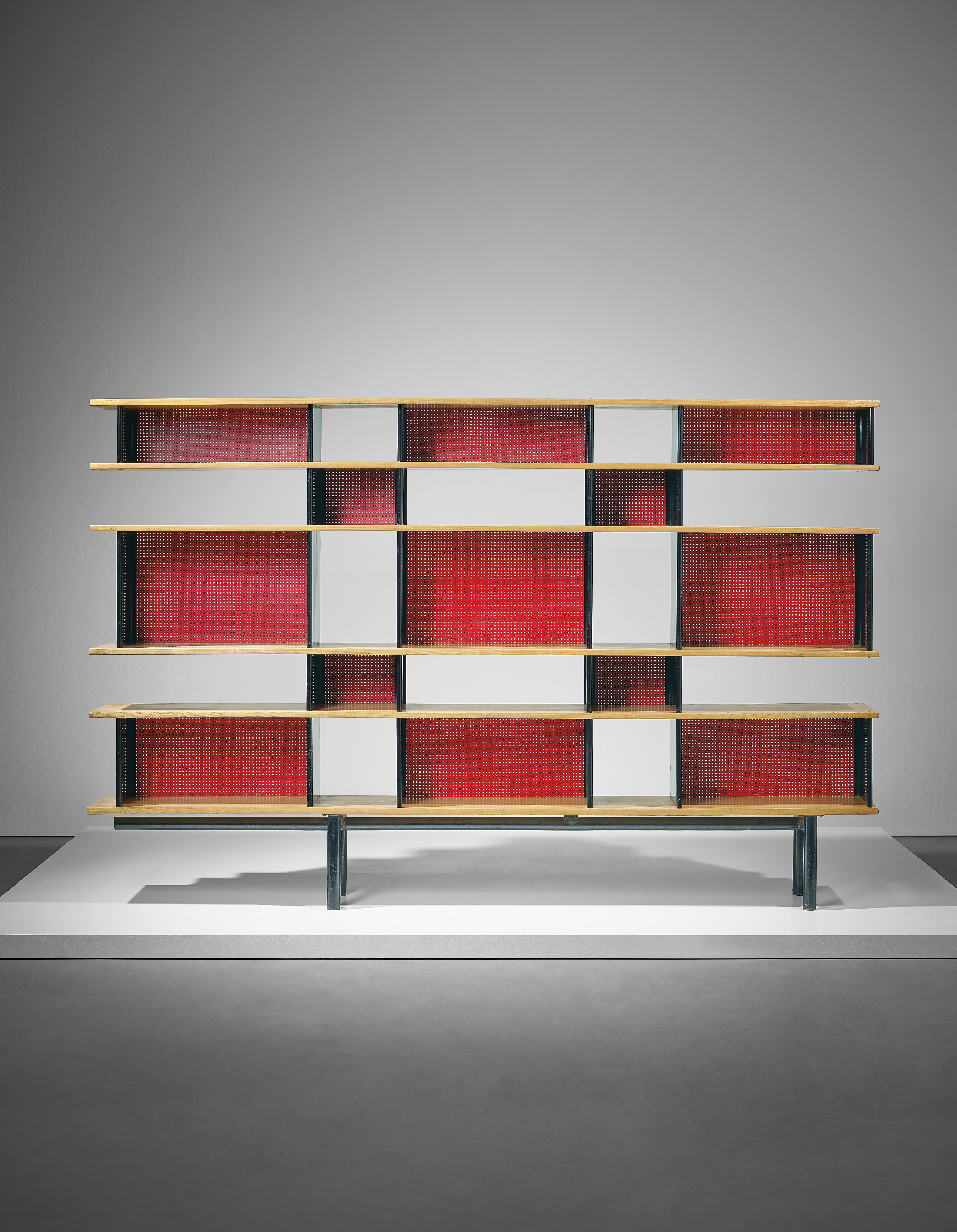
Important 'Antony' bookcase, designed for the Cité Universitaire, Antony
Full-Cataloguing
Demonstrating a considered analysis of both the subject and object, Perriand designed the ‘Antony’ bookcase in response to a student’s day-to-day gestures and needs within their living space. She based the dimensions of the bookcase on precise measurements of the objects she anticipated students would store in the units and the overall proportions of the room. The resulting design created a series of voids within the small inhabited volume. Enhancing the visual composition of the bookcase’s punctuated shelving, Perriand used red perforated hardboard for the back panels. The structural system Perriand designed using two lateral panels and a separate back allowed for potential variation in the width of the shelves, in addition to the benefit of flat transport for assembly onsite. Softening the precise lines of the black-painted steel, the bookcase’s horizontal ash veneer shelving lent an element of warmth, creating a balance between natural and machine-made materials within students’ living space. The compositional structure of the ‘Antony’ bookcase illustrates Perriand’s approach to bring together standardised elements, enhancing the adaptability of her designs which she could re-imagine in response to the requirements of a specific project and its inhabitants.
Charlotte Perriand
French | B. 1903 D. 1999Trailblazer Charlotte Perriand burst onto the French design scene in her early 20s, seemingly undeterred by obstacles in an era when even the progressive Bauhaus school of design barred women from architecture and furniture design courses. She studied under Maurice Dufrêne at the École de l'Union Centrale des art Décoratifs, entering into a competition at the 1925 Expo des Arts Décoratifs by age 22 and gaining critical acclaim for her exhibition at the Salon d'Automne in 1927.
On the heels of this success, that same year she joined the Paris design studio of Le Corbusier and his cousin Pierre Jeanneret. For ten years the three collaborated on "equipment for living," such as the iconic tubular steel B306 Chaise Longue (1928). After World War II, Perriand joined forces with Jean Prouvé to create modernist furniture that combined the precise lines of Prouvé's bent steel with the soft, round edges and warmth of natural wood.