13
William Eggleston
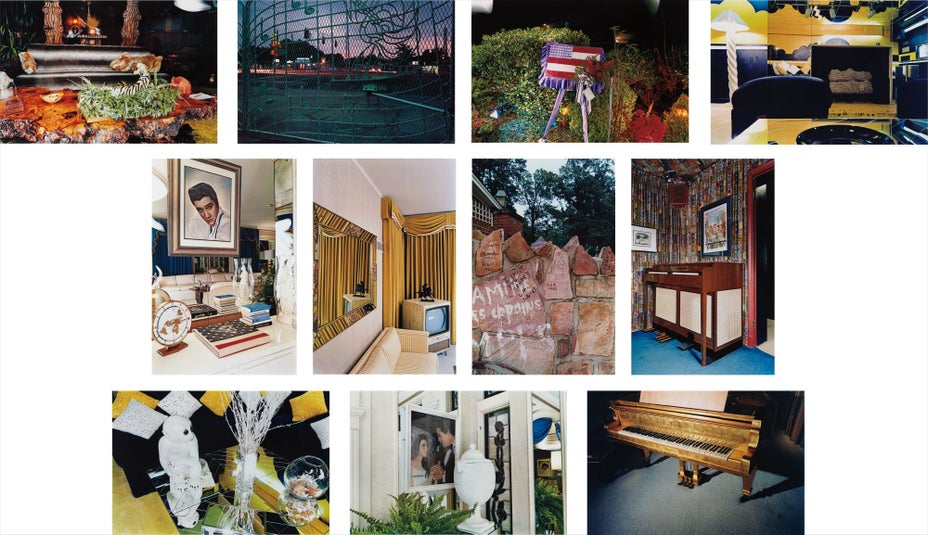
William Eggleston's Graceland
Full-Cataloguing
Eggleston employs a similar approach in Troubled Waters (lot 14.) Once again turning his lens away from full compositions providing few clues regarding context and scale, the portfolio is comprised of fifteen images that range from uncommonly low vantage points of a non-descript living room to a wide-angle view of a closed gas station. The images are insistently untethered to a common theme or location and Eggleston provides no threads connecting one image to the next, forcing viewers to break the conceptual pattern of discovering an underlying narrative and instead focus on the formal qualities belying each work, especially through color. As a result, the inside of a freezer reveals a great subtle variation of the color white, muddy tire marks and potholes become reflective vessels for the colorful sky, and even a heap of refuse becomes a study of volume and composition. As in Graceland, the prints in Troubled Waters are dye-transfer, imbuing each print with strikingly lush color saturation, keeping the viewers eyes as engaged as when the prints were first made and the images first taken.
William Eggleston
American | 1939William Eggleston's highly saturated, vivid images, predominantly capturing the American South, highlight the beauty and lush diversity in the unassuming everyday. Although influenced by legends of street photography Robert Frank and Henri Cartier-Bresson, Eggleston broke away from traditional black and white photography and started experimenting with color in the late 1960s.
At the time, color photography was widely associated with the commercial rather than fine art — something that Eggleston sought to change. His 1976 exhibition at the Museum of Modern Art, Color Photographs, fundamentally shifted how color photography was viewed within an art context, ushering in institutional acceptance and helping to ensure Eggleston's significant legacy in the history of photography.