30
Richard Avedon
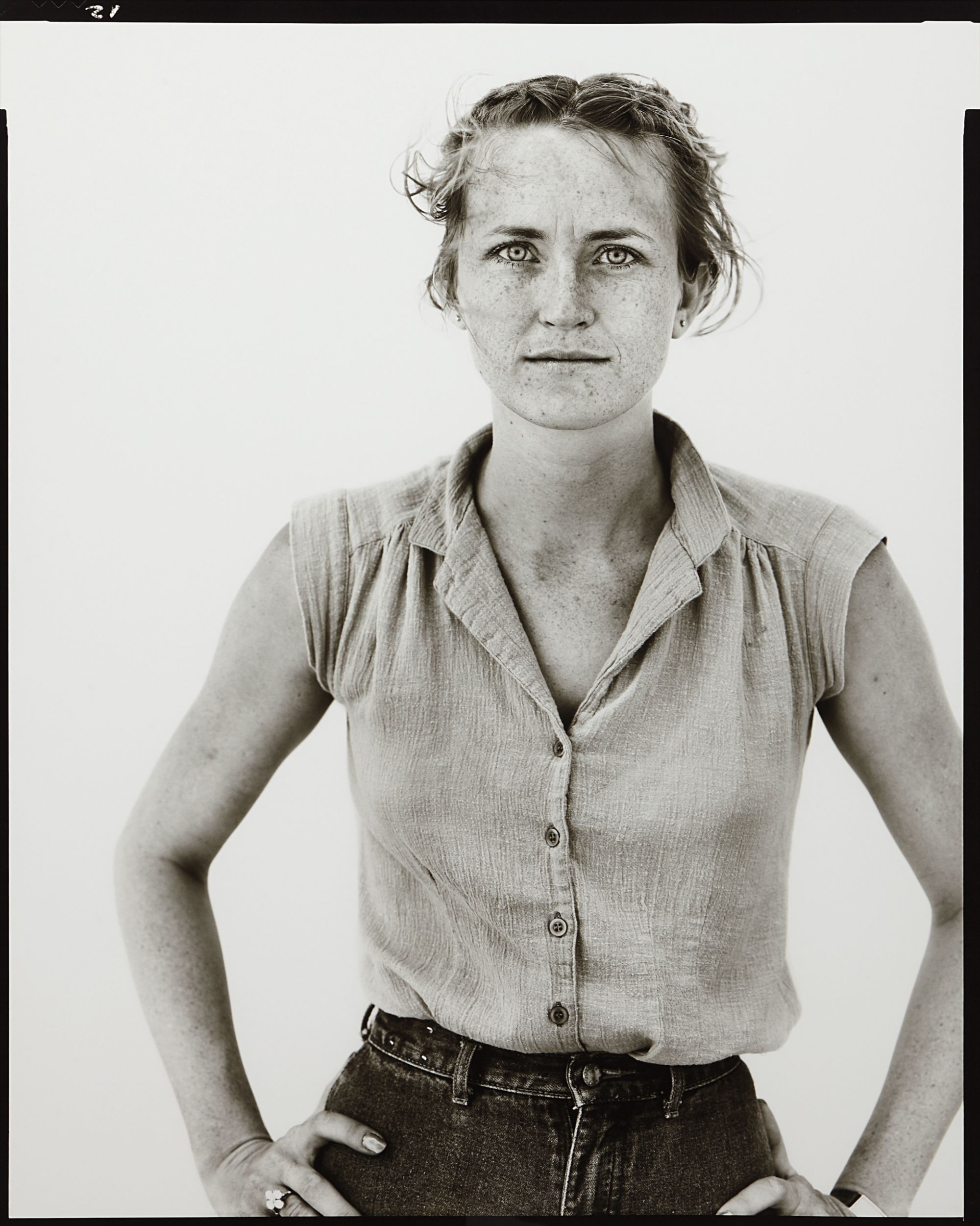
Peggy Daniels, cashier, Giddings, TX, May 7
Full-Cataloguing
In the American West is the culmination of Avedon’s five-year project documenting everyday people in all walks of life, living west of the Mississippi. Though he approached the series with a clear vision, he never intended to have it serve as a representation of the West. “This is a fictional West" he remarked, "I don’t think the West of these portraits is any more conclusive than the West of John Wayne.” He did not search out ‘types’ but rather individuals whose unique lives could speak more broadly to the complexity of the human condition. While Avedon had long-established himself as a pioneer in fashion photography, his incredible career and his many contacts in the field did not afford him any leads in this project, so to find his subjects, he and his team listened to the locals and attended public events that would bring the masses to them. In total, 752 individuals from 17 states stood before Avedon’s lens—oil field workers, cotton farmers, coal miners, pastors, teenagers, elders, fathers, daughters—each photographed against a sheet of oversized white paper, with “invisible” light evenly cast across their faces. The resulting 123 photographs reveal a cast of characters whose differences are balanced only by their similarities, their emotions democratically translated to film by a master of the medium.
Richard Avedon
American | B. 1923 D. 2004From the inception of Richard Avedon's career, first at Harper's Bazaar and later at Vogue, Avedon challenged the norms for editorial photography. His fashion work gained recognition for its seemingly effortless and bursting energy, while his portraits were celebrated for their succinct eloquence. "I am always stimulated by people," Avedon has said, "almost never by ideas."
Indeed, as seen in his portraits — whether of famed movie stars or everyday people — the challenge for Avedon was conveying the essence of his subjects. His iconic images were usually taken on an 8 x 10 inch camera in his studio with a plain white background and strobe lighting, creating his signature minimalist style. Avedon viewed the making and production of photographs as a performance similar to literature and drama, creating portraits that are simultaneously intensely clear, yet deeply mysterious.