629
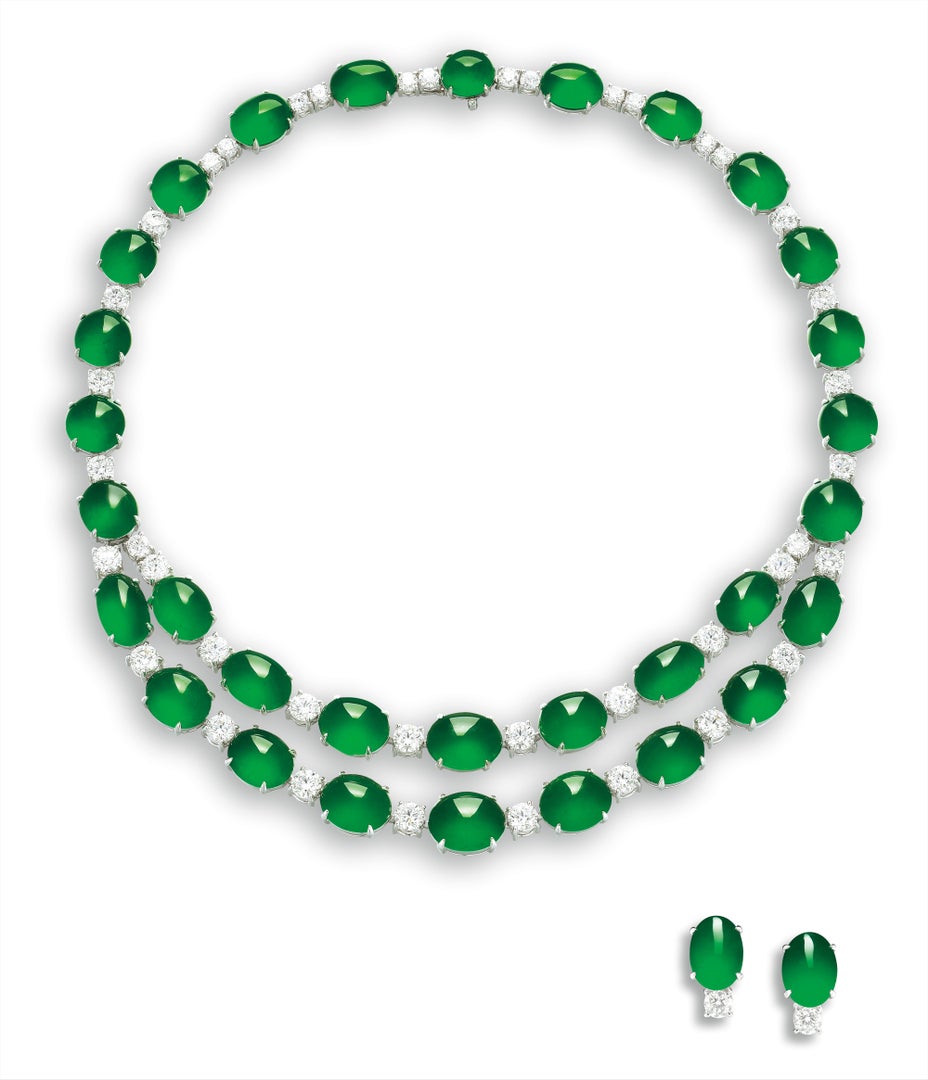
A Very Fine Jadeite Cabochon and Diamond Necklace, and a Pair of Matching Earrings
Estimate
HK$19,000,000–30,000,000
€2,080,000–3,290,000
$2,400,000–3,800,000
Sold For
HK$19,300,000
(Necklace)
Thirty-one jadeite cabochons, <em>measuring approximately 13.06 x 11.12 x 4.26mm to 10.26 x 9.45 x 4.04mm</em>
(Earrings)
Two jadeite cabochons, <em>measuring approximately 13.87 x 10.01 x 5.76mm and 13.72 x 9.68 x 5.65mm</em>Brilliant-cut diamonds on necklace and earrings, totalling approximately 17.10 carats18 karat white gold(Jadeite Cabochons)
<em>Hong Kong Jade & Stone Laboratory reports, numbered KJ97843(1-10), KJ97839 and KJ97840, dated 14 March 2018, Type A jadeites, natural colour without any resin.</em>
Full-Cataloguing
Colour, texture, translucency.
Any jadeite connoisseur will agree that these three attributes determine the quality and value of natural jadeites. Translucency depends greatly on texture. The finer the crystals and the denser the structure, the better light can pass through the stone to give a glass-like translucency. This is referred to as 'high water content' in the trade. Some common varieties of jadeite are 'pea', 'glutinous rice', 'golden silk' and 'ice', each depicting different structural density and water content, with 'glassy' jadeite being the most coveted variety of all. 'Glassy' jadeites possess extremely fine texture, resulting in a watery lustre and a translucency that is comparable to glass. The finest specimen displays an even, vivid green colour, which seems to glow with fluorescence from within.
It is said that good texture compensate for minor imperfections in jadeites, so if a jadeite is blessed with this foremost quality, it is very likely to be considered a top-quality jadeite; if it possesses a brilliant and saturated green colour on top of that, it is most definitely a rare gem. Jadeite is formed under very specific geological conditions which yields very little good-quality rough. The majority of jadeite boulders unearthed are low in translucency, full of fissures and inclusions; many requires artificial enhancement (especially for colour) in order to transform them into marketable products. It is exceedingly difficult to source even one high-quality material among tens of thousands of boulders. A fine jadeite cabochon, therefore, represents the superlative form of the best materials available.
A jadeite cabochon with excellent colour, fine texture and high translucency is very hard to come by, to assemble a collection of such cabochons of matching quality and size and to create a suite of jewelry or a magnificent necklace takes years of perseverance and immense luck.
This necklace is set with thirty-one jadeite cabochons in superb quality, their fine glassy texture was further heighted by the even colour and excellent clarity. Paired with earrings set with cabochons of comparable quality, this demi-parure is destined to be sought after by the most discerning collectors around the world.
Any jadeite connoisseur will agree that these three attributes determine the quality and value of natural jadeites. Translucency depends greatly on texture. The finer the crystals and the denser the structure, the better light can pass through the stone to give a glass-like translucency. This is referred to as 'high water content' in the trade. Some common varieties of jadeite are 'pea', 'glutinous rice', 'golden silk' and 'ice', each depicting different structural density and water content, with 'glassy' jadeite being the most coveted variety of all. 'Glassy' jadeites possess extremely fine texture, resulting in a watery lustre and a translucency that is comparable to glass. The finest specimen displays an even, vivid green colour, which seems to glow with fluorescence from within.
It is said that good texture compensate for minor imperfections in jadeites, so if a jadeite is blessed with this foremost quality, it is very likely to be considered a top-quality jadeite; if it possesses a brilliant and saturated green colour on top of that, it is most definitely a rare gem. Jadeite is formed under very specific geological conditions which yields very little good-quality rough. The majority of jadeite boulders unearthed are low in translucency, full of fissures and inclusions; many requires artificial enhancement (especially for colour) in order to transform them into marketable products. It is exceedingly difficult to source even one high-quality material among tens of thousands of boulders. A fine jadeite cabochon, therefore, represents the superlative form of the best materials available.
A jadeite cabochon with excellent colour, fine texture and high translucency is very hard to come by, to assemble a collection of such cabochons of matching quality and size and to create a suite of jewelry or a magnificent necklace takes years of perseverance and immense luck.
This necklace is set with thirty-one jadeite cabochons in superb quality, their fine glassy texture was further heighted by the even colour and excellent clarity. Paired with earrings set with cabochons of comparable quality, this demi-parure is destined to be sought after by the most discerning collectors around the world.