7
Carlos Cruz-Diez
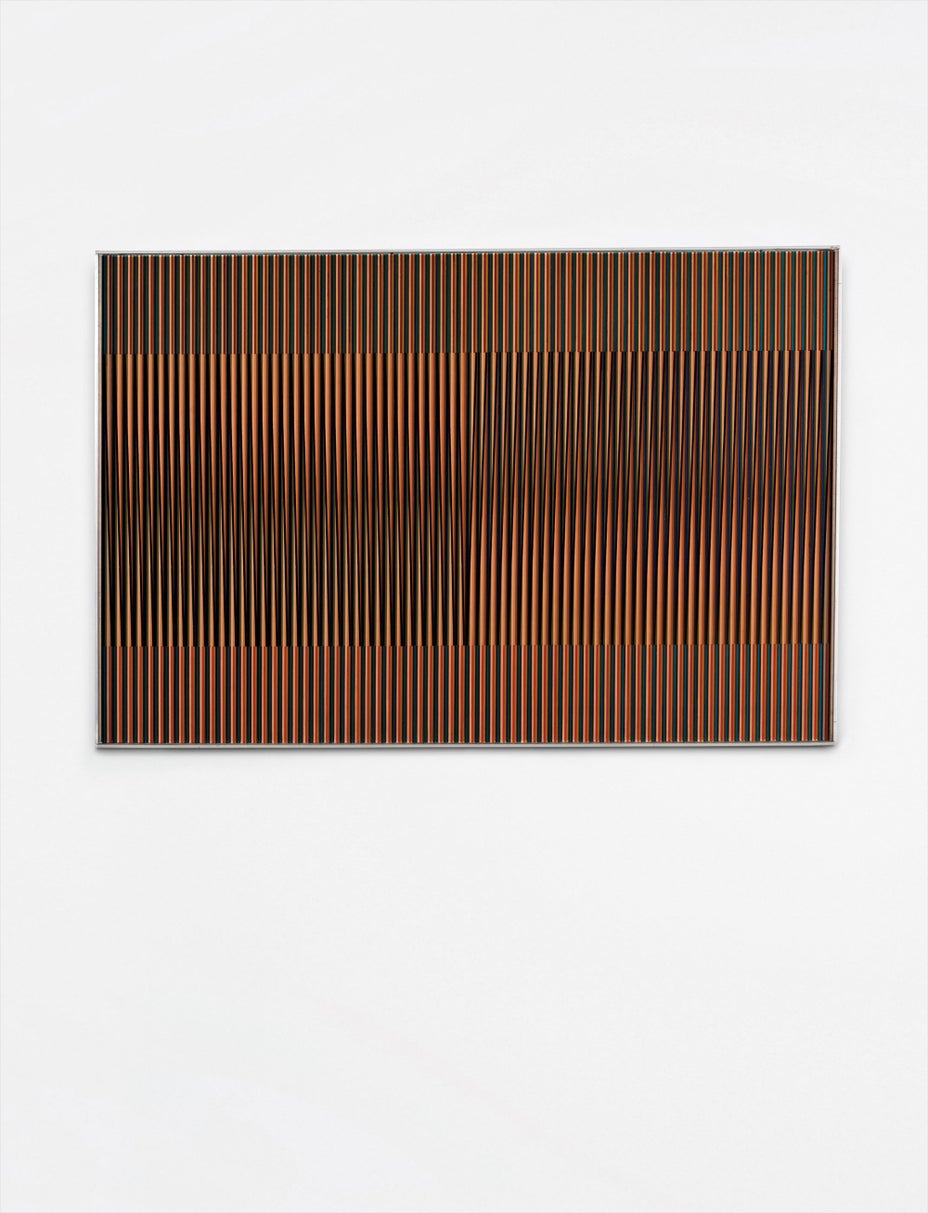
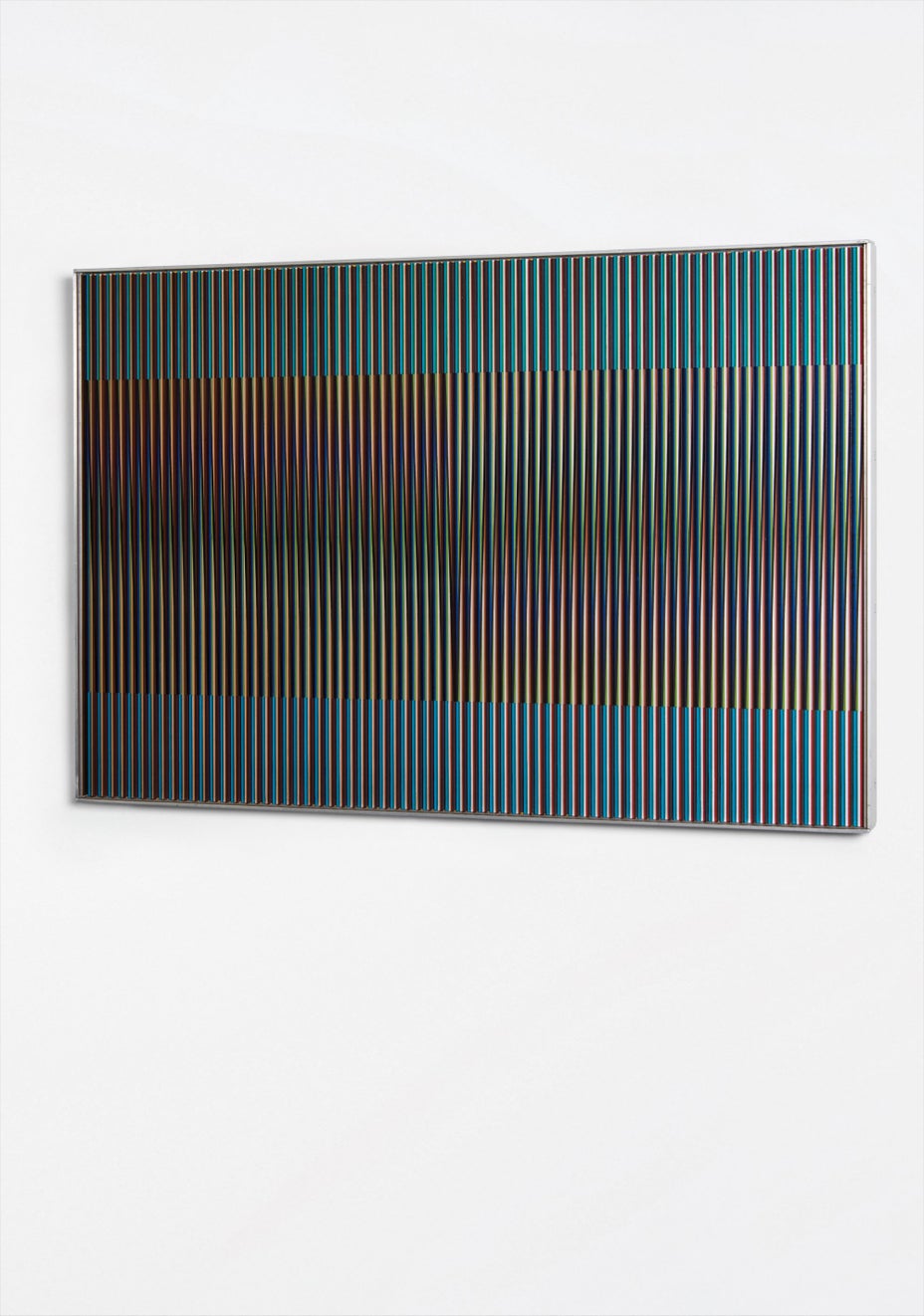
Physichromie No. 939
Estimate
$100,000–150,000
silkscreen and plastic elements on metal support with aluminum frame
19 5/8 x 29 1/2 in. (50 x 75 cm)
Executed in 1977.
Full-Cataloguing
During the 1950s, Carlos Cruz-Diez left Venezuela to travel extensively throughout Europe, where he explored the possibilities of Constructivism while continuing to develop his interest in chromatic structures and color theory. Physichromie No. 939 (1977) is part of his most important series, which he began in 1959 and has continued to investigate for decades. The exact medium of these works has developed over time but has always consisted of alternating colored strips that trap light, producing a chromatic effect that constantly changes as the viewer moves around the piece. In this way, the viewer becomes a participant in the artwork, not merely a spectator. The innovative aspects of the these works immediately caught the attention of the international milieu, and very early in his career Cruz-Diez was included in two seminal exhibitions in Europe and the United States: Movement 2 at the famous Galerie Denise René in Paris in 1964 and The Responsive Eye at the Museum of Modern Art in New York in 1965. Cruz-Diez was also the subject of a major retrospective at the Museum of Fine Arts Houston in 2011, titled Carlos Cruz-Diez: Color in Space and Time.
Carlos Cruz-Diez
Venezuelan | B. 1923 D. 2019Carlos Cruz-Diez moved from his native Caracas to Paris in 1960. He is a major protagonist in the field of kinetic and Op Art, a movement based on "an awareness of the instability of reality."
Inspired by such artists as Georges Seurat and Josef Albers, his work focuses on the kinetic energy of color and its existence as an autonomous and evolving reality, independent from form or structure. Much of his work, in particular his Physichromie series, is created by plotting lines of contrasting color alongside each other, creating an illusion of movement as the viewer's position relative to the artwork shifts.