ULTIMATE
41
Carrie Mae Weems
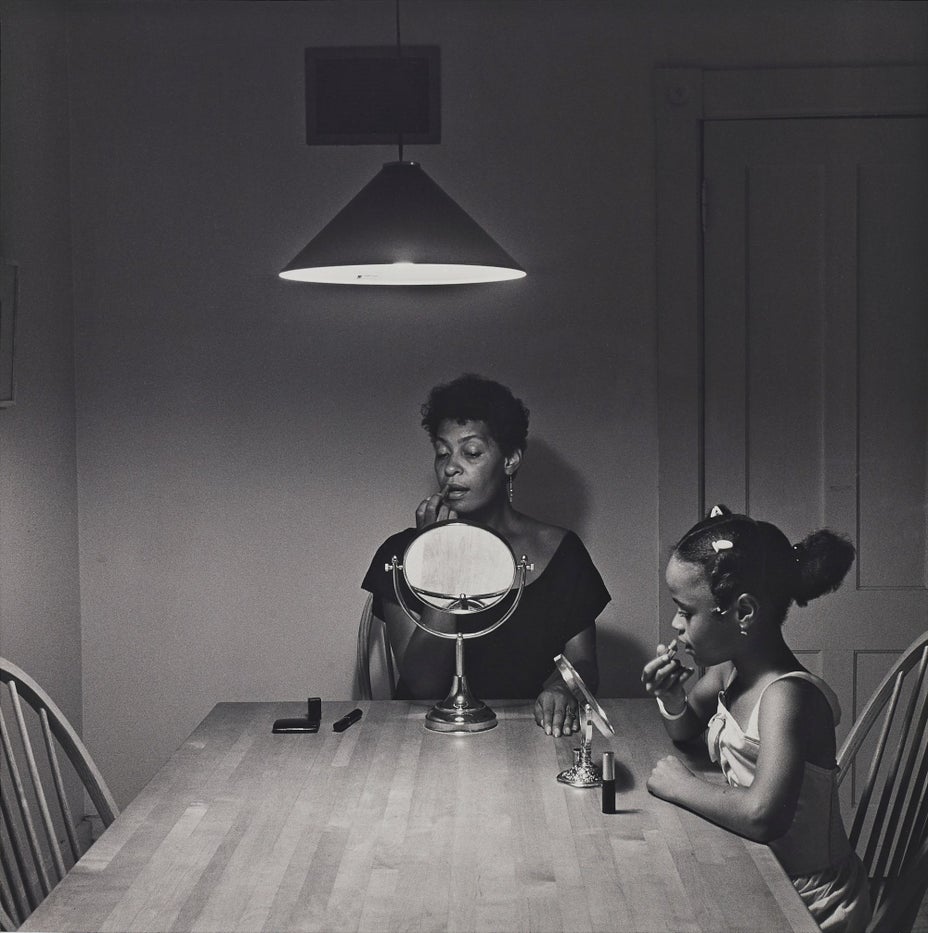
Untitled (Woman and daughter with makeup) from Kitchen Table Series
Estimate
£25,000–35,000‡︎
Sold For
£40,000
1990
Gelatin silver print, mounted to board.
Image: 68.5 x 68.5 cm (26 7/8 x 26 7/8 in.)
Frame: 71.2 x 71 cm (28 x 27 7/8 in.)
Frame: 71.2 x 71 cm (28 x 27 7/8 in.)
Signed, dated and numbered 3/5 in pencil on the reverse of the mount.
This work is number 3 from the sold-out edition of 5 + 2 AP. This image exists only in this size and edition. The Art Institute of Chicago and the Hood Museum, Dartmouth College, hold other prints of this image.
This work is number 3 from the sold-out edition of 5 + 2 AP. This image exists only in this size and edition. The Art Institute of Chicago and the Hood Museum, Dartmouth College, hold other prints of this image.
Full-Cataloguing
‘I realised at a certain moment that I could not count on white men to construct images of myself that I would find appealing or useful or meaningful or complex.’
Carrie Mae Weems
A woman and daughter sit at the kitchen table. The woman looks into her vanity mirror as she applies lipstick; the daughter copies her mother’s pose with her own mirror and lipstick. Although they are not looking at each other, they are synchronised in a shared act. In this seemingly intimate moment between mother and daughter, the woman is, in effect, teaching her daughter the gestures of femininity. When Carrie Mae Weems’s seminal Kitchen Table Series was published for the first time as a stand-alone book in 2016, decades after the completion of the series, it was this poignant image Untitled (Woman and daughter with makeup) that was chosen for the front cover.
In 1990, Kitchen Table Series was one of the first photographic series to place an African-American woman as its protagonist. For this body of work, Weems photographed herself and others at the kitchen table in her own apartment in Northampton, Massachusetts. Contrary to autobiographical self-portraits, her intention was to use her own body to represent all women. ‘She’s a character,’ Weems explains, ‘I use my body as a stand-in, but I never think of it as being about me. Rather, the character helps to reveal something that is more complicated about the lives of women.’ The story of a woman’s relationship with her friends, her lover, her children and herself as told through Weems’s timeless black-and-white photographs is ‘universal at its core’ and is as current today as it was when she first created them.
For more than three decades, Weems has explored the complexities of the African-American experience through photography, video and performance. In 2013, Weems was awarded a MacArthur ‘Genius’ Grant, and her solo exhibition Carrie Mae Weems: Three Decades of Photography and Video (2014), was the first retrospective of an African-American woman at the Solomon R. Guggenheim Museum. She has also exhibited at The Metropolitan Museum of Art, New York; Centro Andaluz de Arte Contemporáneo, Seville; and Contemporary Arts Museum, Houston. Her work is held in many prominent institutions, including Whitney Museum of American Art, New York; Tate Modern, London; and San Francisco Museum of Modern Art.
Carrie Mae Weems
A woman and daughter sit at the kitchen table. The woman looks into her vanity mirror as she applies lipstick; the daughter copies her mother’s pose with her own mirror and lipstick. Although they are not looking at each other, they are synchronised in a shared act. In this seemingly intimate moment between mother and daughter, the woman is, in effect, teaching her daughter the gestures of femininity. When Carrie Mae Weems’s seminal Kitchen Table Series was published for the first time as a stand-alone book in 2016, decades after the completion of the series, it was this poignant image Untitled (Woman and daughter with makeup) that was chosen for the front cover.
In 1990, Kitchen Table Series was one of the first photographic series to place an African-American woman as its protagonist. For this body of work, Weems photographed herself and others at the kitchen table in her own apartment in Northampton, Massachusetts. Contrary to autobiographical self-portraits, her intention was to use her own body to represent all women. ‘She’s a character,’ Weems explains, ‘I use my body as a stand-in, but I never think of it as being about me. Rather, the character helps to reveal something that is more complicated about the lives of women.’ The story of a woman’s relationship with her friends, her lover, her children and herself as told through Weems’s timeless black-and-white photographs is ‘universal at its core’ and is as current today as it was when she first created them.
For more than three decades, Weems has explored the complexities of the African-American experience through photography, video and performance. In 2013, Weems was awarded a MacArthur ‘Genius’ Grant, and her solo exhibition Carrie Mae Weems: Three Decades of Photography and Video (2014), was the first retrospective of an African-American woman at the Solomon R. Guggenheim Museum. She has also exhibited at The Metropolitan Museum of Art, New York; Centro Andaluz de Arte Contemporáneo, Seville; and Contemporary Arts Museum, Houston. Her work is held in many prominent institutions, including Whitney Museum of American Art, New York; Tate Modern, London; and San Francisco Museum of Modern Art.