79
Irving Penn
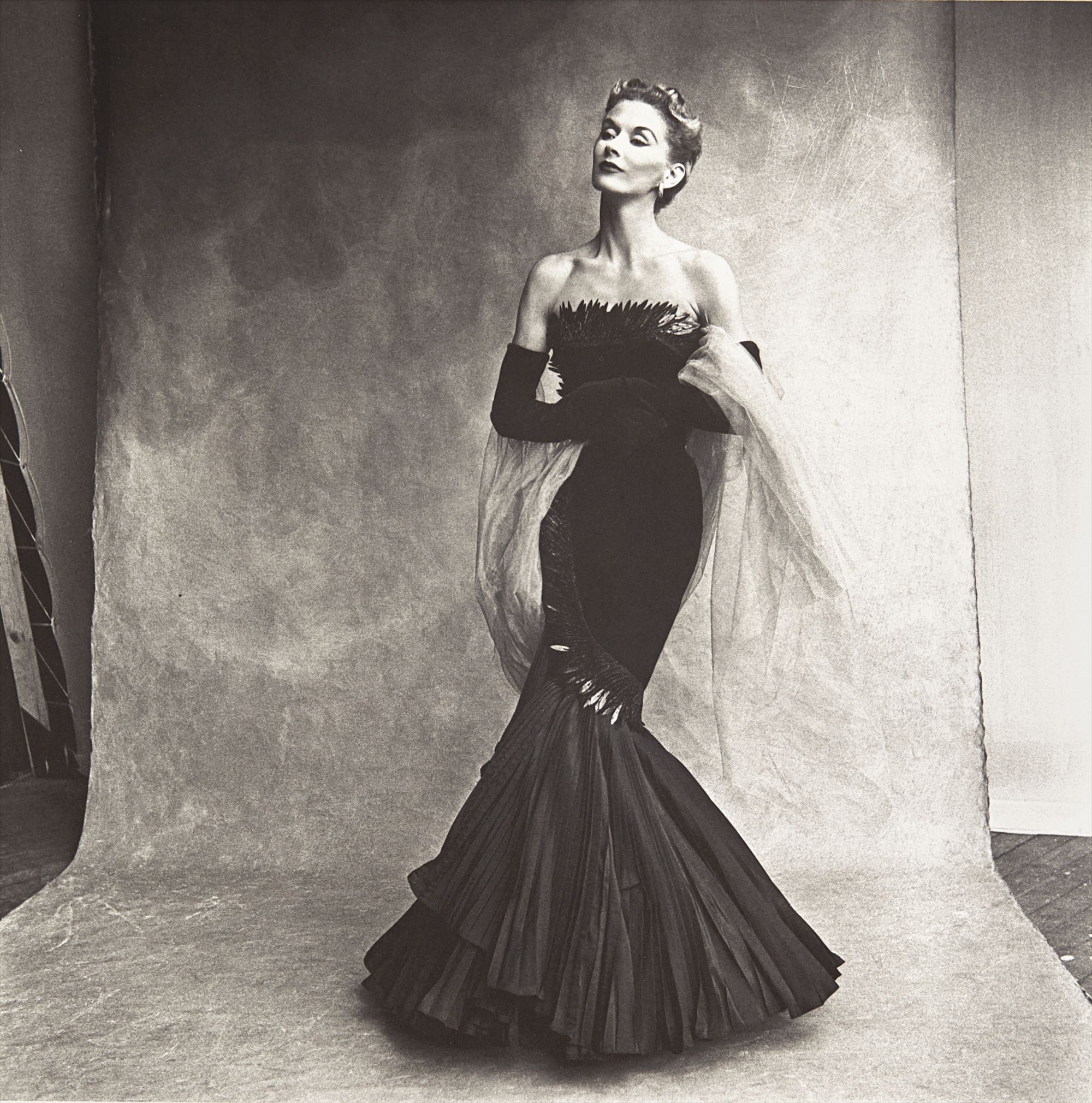
Mermaid Dress (Rochas), Lisa Fonssagrives-Penn
Full-Cataloguing
In 1997, Irving Penn donated his archive to the Art Institute of Chicago. Divided in two parts- the paper archives and the photographic archives- the gift offers a window into the career of the legendary photographer and also helped establish the Art Institute as a leading repository for his work. Comprised of negatives, transparencies, contact sheets and test prints, including the Vogue tear sheet where Mermaid Dress (Rochas), Lisa Fonssagrives-Penn originally appeared, the photographic archive complements the extensive collection of Penn exhibition prints in the Art Institute’s collection which encompasses over 200 works. The print offered here, a duplicate to the platinum-palladium print held in that gift, was one of the first in the edition made by Penn in 1979 and was purchased soon afterward by Mr. Taub.
Irving Penn
American | B. 1917 D. 2009Irving Penn was one of the 20th century’s most significant photographers, known for his arresting images, technical mastery, and quiet intensity. Though he gained widespread acclaim as a leading Vogue photographer for over sixty years, Penn remained a private figure devoted to his craft. Trained under legendary art director Alexey Brodovitch in Philadelphia, he began his career assisting at Harper’s Bazaar before joining Vogue in 1943, where editor and artist Alexander Liberman recognized Penn’s distinctive eye and encouraged him to pursue photography. Penn’s incomparably elegant fashion studies reset the standard for the magazine world, and his portraits, still lifes, and nude studies broke new ground. His 1960 book Moments Preserved redefined the photographic monograph with its dynamic layout and high-quality reproductions. In 1964, Penn began printing in platinum and palladium, reviving this 19th-century process to serve his own distinct vision. An innovator in every sense, Penn’s approach to photography was endlessly adventurous. Few photographers of his generation experimented as widely with both conventional and historic print processes, and none achieved Penn’s level of excellence in all.