
123Δ
Panerai
Ref. Transitional 3646
Luminor
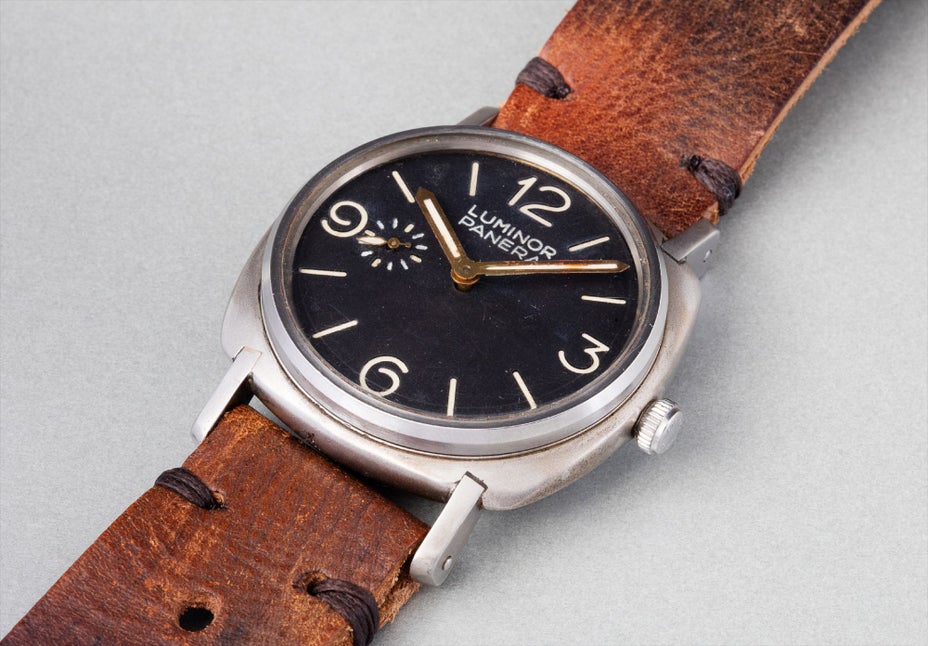
An extremely rare and oversized 8-days diver's wristwatch with glazed back, black dial and subsidiary seconds
- Estimate
- CHF120,000 - 180,000€110,000 - 165,000$124,000 - 186,000
CHF197,000
Lot Details
- Manufacturer
- Panerai
- Year
- 1961
- Reference No
- Transitional 3646
- Movement No
- Marked JUIN 61
- Case No
- Matr. N°11
- Model Name
- Luminor
- Material
- Stainless steel
- Calibre
- Manual, cal. Angelus 240 SF, 15 jewels
- Bracelet/Strap
- Leather
- Clasp/Buckle
- Stainless steel buckle
- Dimensions
- 47mm. Diameter
- Signed
- Case and dial signed. Movement signed Angelus
Specialist
Full-Cataloguing
Catalogue Essay
Officine Panerai’s history can be traced back to 1860, when it was the exclusive supplier of high-precision instruments to the Regia Marina (Royal Italian Navy) through the 1900s. Riding on submersible torpedoes, the commandos, or “frogmen", of the Decima Flottiglia MAS were the protagonists of epic endeavors during World War II. On their wrists, they wore the oversized, precise and highly luminescent watches provided by Officine Panerai. These were extraordinary military watches with a unique aesthetic, manufactured to Panerai’s specifications by Rolex.
Initially, Panerai used copious amounts of radium for the large, highly luminous hour markers on their dials – the inspiration for the name of their first wristwatch model: Radiomir. In 1949, Panerai patented a new self-luminous substance based on tritium, registered under the “Luminor” trademark.
Bearing the iconic features that make a Panerai recognizable at first glance, an expert eye will quickly identify the uniqueness of this unusual piece, which is believed to be a rare prototype or transitional model. Inscribed with ‘I’ and ‘Matr No. 11’, this military watch is fitted with an original, transparent, screw-down case back. Inside and visible through the caseback is a high-grade Angelus 8-day caliber, with subsidiary seconds at 9 o’clock, manufactured in June 1961 as indicated underneath the balance wheel.
The gray-colored Luminor-style case is extraordinary, with four separate lugs soldered into the case, giving it unique and highly attractive aesthetic amongst all Panerai watches. Fitted with a screw-down Oyster crown, the case was most certainly manufactured by Rolex. It is our belief that this watch was possibly created for presentation purposes, along with another similar example that now resides at the Panerai Museum in Florence, Italy. Besides the present watch and the example owned by the Panerai Museum only three further "Transitional 3646" are known today. With its large diameter case, iconic Luminor Marina sandwich dial, and distinctive prototype case, the present lot offers an extraordinary opportunity for collectors of rare and unusual military watches.
Initially, Panerai used copious amounts of radium for the large, highly luminous hour markers on their dials – the inspiration for the name of their first wristwatch model: Radiomir. In 1949, Panerai patented a new self-luminous substance based on tritium, registered under the “Luminor” trademark.
Bearing the iconic features that make a Panerai recognizable at first glance, an expert eye will quickly identify the uniqueness of this unusual piece, which is believed to be a rare prototype or transitional model. Inscribed with ‘I’ and ‘Matr No. 11’, this military watch is fitted with an original, transparent, screw-down case back. Inside and visible through the caseback is a high-grade Angelus 8-day caliber, with subsidiary seconds at 9 o’clock, manufactured in June 1961 as indicated underneath the balance wheel.
The gray-colored Luminor-style case is extraordinary, with four separate lugs soldered into the case, giving it unique and highly attractive aesthetic amongst all Panerai watches. Fitted with a screw-down Oyster crown, the case was most certainly manufactured by Rolex. It is our belief that this watch was possibly created for presentation purposes, along with another similar example that now resides at the Panerai Museum in Florence, Italy. Besides the present watch and the example owned by the Panerai Museum only three further "Transitional 3646" are known today. With its large diameter case, iconic Luminor Marina sandwich dial, and distinctive prototype case, the present lot offers an extraordinary opportunity for collectors of rare and unusual military watches.
Literature
Panerai
Italian | 1860Known for its robust designs and large case sizes, Officine Panerai was established in 1860 by Giovanni Panerai in Florence, Italy. Around 1900, Giovanni's grandson Guido Panerai took over, and Panerai became the supplier to the Regia Marina — the Royal Italian Navy. After supplying the navy with high-precision instruments for a number of years, Officine Panerai created Radiomir, a radium-based powder that gives luminosity to the dials of sighting instruments and devices. By 1936, the Royal Italian Navy approached Panerai again with the request to design a watch resistant to extreme underwater conditions. The watch they created became known as the "Radiomir".
Panerai's watches made during the early twentieth century era were comprised of cases designed and manufactured by Rolex SA, with Cortébert, a Swiss manufacturer, supplying the majority of their movements. The most recognizable designs from the firm are the Radiomir and Luminor. To date, vintage models from the first half of the 1900s, such as the reference 3646 and 6152 models, remain the most desirable among collectors.
Browse MakerPanerai's watches made during the early twentieth century era were comprised of cases designed and manufactured by Rolex SA, with Cortébert, a Swiss manufacturer, supplying the majority of their movements. The most recognizable designs from the firm are the Radiomir and Luminor. To date, vintage models from the first half of the 1900s, such as the reference 3646 and 6152 models, remain the most desirable among collectors.