16
Alejandro Otero
Untitled
Full-Cataloguing
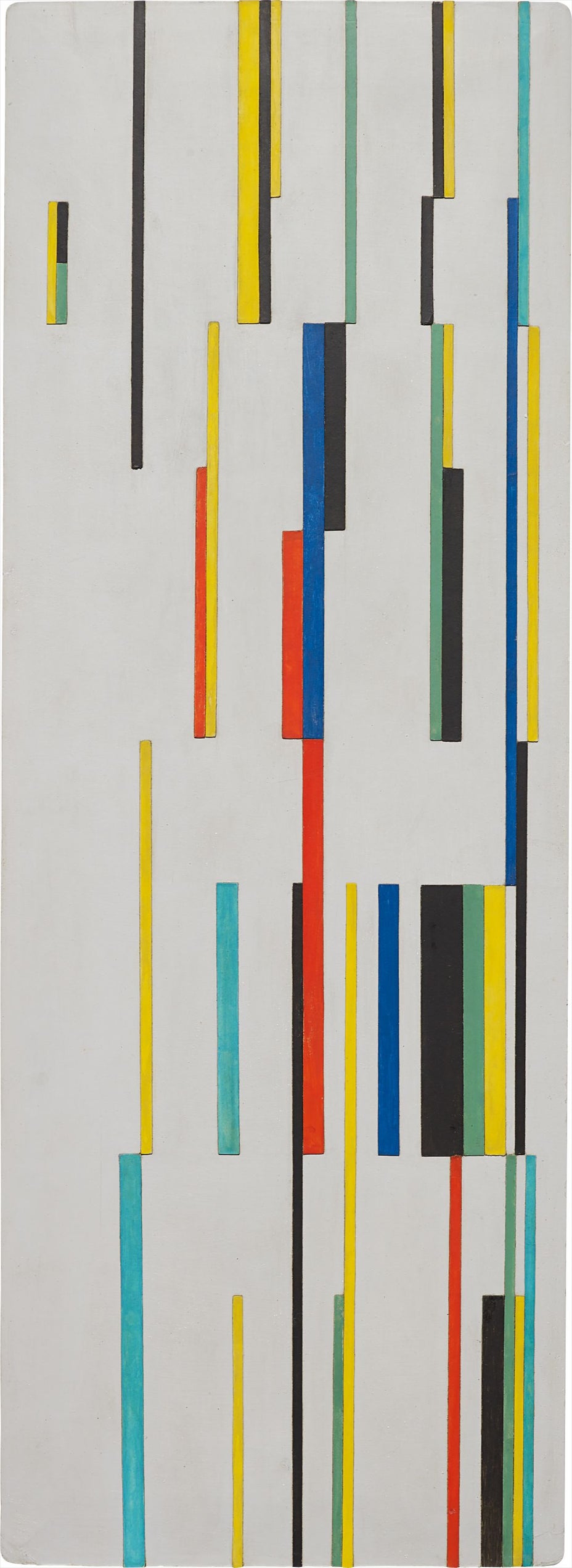
Though this work is clearly informed by all of these previous influences there are both formal and historical aspects to Untitled that make it beautifully unique. Here black, yellow, aquamarine, blue, and red bands dance within a much broader field of white. Instead of functioning as an additional color, however, the white space here serves as the organizing element of the work. It allows the eye to flow downward, following each strip as it ends, and jumping when another one begins; extending the beat of colors through what can be imagined as an animated measure of a musical notation. Larger than a traditional boceto, yet more intimate than a full scale painting, the formica strips are painted with characteristic duco paint and laid on board instead of wood. The result is a work that is a perfect synthesis of painting, collage, and Otero’s lifelong dedication to experimenting with the spatial and optical effects of line and color. Furthermore, the piece counts with a unique historical trajectory and provenance. Gifted and dedicated by Otero to his dear friend Ramón Casas in Cuba in 1984 the work is not only witness to Otero’s personal life and travels, but also proof of the exchange between international artists and the politically and economically isolated Havana of the early 1980s.
Alejandro Otero
Venezuelan | B. 1921 D. 1990Alejandro Otero is an important figure in Venezuelan abstract and kinetic art. He studied and lived in France and returned to Venezuela during a significant moment when his country was undergoing modernization. During this time he participated in a large scale architectural project with renowned Venezuelan architect Raúl Villanueva that significantly informed his works. Primarily influenced by Piet Mondrian, his art denotes the notions of integration and architecture, as well as the continual experimentation with spatial and optical effects of line and color. His most important contribution to the field of painting is his series of Coloritmos (Colorythms), where he applies rhythm to color form, suggesting a subtle spatial ambiguity and insinuating a complex visual dance.