7Ο︎
Andreas Gursky
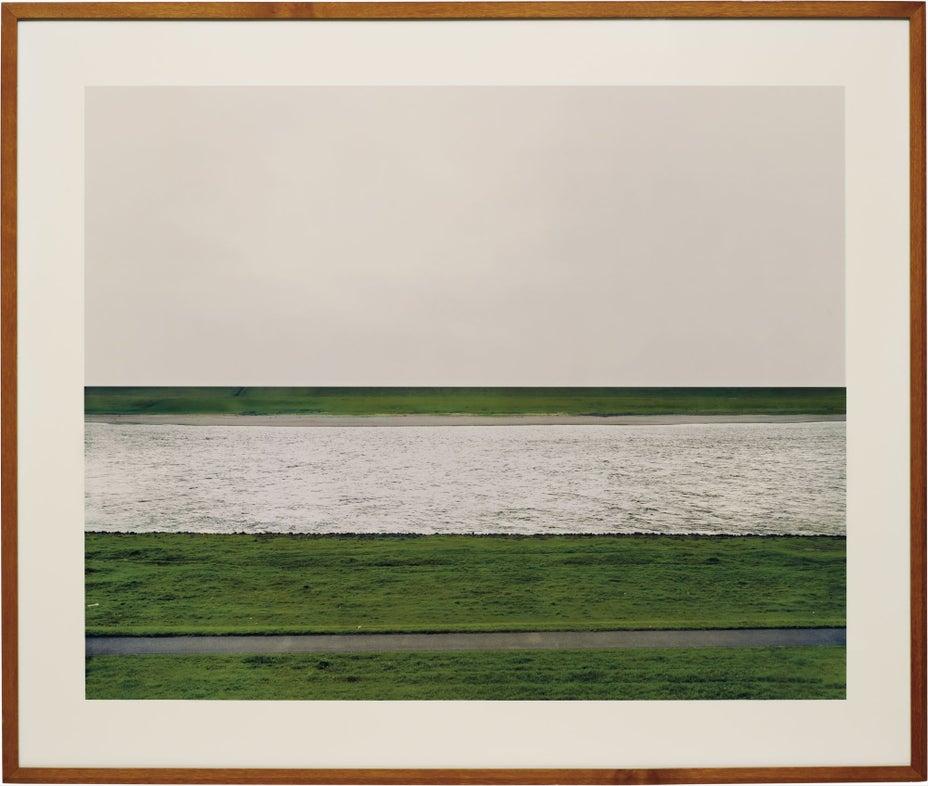
Rhein
Estimate
$1,000,000–1,500,000
Sold For
$1,925,000
c-print laminated on Plexiglas, in artist's frame
sheet 57 3/8 x 71 1/8 in. (145.8 x 180.8 cm.)
frame 73 x 86 1/8 in. (186 x 222 cm.)
frame 73 x 86 1/8 in. (186 x 222 cm.)
Signed, titled, numbered and dated "'Rhein' '96 5/6 A. Gursky" on the reverse of the mount. This work is number 5 from an edition of 6.
Full-Cataloguing
Gursky has cleverly evolved from the classical landscape seen throughout art history into a more contemporary execution, making a radical departure with his brilliant use of color, large-format imagery, and the subtle alteration or omission of certain elements in his work. Confronted with what he considered to be the basic insufficiencies
of the documentary practice, Gursky was influenced in the early 1990s to begin using digital technology as a means of manipulating an image. In doing so, the artist skillfully generated an “illusion of a fictitious reality”, playing with the reality of the image as it alters between an unspoiled landscape and an artificial reframing of the world (R. Pfab, “Perception and Communication: Thoughts on New Motifs by Andreas Gursky”, M. L. Syring (ed.), Andreas Gursky: Photographs from 1984 to the Present, exh. cat., Kunsthalle Dusseldorf, Düsseldorf 1998, p. 9).
Such experiments with photography through digital manipulation may leave the viewer puzzled, questioning what has been changed with the help of technology and what has been left completely authentic and true to the actual site captured.
As seen in the present lot, Gursky created his composition by removing all small and negligible details that he felt interrupted a clean horizon. With regards to the piece,
the artist described, “there is a particular place with a view over the Rhine which has somehow always fascinated me, but it didn’t suffice for a picture as it basically constituted only part of a picture. I carried this idea for a picture around with me for a year and a half and thought about whether I ought perhaps to change my viewpoint ... In the end I decided to digitalize the pictures and leave out the elements that bothered me” (A. Gursky quoted in A. Ltgens, “Shrines and Ornaments: A Look into the Display Cabinet”, Andreas Gursky: Fotografen 1994-1998, exh. cat., Kunstmuseum, Wolfsburg 1998, p. xvi). As a result of this technique, the viewer is not privy to a specific spot along the flowing river but rather an idealistic, unblemished location that few have the advantage of finding without Gursky’s lead.
A breathtaking masterpiece of scale and tranquility, Rhein, 1996, perfectly displays Gursky’s constant strive to capture the sublime. Whether depicting monumental architecture, landscape, stock exchanges, window displays, libraries, or building facades, Gursky documents the post-modern civilized world as he sees it, manipulating his images in order to distance them from the sometimes harsh imperfections of reality.
An impressive and important figurehead in Andreas Gursky’s inspiring oeuvre, Rhein, 1996 is a beautifully contemporary take on the canonical landscape genre of the past.
Here, Gursky invites the viewer to wonder at the digitally perfected line and horizontal striations of green which comprise the composition, while also presenting a quiet
refection on man’s relationship to the surrounding natural world which so many overlook and take for granted.
One of the longest European rivers, the Rhine navigates a curiously straight course, passing through six countries including the artist’s home town of Düsseldorf, Germany before reaching its convergence with the North Sea. Spanning the full width of the dynamic picture plane, the majestic landscape appears vibrant with bands of emerald green grass and silvery water, while illuminated ripples dance across the surface of the river with astounding detail. Looming high above the river’s exceptionally straight path appears a cloudy blue-grey sky, presenting a distant horizon far beyond the verdant riverbank. While clearly depicting a lush landscape of the artist’s surroundings,
Rhein can also be said to take on elements of abstract composition, dissolving away from figurative landscape with its presentation of geometric color blocks, striped with
green, grey, and blue. Gursky has noted, “my pictures are becoming increasingly formal and abstract, a visual structure appears to dominate the real events shown in my pictures. I subjugate the real situation to my artistic concept of the picture” (A. Gursky quoted in L. Cooke, “Andreas Gursky: Visionary (Per)Versions”, M. L. Syring (ed.),
Andreas Gursky: Photographs from 1984 to the present, exh. cat., Kunsthaus Düsseldorf, Düsseldorf 1998, p. 14).
of the documentary practice, Gursky was influenced in the early 1990s to begin using digital technology as a means of manipulating an image. In doing so, the artist skillfully generated an “illusion of a fictitious reality”, playing with the reality of the image as it alters between an unspoiled landscape and an artificial reframing of the world (R. Pfab, “Perception and Communication: Thoughts on New Motifs by Andreas Gursky”, M. L. Syring (ed.), Andreas Gursky: Photographs from 1984 to the Present, exh. cat., Kunsthalle Dusseldorf, Düsseldorf 1998, p. 9).
Such experiments with photography through digital manipulation may leave the viewer puzzled, questioning what has been changed with the help of technology and what has been left completely authentic and true to the actual site captured.
As seen in the present lot, Gursky created his composition by removing all small and negligible details that he felt interrupted a clean horizon. With regards to the piece,
the artist described, “there is a particular place with a view over the Rhine which has somehow always fascinated me, but it didn’t suffice for a picture as it basically constituted only part of a picture. I carried this idea for a picture around with me for a year and a half and thought about whether I ought perhaps to change my viewpoint ... In the end I decided to digitalize the pictures and leave out the elements that bothered me” (A. Gursky quoted in A. Ltgens, “Shrines and Ornaments: A Look into the Display Cabinet”, Andreas Gursky: Fotografen 1994-1998, exh. cat., Kunstmuseum, Wolfsburg 1998, p. xvi). As a result of this technique, the viewer is not privy to a specific spot along the flowing river but rather an idealistic, unblemished location that few have the advantage of finding without Gursky’s lead.
A breathtaking masterpiece of scale and tranquility, Rhein, 1996, perfectly displays Gursky’s constant strive to capture the sublime. Whether depicting monumental architecture, landscape, stock exchanges, window displays, libraries, or building facades, Gursky documents the post-modern civilized world as he sees it, manipulating his images in order to distance them from the sometimes harsh imperfections of reality.
An impressive and important figurehead in Andreas Gursky’s inspiring oeuvre, Rhein, 1996 is a beautifully contemporary take on the canonical landscape genre of the past.
Here, Gursky invites the viewer to wonder at the digitally perfected line and horizontal striations of green which comprise the composition, while also presenting a quiet
refection on man’s relationship to the surrounding natural world which so many overlook and take for granted.
One of the longest European rivers, the Rhine navigates a curiously straight course, passing through six countries including the artist’s home town of Düsseldorf, Germany before reaching its convergence with the North Sea. Spanning the full width of the dynamic picture plane, the majestic landscape appears vibrant with bands of emerald green grass and silvery water, while illuminated ripples dance across the surface of the river with astounding detail. Looming high above the river’s exceptionally straight path appears a cloudy blue-grey sky, presenting a distant horizon far beyond the verdant riverbank. While clearly depicting a lush landscape of the artist’s surroundings,
Rhein can also be said to take on elements of abstract composition, dissolving away from figurative landscape with its presentation of geometric color blocks, striped with
green, grey, and blue. Gursky has noted, “my pictures are becoming increasingly formal and abstract, a visual structure appears to dominate the real events shown in my pictures. I subjugate the real situation to my artistic concept of the picture” (A. Gursky quoted in L. Cooke, “Andreas Gursky: Visionary (Per)Versions”, M. L. Syring (ed.),
Andreas Gursky: Photographs from 1984 to the present, exh. cat., Kunsthaus Düsseldorf, Düsseldorf 1998, p. 14).