13Ο︎
Andy Warhol
Skull
Full-Cataloguing
Andy Warhol was shot and critically injured on the 3rd of June 1968 by Valerie Solanas, a marginal figure in the factory scene and author of separatist feminist manifestos. After this terrifying incident, Andy Warhol became even more obsessed with the subject of death than in his previous work. A ten year period lapsed before the artist returned to self-portraiture, yet when he did, it was clear that his past experience had left a profound effect on the psychological subject of his oeuvre.
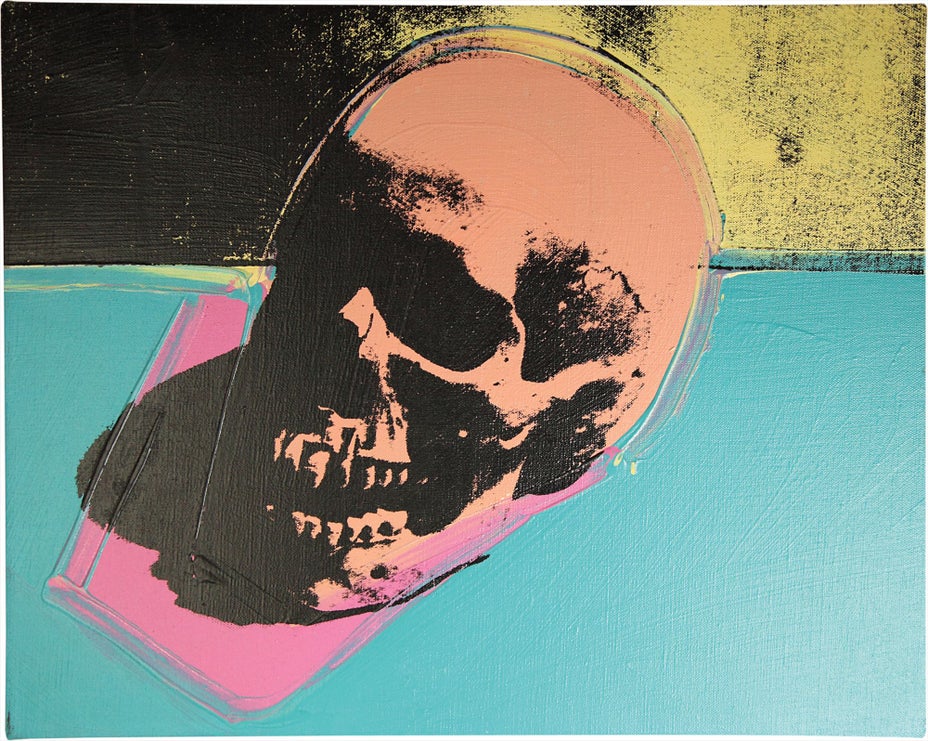
A significant motif in the artist’s later compositions, the representation of the skull in the present lot recalls his series of paintings of Skulls executed in the seventies – a time in which the resurgence of skull imagery accompanied a growing anxiety over the spread of AIDS, as well as the escalating threats of nuclear war and ecological disasters. Death is particularly paradigmatic of Warhol’s work: it is a theme which he drew upon frequently in his final years, and one which he chose to channel through the image of a skull. In this particular painting, the skull’s inclusion acts as a direct allusion to the memento mori tradition that pervades ancient literature, its ominous and foreboding presence patently reminding its observer of the transience of life, and the certainty of death. Indeed, just as Warhol was confronted with own existence as he stared into the face of his assailant, the viewer too is forced to enter a period of self-reflection, as we contemplate our inevitable fate. Reminiscent of his Self-Portrait with Skull, 1978, which was based on one of several striking photographs taken by the artist in the same decade, in which he poses with a skull on his shoulder or head, there is the implication of death as imminent. In the self-portrait, both Warhol and the skull, as the latter does in this piece, appear spectral: the artist’s face seems to disintegrate before the viewer’s eyes, his features slowly morphing into that which, in time, will come to resemble the vacant stare of the dead.
Skull is a work of powerful and tragic utterance. Replacing Warhol’s sixties paintings of Marilyns and Campbell soup cans, it evokes a sense of tragedy which is deeply commanding. Warhol once wrote that “During the 60’s, I think people forgot what emotions were supposed to be. And I don’t think they’ve ever remembered. I think that once you see emotions from a certain angle you can never think of them as real again. That’s what more or less has happened to me.” (A. Warhol, The Philosophy of Andy Warhol (From A to B and Back Again), New York, 1975, p. 27); however, Warhol’s insecurity after facing death is extremely palpable in this painting, refuting the artist’s earlier statement, and presenting a darker, more vulnerable dimension to his work.
Andy Warhol
American | B. 1928 D. 1987Andy Warhol was the leading exponent of the Pop Art movement in the U.S. in the 1960s. Following an early career as a commercial illustrator, Warhol achieved fame with his revolutionary series of silkscreened prints and paintings of familiar objects, such as Campbell's soup tins, and celebrities, such as Marilyn Monroe. Obsessed with popular culture, celebrity and advertising, Warhol created his slick, seemingly mass-produced images of everyday subject matter from his famed Factory studio in New York City. His use of mechanical methods of reproduction, notably the commercial technique of silk screening, wholly revolutionized art-making.
Working as an artist, but also director and producer, Warhol produced a number of avant-garde films in addition to managing the experimental rock band The Velvet Underground and founding Interview magazine. A central figure in the New York art scene until his untimely death in 1987, Warhol was notably also a mentor to such artists as Keith Haring and Jean-Michel Basquiat.