13Ο︎
Andy Warhol
Dance Steps
Full-Cataloguing
- Andy Warhol
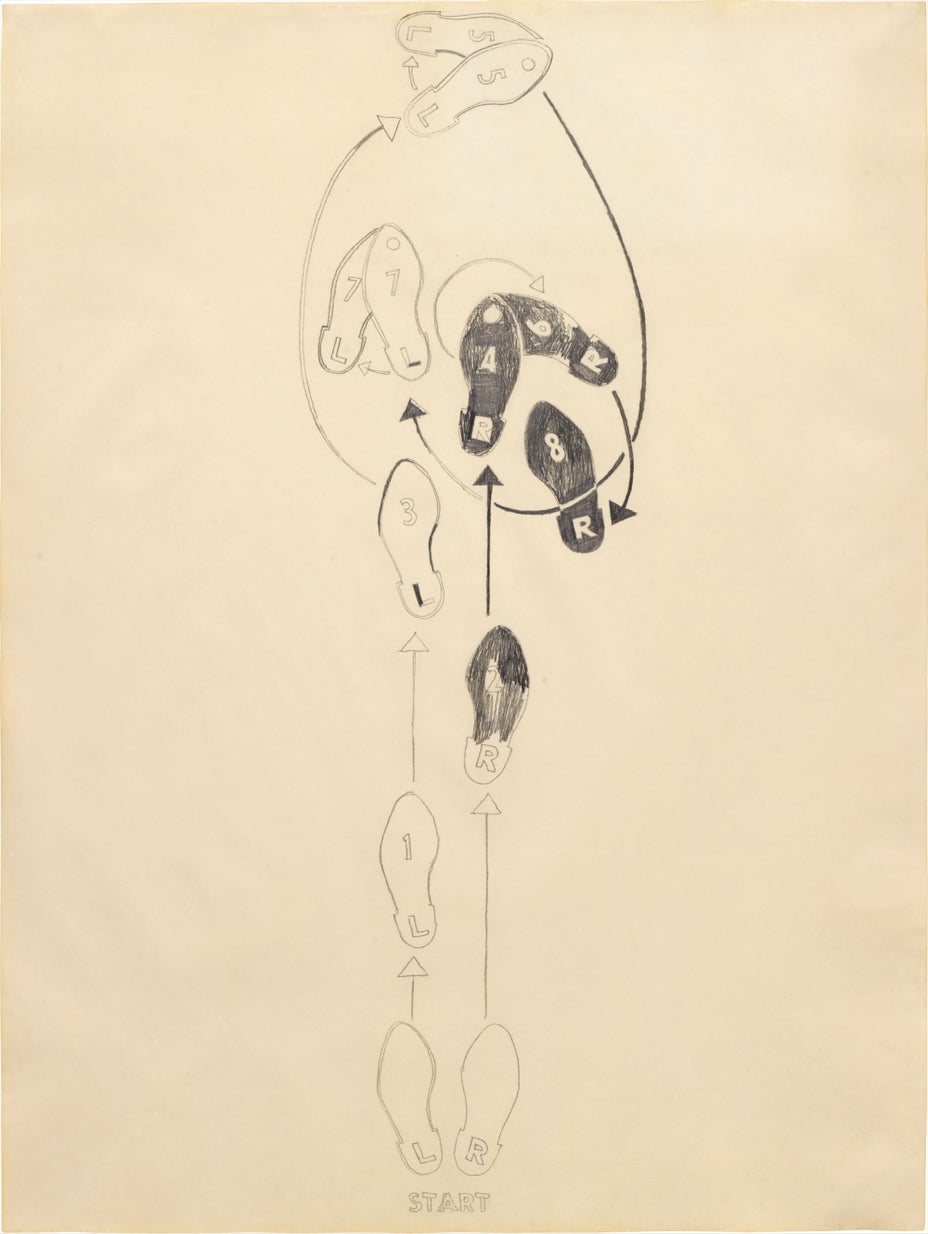
One of only two known fully-finished works on paper from the rare Diagram Paintings series, Andy Warhol’s Dance Steps, 1962, is a unique and extraordinarily fine example of Warhol’s draftsmanship. An early commentary on a society increasingly preoccupied with self-perception and fame, Dance Steps performs the role of social guide both materially and metaphorically, serving not only as choreographic demonstration, but also as a diagram for the viewer’s hopeful entrée into society.
Experimenting with the concept of beauty, Warhol captured in these early works a sense of vulnerability, playing upon a nation’s newfound awareness of the concept of self-improvement. In his Wigs and Make him want you advertisements, both 1961, the artist anticipated his later promulgation of the commerciality that characterized the post-war era, reframing a visual identity that encouraged cultural uniformity. Warhol’s Dance Diagrams, though, are a marked departure from his other “beauty” paintings and drawings, explicitly illustrating the “how-to” of personal development, rather than the cosmetic and commercial fruits of self-enrichment.
Appropriated from images found in two books published by the Dance Guild in the 1950s, Lindy Made Easy (with Charleston) and Fox Trot Made Easy, Warhol would carefully remove the pages of these books, attaching them to makeshift supports, and then project these readymade instructions onto his canvas to trace each figure. For Warhol, each step, numbered and clearly marked “R” or “L”, represented a step closer to the ideal. In Dance Steps, however, the artist strays from his own modular process, skillfully rendering a freehand drawing of this diagram, renouncing the mechanical painting process that would become axiomatic of the work in his most prolific period. An initially shy, self-conscious artist, Warhol provided his audience, and himself, a manual to the social instruments that could transform not only the person, but his entire life.
Andy Warhol
American | B. 1928 D. 1987Andy Warhol was the leading exponent of the Pop Art movement in the U.S. in the 1960s. Following an early career as a commercial illustrator, Warhol achieved fame with his revolutionary series of silkscreened prints and paintings of familiar objects, such as Campbell's soup tins, and celebrities, such as Marilyn Monroe. Obsessed with popular culture, celebrity and advertising, Warhol created his slick, seemingly mass-produced images of everyday subject matter from his famed Factory studio in New York City. His use of mechanical methods of reproduction, notably the commercial technique of silk screening, wholly revolutionized art-making.
Working as an artist, but also director and producer, Warhol produced a number of avant-garde films in addition to managing the experimental rock band The Velvet Underground and founding Interview magazine. A central figure in the New York art scene until his untimely death in 1987, Warhol was notably also a mentor to such artists as Keith Haring and Jean-Michel Basquiat.