13Ο
Andy Warhol
Soup Can
Full-Cataloguing
While Warhol’s practice is defined by the range of media with which he engaged, from painting to film and installation, Soup Can demonstrates how his oeuvre was fundamentally rooted in the act of drawing. Here we see that the medium formed the basis of his engagement with some of his most important motifs. Graduating from Schenley High School in his native Pittsburgh, Warhol deployed exceptional talent as a visual artist even as a teenager, winning a prestigious Scholastic Art and Writing Award. As a child he also displayed exceptional aptitude in his classes at the Carnegie Museum of Art, where he won several prizes for his drawings. The professionalization of his natural ability as an illustrator began when he was a college student at the Carnegie Institute of Technology, where he channeled his burgeoning talents as art director of the student art magazine, Cano. Illustrating a cover for the publication in 1948 and a full-page interior illustration in 1949, it was during these years that Warhol experimented with his signature blotted line technique that would catapult his career as one of the most in-demand commercial illustrators over the course of the 1950s. Foreshadowing his iconic silkscreen paintings and the introduction of mechanical techniques into the arena of fine art, Warhol’s blotted line method combined both drawing and basic printing. Sketching elegant line drawings on tracing paper, Warhol would go over certain lines with fountain pen and then blot a second more absorbent paper on top to create beautifully broken lines. The production style allowed him to quickly produce multiple options for clients when composing advertisement ideas. This experience gave Warhol crucial insight into the mass mediation of images and their influence on the American psyche.
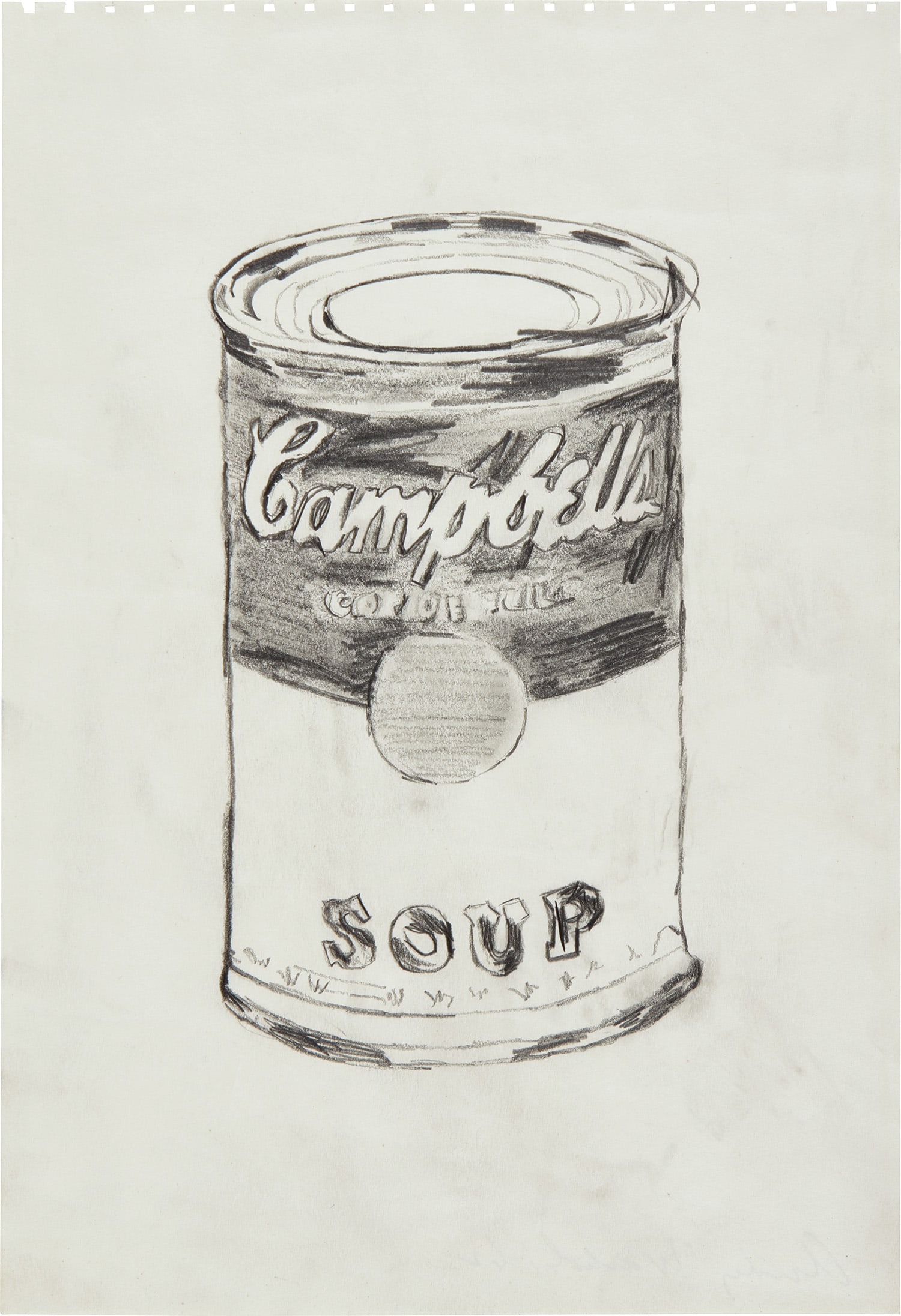
However, as Warhol strove to make the transition into the area of fine art, he abandoned the whimsical flourishes of his illustrative works in search of a precise realism that offered a new and timely perspective on consumer society. As an exemplary drawing that witnesses the final stages of this transition, Soup Can is composed of sketched lines that clearly demarcate the subject and provide it with monumentality, while softly imbuing it with frenetic energy through delicate cross-hatching. As such, the work shows both the making of a defining moment in art history as well as the artist’s personal reverence for one of his everyday icons.
Sketched as a pensive exercise and master drawing in its own right, Soup Can stages a rebellion against the elaborate conventions of the still life genre. Seemingly floating in an abstract space, Warhol elevates the common food item to icon status by privileging its unique and arresting visual properties. Warhol takes this a step further, however, by deconstructing a familiar image before our very eyes. As noted by the influential literary theorist and semiotician Roland Barthes, “What Pop art wants is to desymbolize the object, to give it the obtuse and matte stubbornness of a fact" (Roland Barthes, quoted in Paul Taylor, ed., Post-Pop, Cambridge, 1989, p. 25).
In the present work however, Warhol also leaves us a tantalizing point of entry. While he enshrines the graphic efficacy of the famed Campbell’s Soup label – distilling its basic forms so that it remains instantaneously recognizable despite an economizing of detail – he also leaves the lower section empty, where the flavor of the soup would be ordinarily be written. As such Warhol plays a characteristically ambiguous game of multi-layered signification: does the empty label make an appeal to memory, allowing our personal associations to designate the content of the can; or is it that, in the process of mediation and the movement of the soup can into a new critical context, the image itself has been rendered empty – a hollow form purposed primarily for aesthetic contemplation. As a testament to Warhol’s enduring genius, he condenses in Soup Can the historic conflict between content and form and, instead of making claims to resolve it, he simply continues to whet our appetite.
Andy Warhol
American | B. 1928 D. 1987Andy Warhol was the leading exponent of the Pop Art movement in the U.S. in the 1960s. Following an early career as a commercial illustrator, Warhol achieved fame with his revolutionary series of silkscreened prints and paintings of familiar objects, such as Campbell's soup tins, and celebrities, such as Marilyn Monroe. Obsessed with popular culture, celebrity and advertising, Warhol created his slick, seemingly mass-produced images of everyday subject matter from his famed Factory studio in New York City. His use of mechanical methods of reproduction, notably the commercial technique of silk screening, wholly revolutionized art-making.
Working as an artist, but also director and producer, Warhol produced a number of avant-garde films in addition to managing the experimental rock band The Velvet Underground and founding Interview magazine. A central figure in the New York art scene until his untimely death in 1987, Warhol was notably also a mentor to such artists as Keith Haring and Jean-Michel Basquiat.