Property from a Private Collection, Europe
96
Anonymous
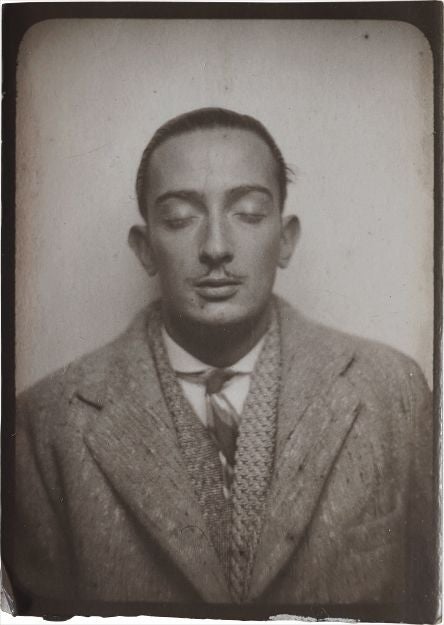
Salvador Dalí
Estimate
£3,000–5,000†︎
Sold For
£4,000
circa 1929
Photomaton.
5.2 x 3.7 cm (2 x 1 1/2 in.)
Full-Cataloguing
In 1928 Parisians were thrilled at the arrival of the latest sensation from the United States. Among those flocking to try the phomaton (photobooth) were André Breton and his fellow Surrealists. The photomaton was immensely attractive for its potential to create a visual equivalent to automatic writing, done quickly without intent, which the Surrealists believed more real and free than traditional ways of writing. The photomaton was the photographic readymade, the ultimate self-portrait, as the subject could portray himself without the interference of the self.
The following year, in the final issue of La Révolution Surréaliste, René Magritte presented a photocollage comprised of 16 photomaton portraits and a reproduction of a painting, to accompany an article on love. In this work the nude model (Magritte’s wife Georgette) represents Venus, the god of love; written on the painting are the words ‘Je ne vois pas la femme cachée dans la forêt’ [I don’t see the woman hidden in the forest]. Included in the work are photomatons of Salvador Dalí, René Magritte, André Breton, Max Ernst, Louis Aragon and others, all with their eyes closed so as not to be distracted by the mirror in the machine that allowed subjects to compose their expressions before the camera clicked. In Photography and Surrealism, art historian, David Bates observes that by framing the naked woman within the portraits of men with their eyes closed, Magritte positions her as the unattainable – a figment of their desires and fantasies.
The current lot, a photomaton portrait of Salvador Dalí, was one of two frames sold as part of a group lot of Surrealist photomaton portraits in the André Breton sale at Camel Cohens in 2003.
The following year, in the final issue of La Révolution Surréaliste, René Magritte presented a photocollage comprised of 16 photomaton portraits and a reproduction of a painting, to accompany an article on love. In this work the nude model (Magritte’s wife Georgette) represents Venus, the god of love; written on the painting are the words ‘Je ne vois pas la femme cachée dans la forêt’ [I don’t see the woman hidden in the forest]. Included in the work are photomatons of Salvador Dalí, René Magritte, André Breton, Max Ernst, Louis Aragon and others, all with their eyes closed so as not to be distracted by the mirror in the machine that allowed subjects to compose their expressions before the camera clicked. In Photography and Surrealism, art historian, David Bates observes that by framing the naked woman within the portraits of men with their eyes closed, Magritte positions her as the unattainable – a figment of their desires and fantasies.
The current lot, a photomaton portrait of Salvador Dalí, was one of two frames sold as part of a group lot of Surrealist photomaton portraits in the André Breton sale at Camel Cohens in 2003.