Property of a Distinguished Collector
30
Arnaldo Pomodoro
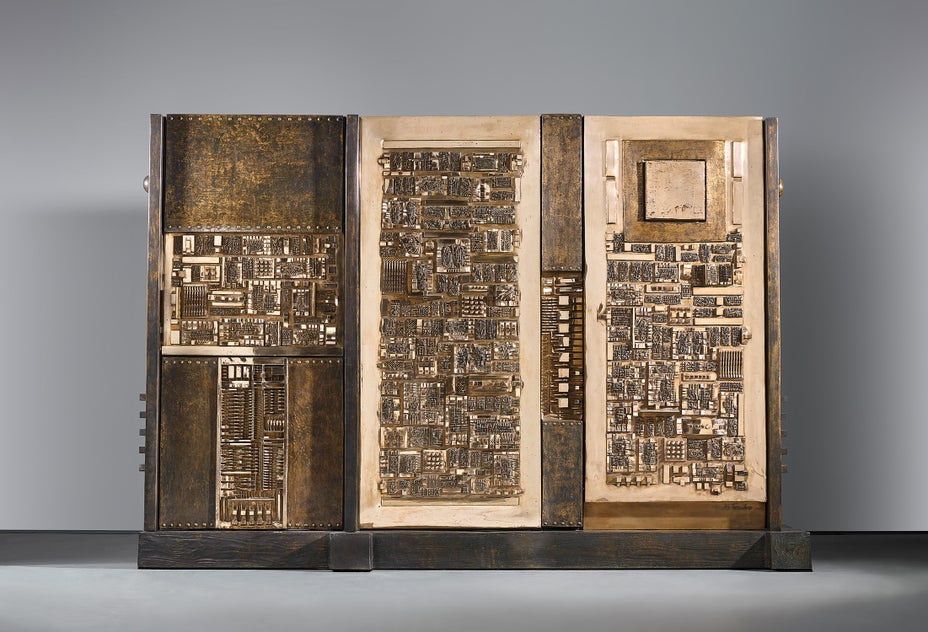
Grande Tavola Della Memoria
Estimate
£400,000–600,000‡︎♠︎
inscribed with the artist's name and number 'Arnaldo Pomodoro, p.a.' lower right of right panel
bronze
223 x 320.6 x 64 cm (87 3/4 x 126 1/4 x 25 1/4 in.)
Executed in 1959-65, this work is the artist's proof from an edition of 2 plus 1 artist's proof.
Full-Cataloguing
Grande Tavola della Memoria (1959-65) is a work that is colossal and multifaceted in both its material physicality and its metaphysical connotations. Brimming with dualities and complex references, this formative sculpture became a cornerstone for the subsequent spherical and columnar bodies of work that went on to define Arnaldo Pomodoro’s career. Stretching approximately two metres in height and over three metres in length, the expansive bronze panels juxtapose stillness and dynamism, interiority and exteriority, past and present, in an abstract and intricate representation of continuity and evolution. Grande Tavola della Memoria forms the apex of Pomodoro’s extensive and prolific career; monumental not only in its size but also its importance, the work is situated at the very core of the artist’s oeuvre, encompassing both the physical and philosophical practices that define his work. A testament to the importance of these structures in his oeuvre, another cast from the edition was included in the artist’s one room installation at the 1988 Venice Biennale, that example is still in the artist's collection and the other is in the collection of the municipality of Darmstadt.
Pomodoro was an essential player in the post-war Italian art scene and one of the founding members of the Continuatà movement in Milan, who were intent upon forging a relationship between matter and sign. The notion of continuity is exemplified in the present work, which considers the evolutionary trajectory of humankind, specifically how this evolution is marked by the consistent presence of signs and symbols. Engraved with a complex myriad of glyphs that create intense cadences of light and shade that stand in stark contrast to the golden polished surface, Grande Tavola della Memoria embodies the artist’s lifelong fascination with the codes and markings that define the human condition: ‘[Pomodoro] said of The Table of Memory that he wanted to put there everything he ever knew. ‘Thoughts’ were still his goal, but he sought to turn each into an abstract mark occupying a place in a register of such marks…It is as if a secret language is rendered which communicates poetic myths and private symbols. Yet the language can never be deciphered. Rather, Table of Memory stands as a modern testament to the need for locking away both an individual’s and society’s secrets’ (Mark Rosenthal, ‘The Art of Arnaldo Pomodoro: Essence and Evolution’, Arnaldo Pomodoro, exh. cat., Columbus Museum of Art, Ohio, 1983, p. 6).
Informed by his studies in engineering and architecture, Pomodoro was raised in the rural region of Montefeltro, and was inspired by the fissures and crags of the landscape of his upbringing, as well as by the remnants of the artistic legacy of Renaissance civilisation prevalent in his native country. Pomodoro has readily acknowledged the inspiration of Lorenzo Ghiberti’s bronze Gates of Paradise (1425-52) in Florence, and ‘just as the collection of themes on the Renaissance relief was meant to give a historical overview of events affecting all humanity, Pomodoro’s narratives were intended to be similarly all-encompassing’. ‘“You could say that I’m trying to imitate the Italian Renaissance,” he wrote. Comparison to Italian art history is indeed apt. The sense of the monumental, the elaboration of these of the largest dimension, the strong ties to civilization, the underlying commitment to humanistic, artistic, intellectual and philosophical values: these are qualities of the Italian past that Pomodoro willingly embraces’ (Mark Rosenthal, ‘The Art of Arnaldo Pomodoro: Essence and Evolution’, Arnaldo Pomodoro, exh. cat., Columbus Museum of Art, Ohio, 1983, p. 6).
In his work Pomodoro pays homage to the advancements in technology that defined the period in which he was working: ‘I think in these sculptures, I sense discovery, that is, the drama of technological discovery and its powers’ (Arnaldo Pomodoro, quoted in conversation with Professor Sam Hunter, ‘An Interview with Arnaldo Pomodoro’, Arnaldo Pomdoro, exh. cat., Milan, 1974, n.p.). The artist’s experience as a jeweller, his intricate knowledge of metalwork and craftsmanship is at the forefront of Grande Tavola della Memoria. He was also influenced by the mysterious hieroglyphs of Paul Klee’s paintings: ‘when I was young’, Pomodoro writes, ‘the artist who most inspired me was Paul Klee and it’s perhaps from Klee that I learned the use of graphemes that constitute the stylistic trait with which I have come to be identified’ (Arnaldo Pomodoro, ‘Arnaldo Pomodoro, 1993: Statement’, Arnaldo Pomodoro, exh. cat., The Hakone Open-Air Museum, 1994, p. 8).
Grande Tavola della Memoria is a work of such gravitas and overwhelming complexity that it bears the capacity to impress upon the viewer a momentous weight of philosophical and cultural significance. It embodies not only our history of artistic progression but also a representation of humankind that, despite its seemingly indecipherable abstraction, speaks directly to our innate understanding of the human condition. ‘For my work, then, I hope to strike a balance between an absolute artistic quality…and the sense of being in the midst of life, a part of its movement, and its hope for change’ (Arnaldo Pomodoro, quoted in conversation with Sam Hunter, ‘An Interview with Arnaldo Pomodoro by Professor Sam Hunter, Princeton University’, Arnaldo Pomdoro, exh. cat., Milan, 1974, n.p.).
Pomodoro was an essential player in the post-war Italian art scene and one of the founding members of the Continuatà movement in Milan, who were intent upon forging a relationship between matter and sign. The notion of continuity is exemplified in the present work, which considers the evolutionary trajectory of humankind, specifically how this evolution is marked by the consistent presence of signs and symbols. Engraved with a complex myriad of glyphs that create intense cadences of light and shade that stand in stark contrast to the golden polished surface, Grande Tavola della Memoria embodies the artist’s lifelong fascination with the codes and markings that define the human condition: ‘[Pomodoro] said of The Table of Memory that he wanted to put there everything he ever knew. ‘Thoughts’ were still his goal, but he sought to turn each into an abstract mark occupying a place in a register of such marks…It is as if a secret language is rendered which communicates poetic myths and private symbols. Yet the language can never be deciphered. Rather, Table of Memory stands as a modern testament to the need for locking away both an individual’s and society’s secrets’ (Mark Rosenthal, ‘The Art of Arnaldo Pomodoro: Essence and Evolution’, Arnaldo Pomodoro, exh. cat., Columbus Museum of Art, Ohio, 1983, p. 6).
Informed by his studies in engineering and architecture, Pomodoro was raised in the rural region of Montefeltro, and was inspired by the fissures and crags of the landscape of his upbringing, as well as by the remnants of the artistic legacy of Renaissance civilisation prevalent in his native country. Pomodoro has readily acknowledged the inspiration of Lorenzo Ghiberti’s bronze Gates of Paradise (1425-52) in Florence, and ‘just as the collection of themes on the Renaissance relief was meant to give a historical overview of events affecting all humanity, Pomodoro’s narratives were intended to be similarly all-encompassing’. ‘“You could say that I’m trying to imitate the Italian Renaissance,” he wrote. Comparison to Italian art history is indeed apt. The sense of the monumental, the elaboration of these of the largest dimension, the strong ties to civilization, the underlying commitment to humanistic, artistic, intellectual and philosophical values: these are qualities of the Italian past that Pomodoro willingly embraces’ (Mark Rosenthal, ‘The Art of Arnaldo Pomodoro: Essence and Evolution’, Arnaldo Pomodoro, exh. cat., Columbus Museum of Art, Ohio, 1983, p. 6).
In his work Pomodoro pays homage to the advancements in technology that defined the period in which he was working: ‘I think in these sculptures, I sense discovery, that is, the drama of technological discovery and its powers’ (Arnaldo Pomodoro, quoted in conversation with Professor Sam Hunter, ‘An Interview with Arnaldo Pomodoro’, Arnaldo Pomdoro, exh. cat., Milan, 1974, n.p.). The artist’s experience as a jeweller, his intricate knowledge of metalwork and craftsmanship is at the forefront of Grande Tavola della Memoria. He was also influenced by the mysterious hieroglyphs of Paul Klee’s paintings: ‘when I was young’, Pomodoro writes, ‘the artist who most inspired me was Paul Klee and it’s perhaps from Klee that I learned the use of graphemes that constitute the stylistic trait with which I have come to be identified’ (Arnaldo Pomodoro, ‘Arnaldo Pomodoro, 1993: Statement’, Arnaldo Pomodoro, exh. cat., The Hakone Open-Air Museum, 1994, p. 8).
Grande Tavola della Memoria is a work of such gravitas and overwhelming complexity that it bears the capacity to impress upon the viewer a momentous weight of philosophical and cultural significance. It embodies not only our history of artistic progression but also a representation of humankind that, despite its seemingly indecipherable abstraction, speaks directly to our innate understanding of the human condition. ‘For my work, then, I hope to strike a balance between an absolute artistic quality…and the sense of being in the midst of life, a part of its movement, and its hope for change’ (Arnaldo Pomodoro, quoted in conversation with Sam Hunter, ‘An Interview with Arnaldo Pomodoro by Professor Sam Hunter, Princeton University’, Arnaldo Pomdoro, exh. cat., Milan, 1974, n.p.).