19
Arshile Gorky
Untitled (Study for Mural)
Estimate
$300,000–400,000
Sold For
$275,000
ink on paper
image 5 3/8 x 23 3/4 in. (13.7 x 60.3 cm.)
sheet 9 1/2 x 29 in. (24.1 x 73.7 cm.)
sheet 9 1/2 x 29 in. (24.1 x 73.7 cm.)
Executed circa 1933-1934, this work is recorded in the Arshile Gorky Foundation Archives under number D0192.
Full-Cataloguing
“My subject matter is directional. American plains are horizontal. New York City which I live in is vertical. In the middle of my pictures stands a column which symbolizes the determination of the American nation.” - Arshile Gorky, 1933, quoted in Francis V. O’Connor, Murals Without Walls: Arshile Gorky’s Aviation Murals Rediscovered, exh. cat., Newark Museum, Newark, 1978.
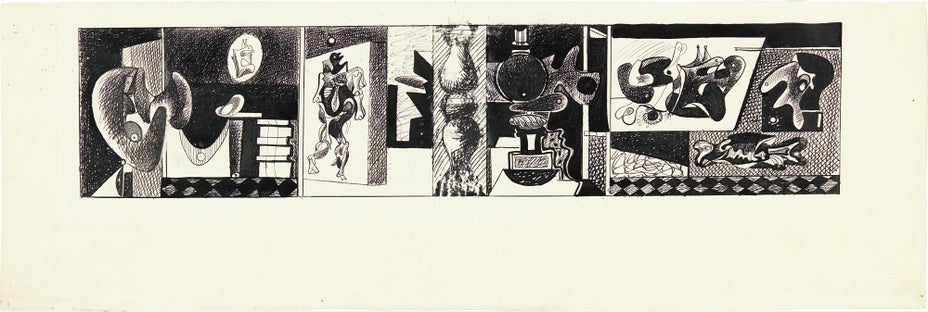
Executed in 1933-1934, Untitled (Study for Mural) is a seminal early work by Arshile Gorky that exemplifies the central role of draughtsmanship in the artist’s practice. As with its sister drawing, which resides in the collection of the Detroit Institute of Arts, this work presents a series of surreal vignettes populated by precisely drawn, cross-hatched abstract and figurative shapes and objects. A quintessential example of Gorky’s graphic output at the time, Untitled (Study for Mural) is one of only three black-and-white pen and ink drawings the artist specifically conceived as studies for a mural commissioned for the Public Works of Art Project (PWAP), a short-lived program formed in 1934 as part of the New Deal during the Great Depression that also commissioned artists such as Grant Wood. Since its public debut at the Museum of Modern Art, New York, in 1962, Untitled (Study for Mural) has been included in some of the artist’s most significant retrospectives.
Gorky, a largely self-taught Armenian émigré artist based in New York City, was a seminal figure in the American movement towards abstraction in the first half of 20th century – his groundbreaking work ultimately paved the way for Abstract Expressionism. Untitled (Study for Mural) represents a crucial stage in Gorky’s career, synthesizing in mural format his Nighttime, Enigma, and Nostalgia series from 1931 and 1934 that is widely regarded as a distinct departure from his earlier experiments with the techniques and imagery of Paul Cézanne and other modern masters. The Nighttime, Enigma, and Nostalgia series introduced a complex web of art historical references that Gorky transcended with a self-assured, and crucially, more abstract style. The Surrealist motifs Gorky introduced here would come to dominate his mature aesthetic through the 1940s.
For his application to the PWAP in 1933, Gorky essentially united compositions of his earlier drawings within the present work, fusing, from left to right, Nighttime, Enigma and Nostalgia, 1931-1932, Whitney Museum of American Art, New York, Column with Objects, 1931-1932, and Nighttime, Enigma and Nostalgia, 1932, Hirschhorn Museum and Sculpture Garden, Washington D.C. As has been widely noted, Gorky presented an intentionally vague explanation to the federally sponsored project, attempting to link his work with the PWAP’s goal of commissioning imagery speaking to American progress. Rather than putting forward a conventional mural, Gorky conceived this radically abstract one, which, in an almost postmodern twist, played on the figurative narrative models of the mural tradition.
Gorky modelled the lateral integration of the separate yet related compositions – themselves formally in debt to Pablo Picasso, Hans Arp, and Giorgio de Chirico– on Paolo Uccello’s altarpiece panel Miracle of the Host, 1465-1469. To join the individual drawings he had been working on for some time, Gorky copied Uccello’s compositional format, adding the central column as a focal point, integrating angled panels reminiscent of Uccello’s retreating walls and inserting patterned floor tiles. Although Uccello was widely praised as a master of perspective, it was the qualities of flat abstraction within his paintings that Gorky admired most.
While the PWAP mural was never realized, it was upon the basis of drawings such as the present one that Gorky was given his first solo exhibition at the Mellon Galleries in Philadelphia in 1934 and his first New York one-man show at the Guild Art Gallery in 1935 – ultimately establishing his credentials as one of the leading modern artists in New York.
Executed in 1933-1934, Untitled (Study for Mural) is a seminal early work by Arshile Gorky that exemplifies the central role of draughtsmanship in the artist’s practice. As with its sister drawing, which resides in the collection of the Detroit Institute of Arts, this work presents a series of surreal vignettes populated by precisely drawn, cross-hatched abstract and figurative shapes and objects. A quintessential example of Gorky’s graphic output at the time, Untitled (Study for Mural) is one of only three black-and-white pen and ink drawings the artist specifically conceived as studies for a mural commissioned for the Public Works of Art Project (PWAP), a short-lived program formed in 1934 as part of the New Deal during the Great Depression that also commissioned artists such as Grant Wood. Since its public debut at the Museum of Modern Art, New York, in 1962, Untitled (Study for Mural) has been included in some of the artist’s most significant retrospectives.
Gorky, a largely self-taught Armenian émigré artist based in New York City, was a seminal figure in the American movement towards abstraction in the first half of 20th century – his groundbreaking work ultimately paved the way for Abstract Expressionism. Untitled (Study for Mural) represents a crucial stage in Gorky’s career, synthesizing in mural format his Nighttime, Enigma, and Nostalgia series from 1931 and 1934 that is widely regarded as a distinct departure from his earlier experiments with the techniques and imagery of Paul Cézanne and other modern masters. The Nighttime, Enigma, and Nostalgia series introduced a complex web of art historical references that Gorky transcended with a self-assured, and crucially, more abstract style. The Surrealist motifs Gorky introduced here would come to dominate his mature aesthetic through the 1940s.
For his application to the PWAP in 1933, Gorky essentially united compositions of his earlier drawings within the present work, fusing, from left to right, Nighttime, Enigma and Nostalgia, 1931-1932, Whitney Museum of American Art, New York, Column with Objects, 1931-1932, and Nighttime, Enigma and Nostalgia, 1932, Hirschhorn Museum and Sculpture Garden, Washington D.C. As has been widely noted, Gorky presented an intentionally vague explanation to the federally sponsored project, attempting to link his work with the PWAP’s goal of commissioning imagery speaking to American progress. Rather than putting forward a conventional mural, Gorky conceived this radically abstract one, which, in an almost postmodern twist, played on the figurative narrative models of the mural tradition.
Gorky modelled the lateral integration of the separate yet related compositions – themselves formally in debt to Pablo Picasso, Hans Arp, and Giorgio de Chirico– on Paolo Uccello’s altarpiece panel Miracle of the Host, 1465-1469. To join the individual drawings he had been working on for some time, Gorky copied Uccello’s compositional format, adding the central column as a focal point, integrating angled panels reminiscent of Uccello’s retreating walls and inserting patterned floor tiles. Although Uccello was widely praised as a master of perspective, it was the qualities of flat abstraction within his paintings that Gorky admired most.
While the PWAP mural was never realized, it was upon the basis of drawings such as the present one that Gorky was given his first solo exhibition at the Mellon Galleries in Philadelphia in 1934 and his first New York one-man show at the Guild Art Gallery in 1935 – ultimately establishing his credentials as one of the leading modern artists in New York.