

26
Audemars Piguet
Grand Complication Clock Watch with Grande and Petite Sonnerie
An important, massive, and superbly crafted yellow gold minute repeating hunter cased split-seconds chronograph, perpetual calendar, grande and petite sonnerie clock watch
- Estimate
- $150,000 - 300,000
$508,000
Lot Details
- Manufacturer
- Audemars Piguet
- Year
- 1892
- Movement No
- 4091
- Case No
- 4091
- Model Name
- Grand Complication Clock Watch with Grande and Petite Sonnerie
- Material
- 18K yellow gold
- Calibre
- Manual, cal. 19’’’, jewelled to center
- Dimensions
- 62mm Diameter
- Signed
- Case and cuvette numbered, movement stamped Audemars Piguet on the dial plate
- Accessories
- Accompanied by an unsigned leather box. Further accompanied by Audemars Piguet Extract from the Archives confirming production of the present watch in 1892.
Full-Cataloguing
Catalogue Essay
While Audemars Piguet is most recognized today for their iconic Royal Oak wristwatch models, their horological history dates to 1875 when watchmakers and long-time friends Jules-Louis Audemars and Edward-August Piguet partnered to address growing demand for complicated watch movements.
Their earliest watches were among the world’s most prestigious, creating grande sonneries, minute repeaters, perpetual calendars, and chronographs – watchmaking’s most complex and desirable complications. Their complex, specialized movements like the present exceptional “Grand Complication Clock Watch” from 1892, quickly earned the brand world-renown as a leader in high-end, luxury timepieces.
“Grande Complication” watches are the ultimate expression of watchmaking at its very finest. They are mechanical works of art that bring together three refined complications: a minute repeater, a perpetual calendar and a split-seconds chronograph.
Elevating the craft even further, clock watches perform like a clock striking the hours and quarter hours (Grande Sonnerie) or the hours on the hour (Petite Sonnerie). They are considered to be the most prestigious, innovative, and technically challenging in all of watchmaking.
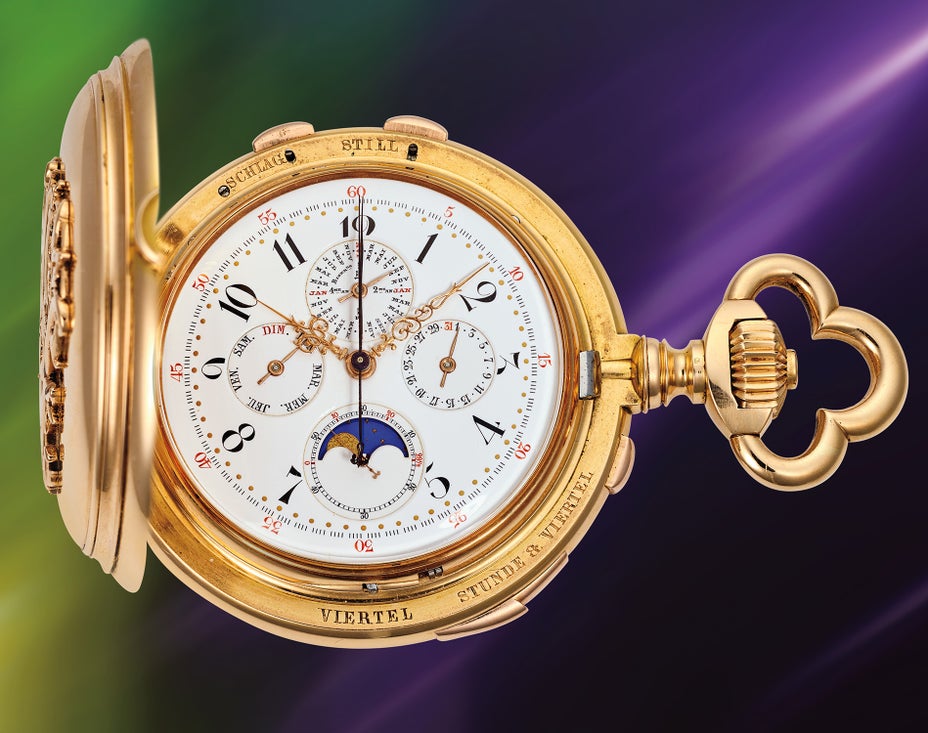
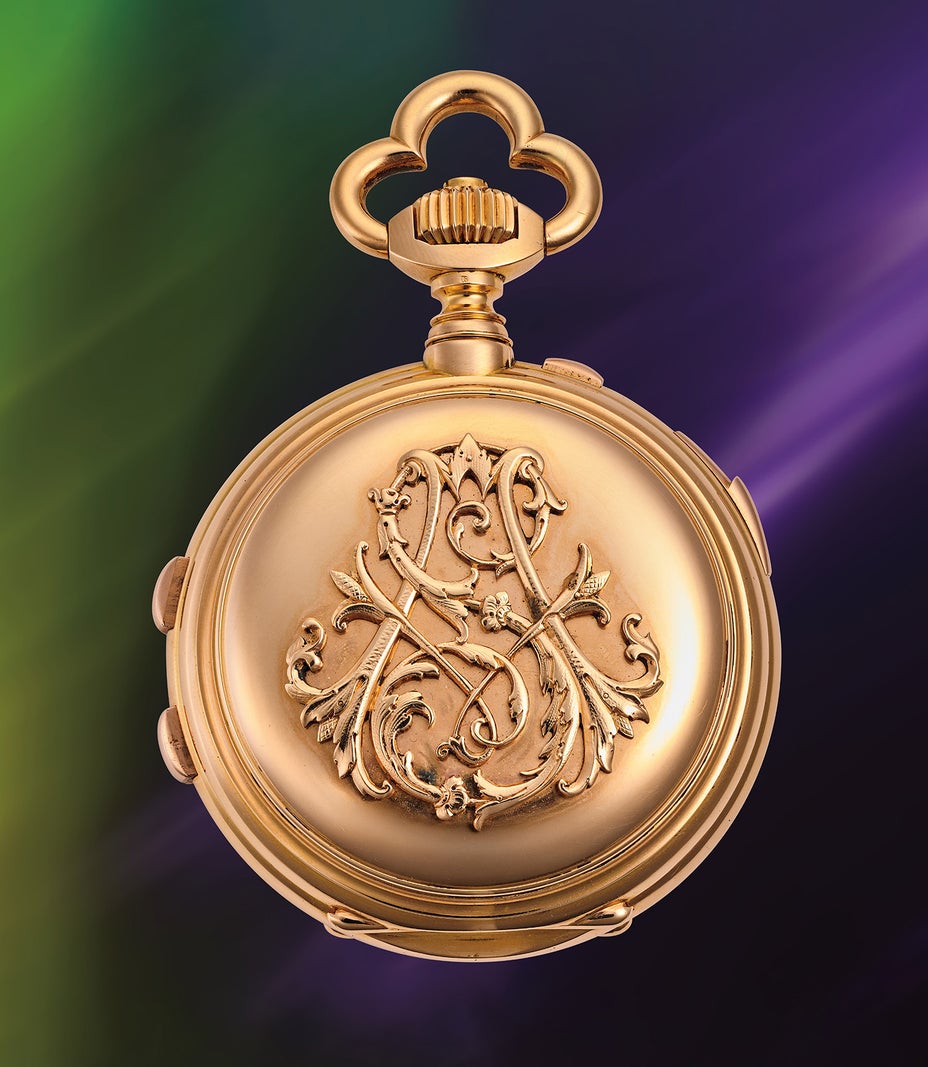
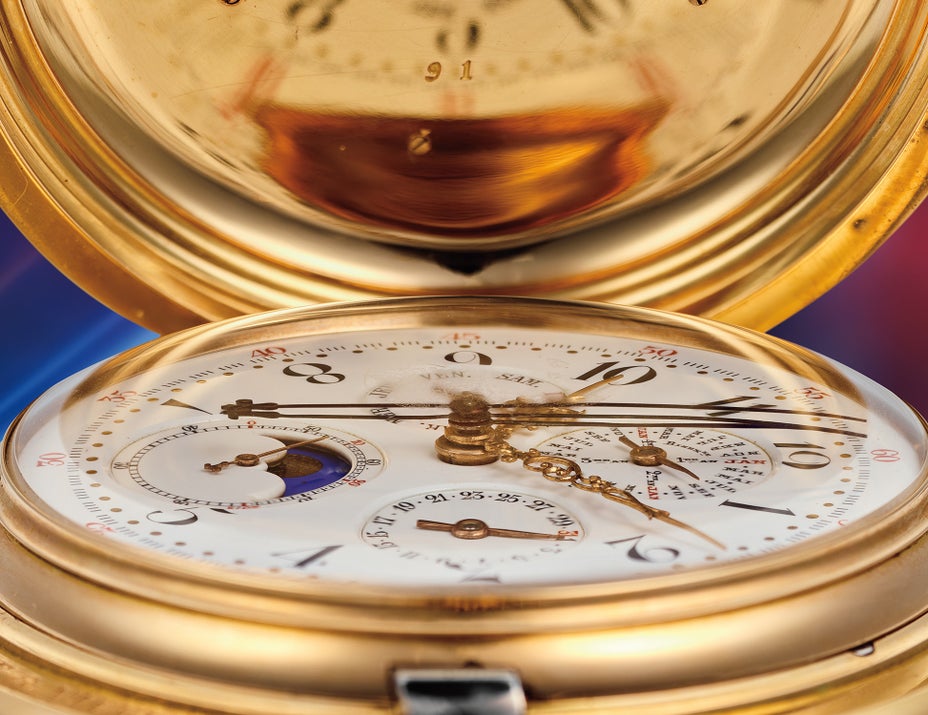
The present, extraordinary yellow gold grand complication clock watch is certainly one of the most important timepieces created during Audemars Piguet’s first two decades of existence. Manufactured in 1892 as confirmed by the brand, the watch has a massive 62mm diameter case with a neo-Gothic, tri-foil bow. The flawless white enamel dial with Arabic numerals has four subsidiary dials with the month and leap year indications at the 12 o’clock, date at 3 o’clock, moon phase and lunar calendar at 6 o’clock and month in French at 9 o’clock. The unsigned dial is indicative of the state of the industry during this era, where retailers, with their dominant position, would relegate the makers’ name to the background. The incredibly crafted case features levers for strike/silent and grande/petite sonnerie.
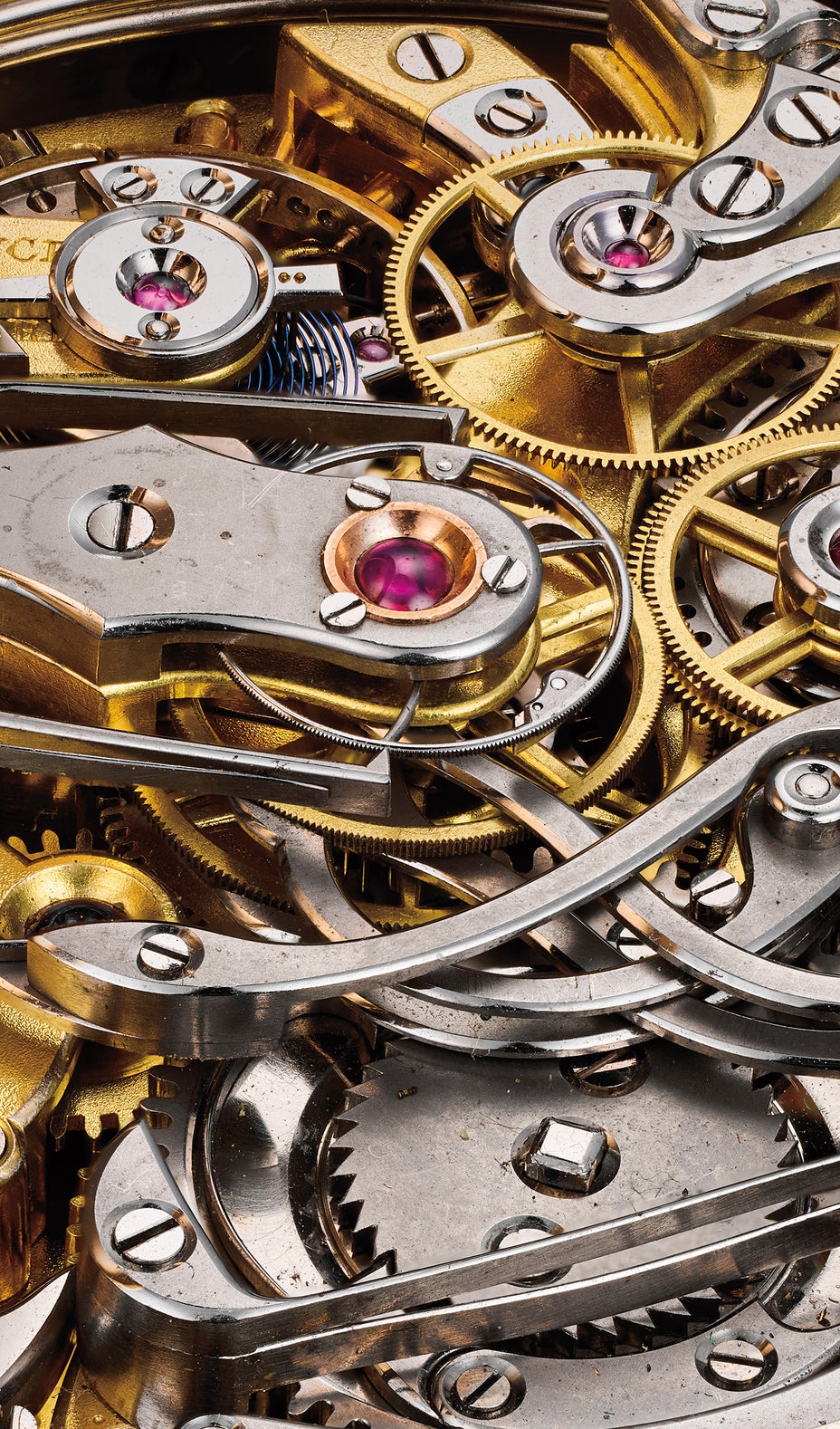
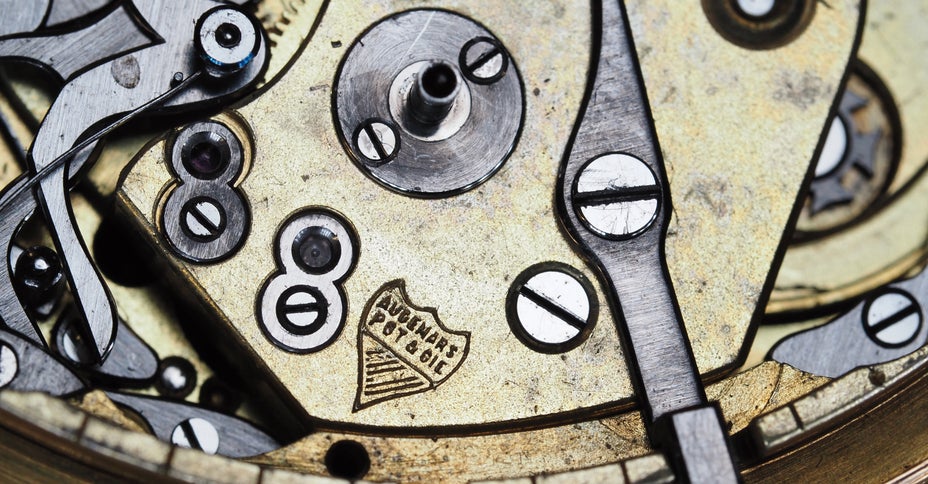
Underneath the dial, the unmistakable stamp of Audemars Piguet is found on the movement’s dial plate. The minute repeating mechanism, activated through a slide in the band, chimes with great tone and clarity, attesting to the manufacture's mastery. According to research, beginning in approximately 1890, Audemars Piguet would only offer such highly complicated masterpieces with their highest quality level, “Extra”-grade, finishing across all movement components. This meticulous finishing quality is immediately apparent upon viewing the movement. With its combination of grand and petite sonnerie, minute repeater, split seconds chronograph, and perpetual calendar, it was a “top-of-the-line” model and certainly one of the most expensive watches of its era.
The watch embodies the beauty and masterful craftsmanship of Audemars Piguet’s expertise in complications. Purchased by the consignor at auction in 1997, the present watch has been preserved unused since then, remaining in overall outstanding condition. It presents a rare opportunity for collectors to own a horological treasure from Audemars Piguet.
Their earliest watches were among the world’s most prestigious, creating grande sonneries, minute repeaters, perpetual calendars, and chronographs – watchmaking’s most complex and desirable complications. Their complex, specialized movements like the present exceptional “Grand Complication Clock Watch” from 1892, quickly earned the brand world-renown as a leader in high-end, luxury timepieces.
“Grande Complication” watches are the ultimate expression of watchmaking at its very finest. They are mechanical works of art that bring together three refined complications: a minute repeater, a perpetual calendar and a split-seconds chronograph.
Elevating the craft even further, clock watches perform like a clock striking the hours and quarter hours (Grande Sonnerie) or the hours on the hour (Petite Sonnerie). They are considered to be the most prestigious, innovative, and technically challenging in all of watchmaking.
The present, extraordinary yellow gold grand complication clock watch is certainly one of the most important timepieces created during Audemars Piguet’s first two decades of existence. Manufactured in 1892 as confirmed by the brand, the watch has a massive 62mm diameter case with a neo-Gothic, tri-foil bow. The flawless white enamel dial with Arabic numerals has four subsidiary dials with the month and leap year indications at the 12 o’clock, date at 3 o’clock, moon phase and lunar calendar at 6 o’clock and month in French at 9 o’clock. The unsigned dial is indicative of the state of the industry during this era, where retailers, with their dominant position, would relegate the makers’ name to the background. The incredibly crafted case features levers for strike/silent and grande/petite sonnerie.
Underneath the dial, the unmistakable stamp of Audemars Piguet is found on the movement’s dial plate. The minute repeating mechanism, activated through a slide in the band, chimes with great tone and clarity, attesting to the manufacture's mastery. According to research, beginning in approximately 1890, Audemars Piguet would only offer such highly complicated masterpieces with their highest quality level, “Extra”-grade, finishing across all movement components. This meticulous finishing quality is immediately apparent upon viewing the movement. With its combination of grand and petite sonnerie, minute repeater, split seconds chronograph, and perpetual calendar, it was a “top-of-the-line” model and certainly one of the most expensive watches of its era.
The watch embodies the beauty and masterful craftsmanship of Audemars Piguet’s expertise in complications. Purchased by the consignor at auction in 1997, the present watch has been preserved unused since then, remaining in overall outstanding condition. It presents a rare opportunity for collectors to own a horological treasure from Audemars Piguet.
Provenance
Literature
Audemars Piguet
Swiss | 1881A specialist in the manufacture of complications since it was established in 1881, Audemars Piguet never ceases to impress with a rich history of creating bold, even audacious, timepieces underpinned by traditional watchmaking at its finest. This Le Brassus-based Swiss manufacturer is one of only two major manufacturers still owned by the founding family. Since its earliest days, AP is considered a leader in the field of minute repeaters and grande complication pocket and wristwatches. The brand is devoted to preserving the history of watchmaking in the Vallée de Joux, showcased at their superb museum in Le Brassus.
Today, the brand is best known for its Royal Oak models, a revolutionary luxury sports watch launched in 1972. Other key models include early minute repeating wristwatches, vintage chronograph wristwatches, such as the oversized reference 5020, perpetual calendar watches and the Royal Oak Offshore, first introduced in 1993.
Browse MakerToday, the brand is best known for its Royal Oak models, a revolutionary luxury sports watch launched in 1972. Other key models include early minute repeating wristwatches, vintage chronograph wristwatches, such as the oversized reference 5020, perpetual calendar watches and the Royal Oak Offshore, first introduced in 1993.