956Σ︎
Bovet
Ref. D860
Notre Dame
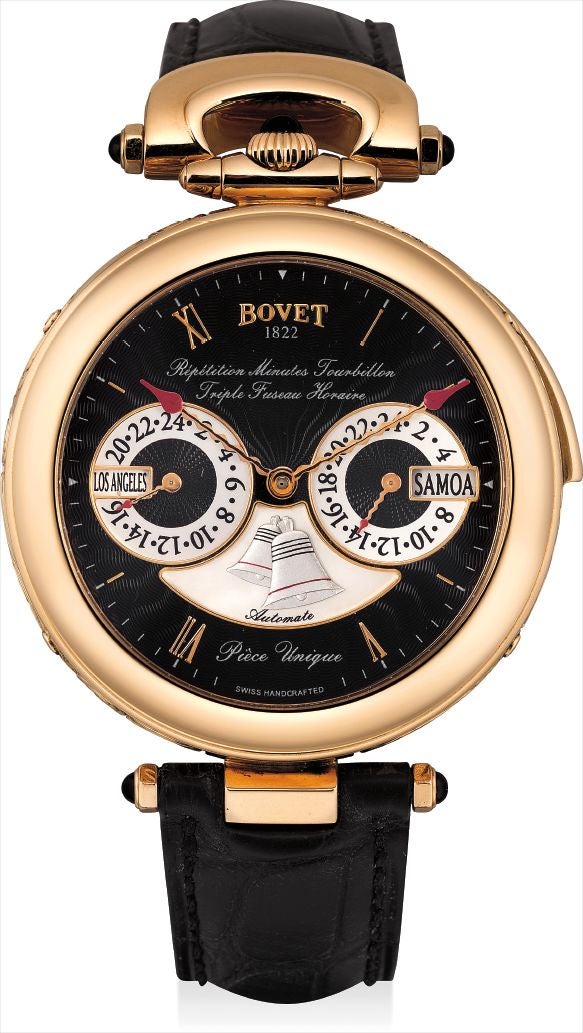
A very fine and unique pink gold triple time zone minute repeating tourbillon automata wristwatch with guilloché dial and engraved case
Full-Cataloguing
Featuring an eye-catching guilloché dial which proudly displays "Piece Unique", the present watch houses three key complications that are fitted within the cofines of a 44.5 mm. diameter case. The minute repeating mechanism chimes with great tone and clarity, and moves in sync with the automated bells on the dial. The subdials display two different time zones in addition the central minutes and hour hand. The tourbillon rotates in an ornate escapement, which is chiseled and engraved to perfection. Painstaking detail has been applied to the band too, which features a similar baroque-style engraving.
Taking into account the complexity and level of known-how required to produce such a horological marvel, it comes as no surprise that the present watch retailed for over 600,000 USD at the time of its launch.
Bovet
Swiss | 1822The firm Bovet 1822 has a rich, centuries-long history beginning when Edouard Bovet sold four decorative pocket watches in Canton Asia for what would today equal $1 million. By 1822, Edouard, with his brothers, registered the company in London, which at the time was an important center for watches and clocks. That same year, they moved their manufacturing center to the Swiss municipality Fleurier. Bovet became known for their highly decorative pocket watches for the Chinese market. Their richly engraved movements were so important to the watch that Bovet created the concept of the transparent watch back so owners could see the beauty of the movement. Bovet's oversized chronograph wristwatches, such as the Mono Rattrapante chronograph, are especially sought-after. Today, the firm continues their tradition of exquisitely enameled watches.