29
Brent Wadden
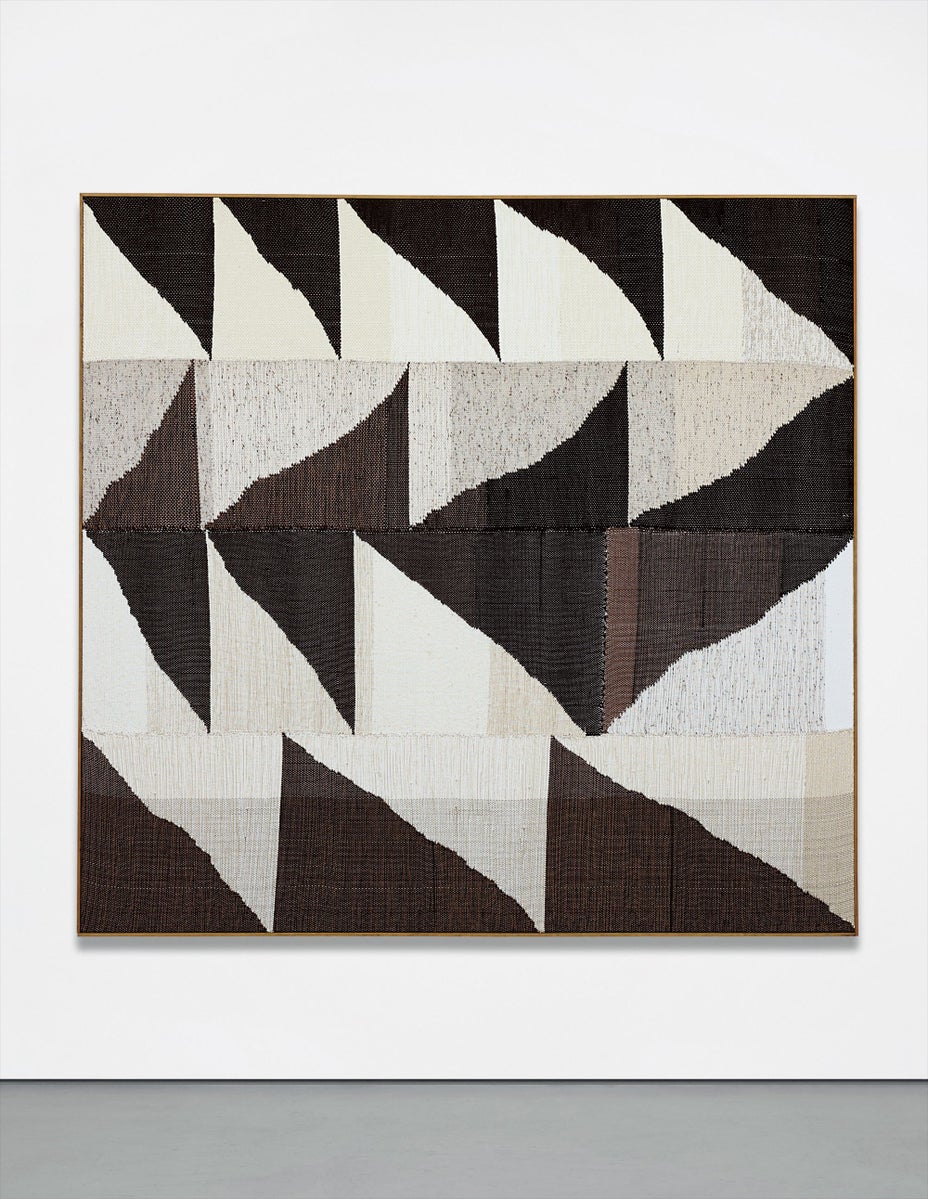
Alignment #22
Estimate
£20,000–30,000‡︎
Sold For
£43,750
hand woven fibres, wool, cotton, acrylic on canvas, in artist's frame
201.9 x 212.1 cm (79 1/2 x 83 1/2 in.)
Signed, titled and dated 'ALIGNMENT #22 Brent Wadden 2013' on the reverse.
Full-Cataloguing
‘I draw inspiration from all over, but mostly I’m attracted to objects that are handmade and have some kind of special quality to them. It’s hard to explain, but I can admire a Picasso just as much as a crusty wooden lawn ornament my uncle made in 1987.’
- BRENT WADDEN, 2013
Brent Wadden’s quietly intricate artworks are born from a unique fusion of influences. Growing up in a small village in Nova Scotia, Wadden was surrounded by the woven materials of indigenous folk art; at art school on the mainland he became fascinated by the work of Abstract Expressionists such as Jackson Pollock, and after five years spent in Berlin he developed an intense appreciation for the legacy of Bauhaus.
His deeply personal response to this range of aesthetics is, quite literally, to weave them together. Works which initially appear to stem from the hard edges of avant-garde Minimalist form are softened by his use of wool and yarn, their repeating patterns delicately disrupted. ‘The texture and unpredictability of how the wool acts resembles the accidental drips or gestural brushstrokes that might occur in a painting, while the fibre of the wool maintains the kind of emotional warmth that is deliberately absent in a flat painted surface.’ (exh. cat. Abstract American Today, Saatchi Gallery 2014). Working on a floor loom with exclusively pre-used and second-hand fibres, Wadden often runs out of one yarn before completing an area; he fills the gaps with subtly different materials, further disrupting the surface’s consistency. The felt presence of the artist’s hand is heightened, and the geometry of his monochrome forms are made shifting and intimately textural.
Comfortable in their contradictions, Wadden’s ‘paintings’ exist somewhere between folk art and fine art, exploring boundaries between the traditionally masculine vanguard of modernist abstraction and the more feminine, even domestic connotations of the works’ materiality. Beyond the dialogue with artistic tradition, there is something calming and perhaps therapeutic in Wadden’s methodical approach: he makes a powerfully coherent process-based statement that rejects the impatience and desire for instant gratification that pervade contemporary existence, and returns us to a rewarding sense of craft that is woven into the canvas itself.
- BRENT WADDEN, 2013
Brent Wadden’s quietly intricate artworks are born from a unique fusion of influences. Growing up in a small village in Nova Scotia, Wadden was surrounded by the woven materials of indigenous folk art; at art school on the mainland he became fascinated by the work of Abstract Expressionists such as Jackson Pollock, and after five years spent in Berlin he developed an intense appreciation for the legacy of Bauhaus.
His deeply personal response to this range of aesthetics is, quite literally, to weave them together. Works which initially appear to stem from the hard edges of avant-garde Minimalist form are softened by his use of wool and yarn, their repeating patterns delicately disrupted. ‘The texture and unpredictability of how the wool acts resembles the accidental drips or gestural brushstrokes that might occur in a painting, while the fibre of the wool maintains the kind of emotional warmth that is deliberately absent in a flat painted surface.’ (exh. cat. Abstract American Today, Saatchi Gallery 2014). Working on a floor loom with exclusively pre-used and second-hand fibres, Wadden often runs out of one yarn before completing an area; he fills the gaps with subtly different materials, further disrupting the surface’s consistency. The felt presence of the artist’s hand is heightened, and the geometry of his monochrome forms are made shifting and intimately textural.
Comfortable in their contradictions, Wadden’s ‘paintings’ exist somewhere between folk art and fine art, exploring boundaries between the traditionally masculine vanguard of modernist abstraction and the more feminine, even domestic connotations of the works’ materiality. Beyond the dialogue with artistic tradition, there is something calming and perhaps therapeutic in Wadden’s methodical approach: he makes a powerfully coherent process-based statement that rejects the impatience and desire for instant gratification that pervade contemporary existence, and returns us to a rewarding sense of craft that is woven into the canvas itself.