205
Carlo Mollino
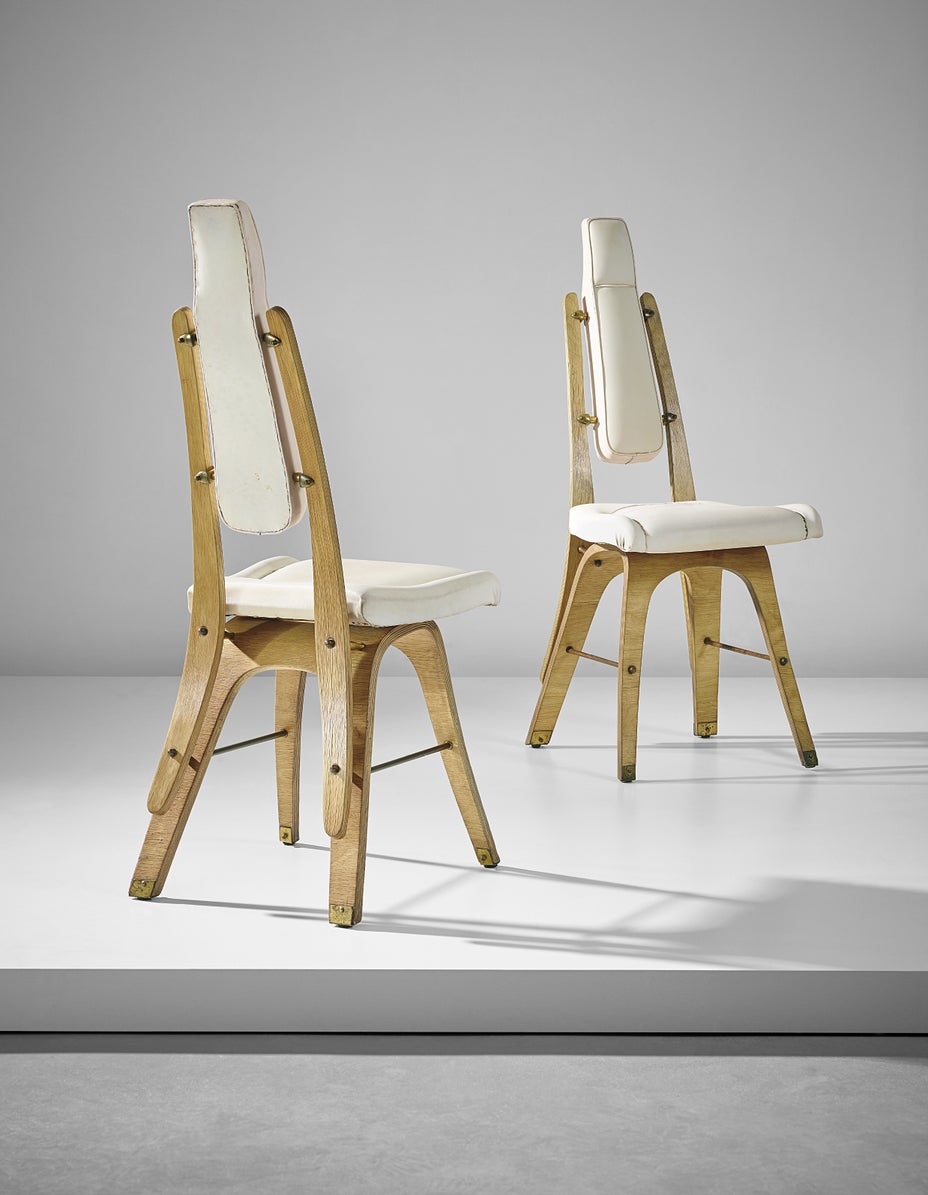
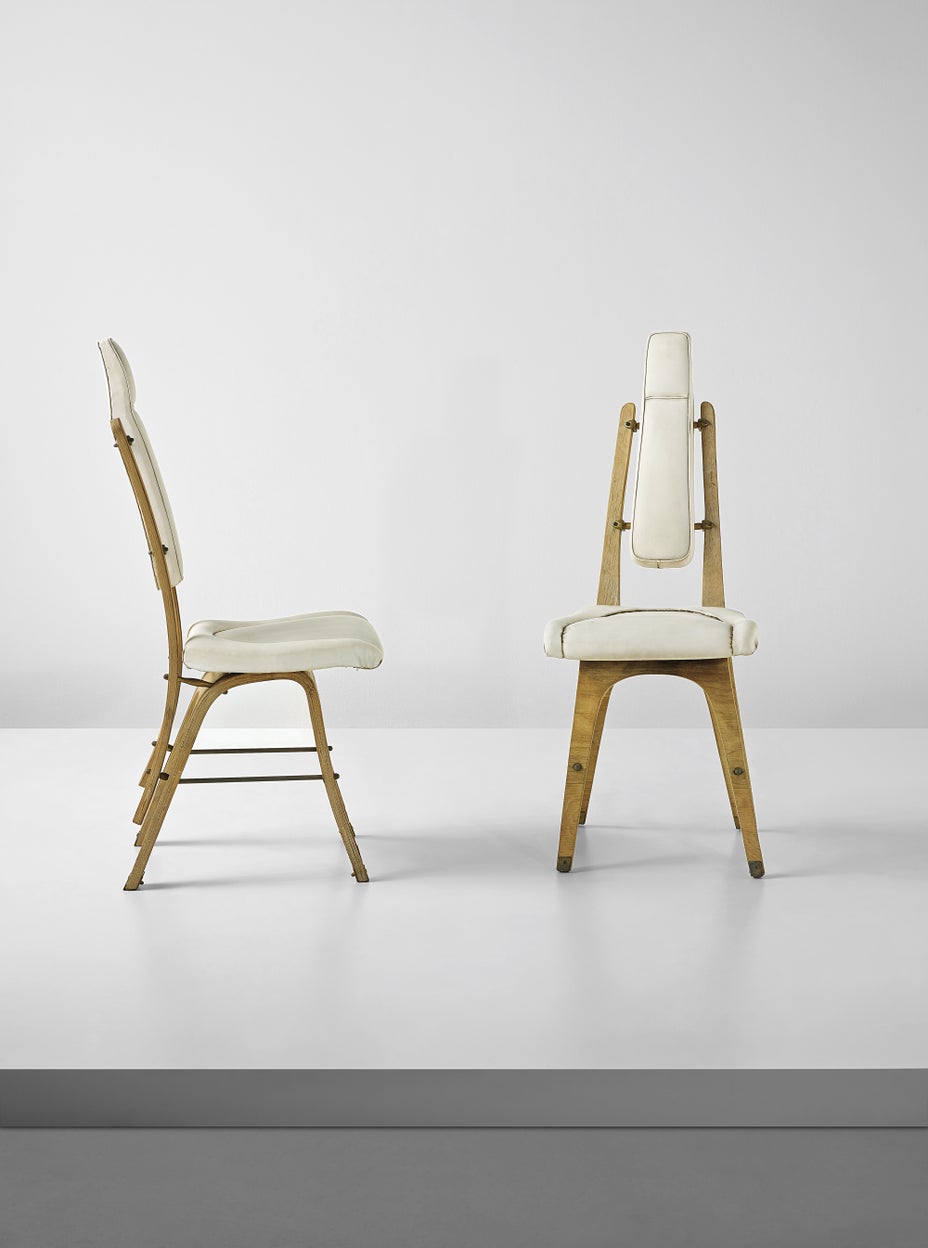
Pair of chairs, designed for the conference room, Lattes Publishing House, Turin
Full-Cataloguing
Phillips wishes to thank Fulvio Ferrari and Napoleone Ferrari, Museo Casa Mollino, Turin, for their assistance with the cataloguing of the present lot.
Chairs from the conference room of the Lattes Publishing House, Turin, 1951
by Fulvio Ferrari
Among the few interiors Carlo Mollino conceived were projects for two brave editors: Vladi Orengo, who fearlessly published art books during the 1940s whilst Turin was being heavily bombed, and Mario Lattes, the director of Lattes Publishing House, which published books by Simone Weil and Theodor Adorno, among others. Mario Lattes was, among other things, a painter, and his friendship with Carlo Mollino was characterized by high intellectual exchange. In fact, Mollino contributed to the journal Galleria Arti e Lettere, founded by Lattes in 1953. When asked to design the interior of the new headquarters of the Lattes Publishing House, their reciprocal respect and understanding drove the architect to submit to his client some of his most creative designs, confident they would be able to reach consensus and find the necessary financial resources. In fact, Mollino chose avant-garde materials for the offices, such as Fibrosil, metallic modular units, and bent plywood – materials which were at the time complicated to work with and of high production value.
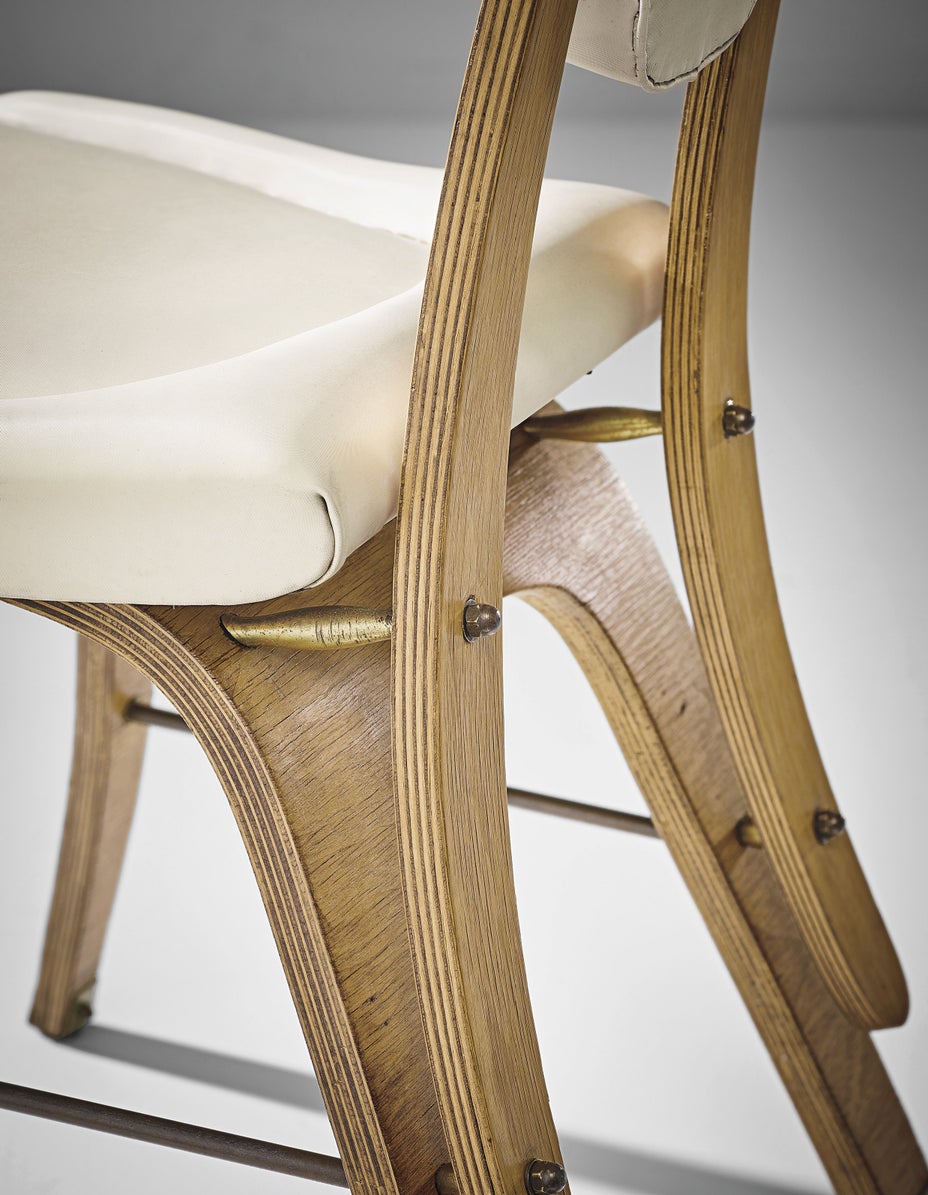
The conference room, which was also used as an art exhibition room, featured at its center a spectacular table made of bent plywood, surrounded by twelve chairs which were also executed in this new material and upholstered with white Resinfex. It is interesting to note that while the other furnishings from the Lattes Publishing House were made of solid wood with simple structural frames, Mario Lattes’s own office furniture included refined armchairs in bent plywood with sculpted armrests, as well as a large Fibrosil bookcase with a red Resinfex lining. It is important to remember that Apelli & Varesio, the manufacturer of this furniture, only used materials of the highest quality and therefore had to produce it in-house, which involved extremely costly procedures and at times methods of domestic fabrication. The necessary heat to bend the pre-cut wood was transferred using sponges soaked in boiling water and a fat iron. The cut wood was then inserted into the mould designed for the particular component. More specifically, the production of the present lot required the use of two moulds/stamps, one for the lower frame and one for the support of the seat back, the manufacture of which also required great workforce and a long time.
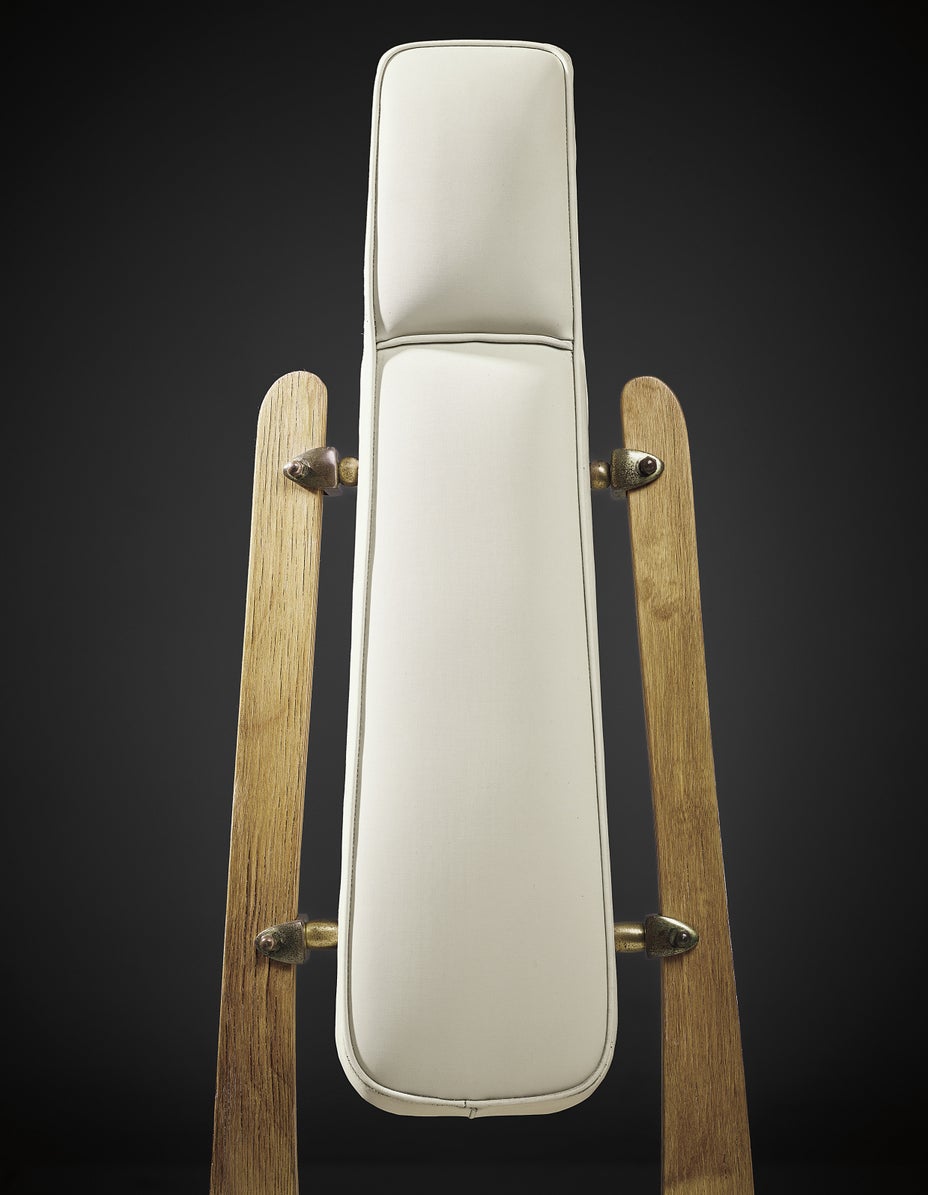
The chairs here examined are a perfect testimony to Mollino’s modus operandi which can be defined as pure engineering: they in fact present a structure which, visible in all its parts, offers a very effective aesthetic expression. Designed to use the minimum quantity of material and only where strictly necessary, the chairs were reinforced with brass fixtures, used to keep its bent wood parts in tension and at distance from one another and which act as the chair’s bone structure, emphasising its physical and artistic tension. The chair is imagined in its space; you can move around it, as you do with sculptures, appreciating every detail. Mollino re-elaborated the human body structure and reinterpreted it with fervour as a chair. He wrote: “Whilst inventing, I was thinking of every dimension and effect in relation to those of man”. The elegance of the object was achieved by opting for a small seat back, suspended in between its lateral supports, and by breaking down the heaviness of the seat with a gentle, curved line.
Fulvio Ferrari
March 2017
Carlo Mollino
Italian | B. 1905 D. 1973Carlo Mollino made sexy furniture. His style may have grown out of the whiplash curves of Art Nouveau, but the sinuous lines of his furniture were more humanoid than vegetal, evoking arched backs and other body parts. Mollino was also an avid aviator, skier and racecar driver — he designed his own car for Le Mans. His love of speed and danger comes across in his designs, which MoMA curator Paola Antonelli has described as having "frisson."
Mollino had no interest in industrial design and the attendant constraints of material costs and packaging. His independent wealth allowed him to pick and choose projects, resulting in an oeuvre of unique, often site-specific works that were mostly executed by the Turin joinery firm Apelli & Varesio. Apart from a coffee table that he designed in 1950 for the American company Singer & Sons, his furniture never went into production. Notwithstanding the support of Gio Ponti, Mollino's design contemporaries largely dismissed him as an eccentric outsider. However, the combination of scarcity (Mollino only made several hundred works in his lifetime), exquisite craftsmanship and idiosyncratic "frisson" has rightly placed Carlo Mollino in the highest tier of twentieth-century design collecting.