2Σ︎
Carlo Mollino
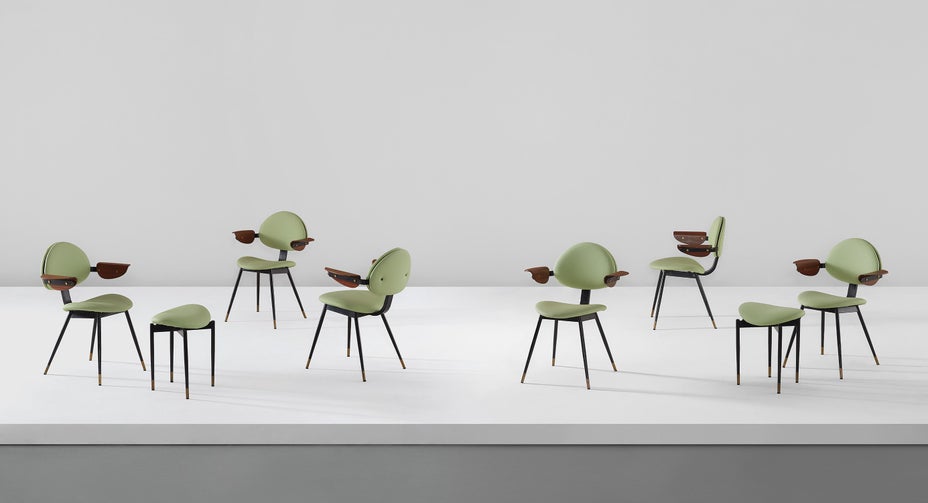
Set of six armchairs and two stools, from the Lutrario Ballroom, Turin
Each stool: 17 3/4 x 16 1/2 x 10 3/8 in. (45 x 42 x 26.5 cm)
Full-Cataloguing
Carlo Mollino
Italian | B. 1905 D. 1973Carlo Mollino made sexy furniture. His style may have grown out of the whiplash curves of Art Nouveau, but the sinuous lines of his furniture were more humanoid than vegetal, evoking arched backs and other body parts. Mollino was also an avid aviator, skier and racecar driver — he designed his own car for Le Mans. His love of speed and danger comes across in his designs, which MoMA curator Paola Antonelli has described as having "frisson."
Mollino had no interest in industrial design and the attendant constraints of material costs and packaging. His independent wealth allowed him to pick and choose projects, resulting in an oeuvre of unique, often site-specific works that were mostly executed by the Turin joinery firm Apelli & Varesio. Apart from a coffee table that he designed in 1950 for the American company Singer & Sons, his furniture never went into production. Notwithstanding the support of Gio Ponti, Mollino's design contemporaries largely dismissed him as an eccentric outsider. However, the combination of scarcity (Mollino only made several hundred works in his lifetime), exquisite craftsmanship and idiosyncratic "frisson" has rightly placed Carlo Mollino in the highest tier of twentieth-century design collecting.