
87
Carlo Scarpa
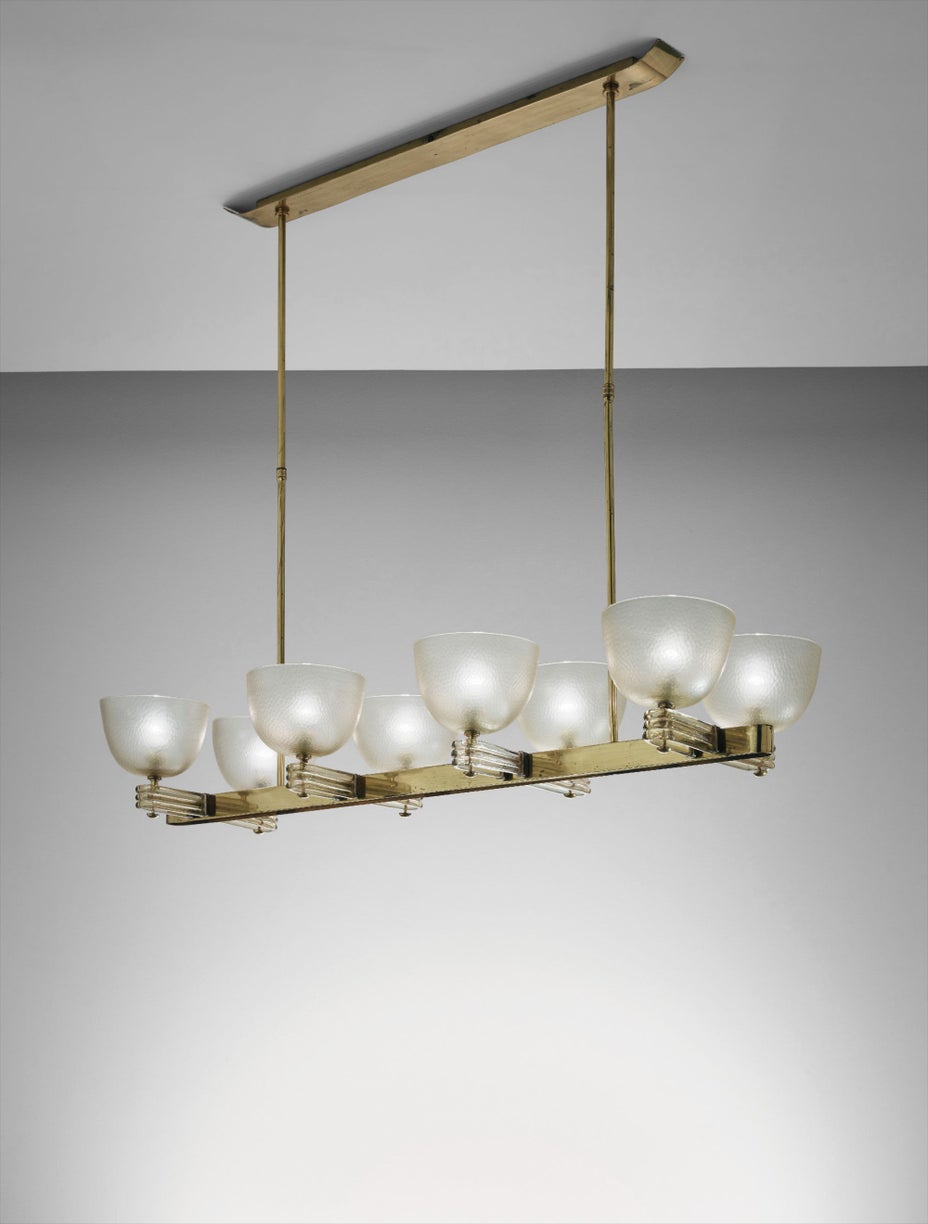
Ceiling light, model no. 5212
- Estimate
- $22,000 - 28,000
Lot Details
Battuto glass, glass, brass.
circa 1940
50 x 53 1/2 x 20 in. (127 x 135.9 x 50.8 cm)
Produced by Venini & Co., Murano, Italy.
Specialist
Full-Cataloguing
Catalogue Essay
The present model ceiling light was designed under the artistic direction of Tomaso Buzzi at Venini, circa 1933. The four bell-shaped shades were originally made in gold-shaded lattimo glass. However the present ceiling light features battuto glass shades, a technique introduced under the artistic direction of Carlo Scarpa in 1940. For that reason, we have chosen to present this “hybrid” piece as the work of Carlo Scarpa.
Literature
Carlo Scarpa
Italian | B. 1906 D. 1978Phillips Design has a deep-rooted passion for the work of Carlo Scarpa, one of the twentieth century's great poets, whose rhythms, lines and materials — a grammar of space — appeal both as a local response to the architect's birth city, Venice, and a universal language of ordered dynamism.
Carlo Scarpa graduated with a degree in architectural drawing from the Accademia di Belle Arti in Venice in 1926. In the years that followed, he worked as a teaching assistant for a former professor, ran his own architectural practice in Venice and worked as a freelance artist for M.V.M. Cappellin glassworks. When M.V.M. Cappellin went bankrupt in 1932, Scarpa joined Venini & C. in Murano, where he served as artistic director until 1947. During his tenure at Venini, Scarpa developed a host of new techniques — in particular, mezza filigrano, a bollicine and corroso — that catapulted the centuries-old tradition of Venetian glassblowing to the forefront of modernist design.
Browse ArtistCarlo Scarpa graduated with a degree in architectural drawing from the Accademia di Belle Arti in Venice in 1926. In the years that followed, he worked as a teaching assistant for a former professor, ran his own architectural practice in Venice and worked as a freelance artist for M.V.M. Cappellin glassworks. When M.V.M. Cappellin went bankrupt in 1932, Scarpa joined Venini & C. in Murano, where he served as artistic director until 1947. During his tenure at Venini, Scarpa developed a host of new techniques — in particular, mezza filigrano, a bollicine and corroso — that catapulted the centuries-old tradition of Venetian glassblowing to the forefront of modernist design.