

105
Cartier
Ref. 4536
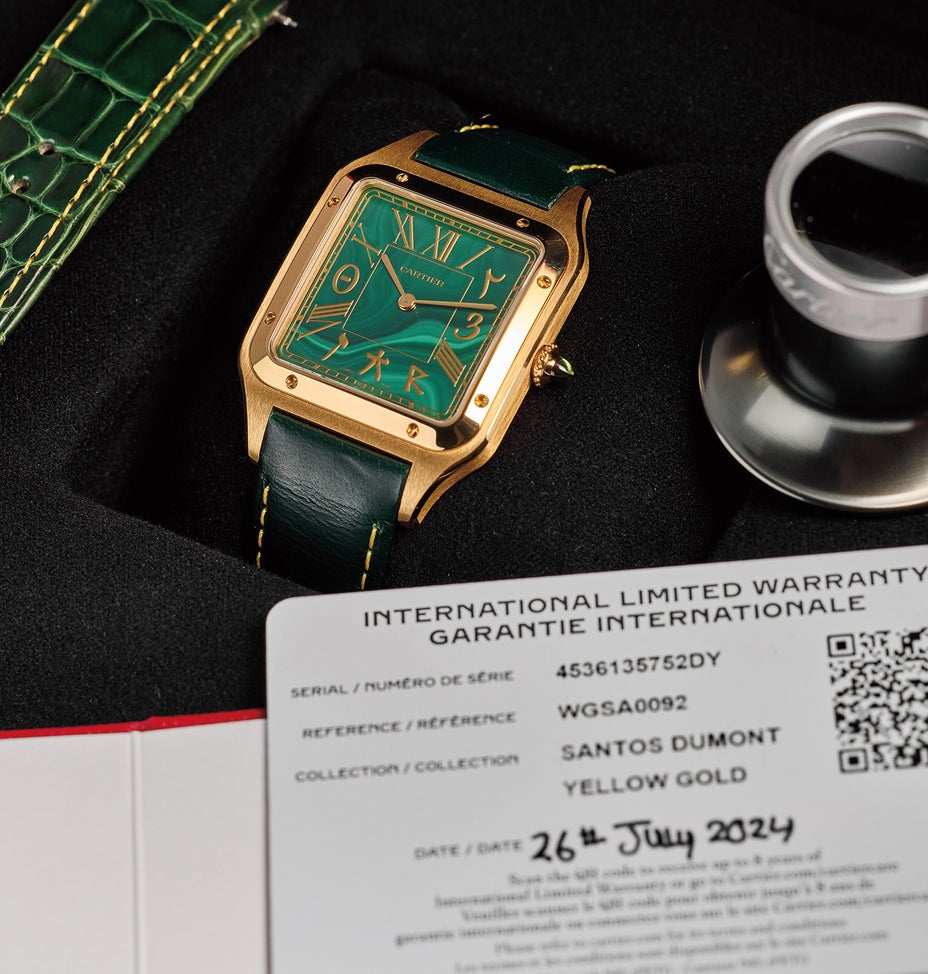
Santos Dumont XL “Timepeace” Edition
A virtually brand new, highly unusual, and very attractive limited edition yellow gold wristwatch with malachite dial, warranty, and presentation box, numbered 14 of a limited edition of 25
Full-Cataloguing
The brainchild of collector Yoni Ben-Yehuda, it is the dial where this piece reveals its soul, as it is one that champions not only individuality, but also empathy and common ground.
A striking canvas of natural malachite, with its undulating green striations, provides a vivid and organic backdrop to an unorthodox and deeply human composition: a selection of numerals drawn from alphabets around the world—Arabic, Hebrew, Mandarin, and Latin. The design is a visual ode to unity through difference, a poetic meditation on the international language of horology. For passionate collectors, the “Timepeace” serves as a subtle reminder that what binds us in this shared passion for watches transcends language, geography, and culture.
Offered in like-new condition by its original owner and accompanied by all its accessories, this example is not merely a representation of Cartier craftsmanship—it is a message. With the closing of the NSO programme, pieces like this will no longer be made. As such, the “Timepeace” stands as both a horological rarity and a philosophical beacon: a tribute to friendship, to camaraderie, to peace—and to the beauty of difference.
Cartier
FrenchWith the Constitution of 1848 came a new standard for luxury in France. Founded one year prior by Louis-Francois Cartier, the house of Cartier was one of the first to use platinum in jewelry making. This incredibly expensive material became the stepping-stone for Cartier to experiment in form, mechanisms and attitude. It helped men move from pocket watches to wristwatches, effectively making the watch much more functional and prominent in a man's overall wardrobe.
Cartier did not only touch on functionality. Inspired by a commissioned painting by George Barbier featuring a black panther at the feet of an elegantly bejeweled woman, Cartier began incorporating wild animals in his designs—most notably, Cartier Panthère rings, bangle bracelets and watches. Yet it wasn't until the late 1960s that the house of Cartier debuted their iconic yellow and rose gold LOVE collection, which includes the famous bracelet that only a special screwdriver can open.