31
Charles Nègre
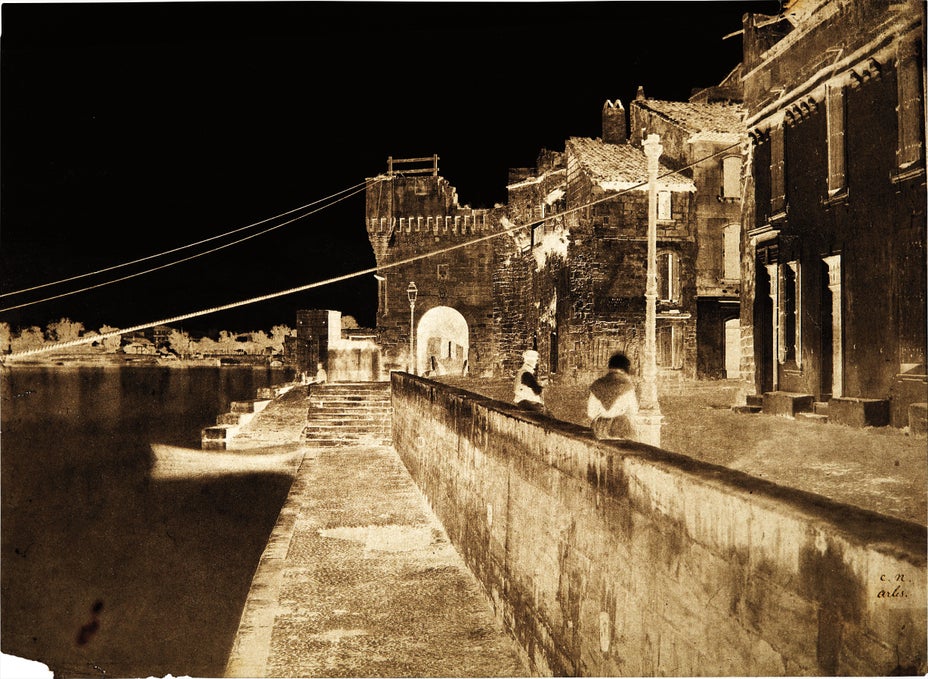
Arles, Porte des Châtaignes
Estimate
$70,000–90,000
Sold For
$62,500
1852
Unique paper negative.
9 1/4 x 12 5/8 in. (23.4 x 32 cm)
Initialed and titled 'Arles' in ink on the recto.
Full-Cataloguing
Prints produced from this unique negative are in the collections of the Musée d'Orsay, Paris; The Metropolitan Museum of Art, New York; and The National Gallery of Canada, Ottawa.
Trained as a painter, Nègre became a master of the new art of photography in the 1840s. He immediately grasped the potential of the paper-negative process and learned to coax a level of detail out of his images that is exceptional. This view of the banks of the Rhône in the city of Arles demonstrates Nègre’s capabilities with this primitive photographic process, revealing the minute detail and textures of the buildings and cobblestone embankment. In technical terms, it is a perfect negative. Nègre’s composition is made taut by a series of diagonals: the mooring lines, the sea wall, and the jagged declining roofline all converge to create a complex and balanced image.
The negative offered here is a unique object: it is the very sheet of paper, photographically sensitized, that Nègre exposed in his camera. While the negative was not Nègre’s intended final product, the visual impact of this primary photographic exposure is undeniable. Many subsequent photographers, as different from one another as Moholy-Nagy, Maurice Tabard, and Robert Heinecken, experimented with the creative possibilities of negative images. Although the digital age has nearly outmoded the negative as a step in the photographic process, recent work by Richard Misrach, among others, shows that it is still fertile ground for aesthetic exploration.
This negative comes originally from the collection of pioneering photography collector and dealer André Jammes, who acquired the definitive archive of Nègre’s work from a descendent in the 1950s. It is through Jammes that the work of this important and formative photographer became known in the 20th century. Jammes’s beautifully-produced 1963 book Charles Nègre Photographe: 1820-1880 reintroduced Nègre to the world and opened his work to study. The important publications on Nègre by James Borcoman and Françoise Heilbrun in the 1970s and ‘80s owe their existence to Jammes’s discovery, as does our current understanding of Nègre’s place in the canon of 19th-century photographers.
Trained as a painter, Nègre became a master of the new art of photography in the 1840s. He immediately grasped the potential of the paper-negative process and learned to coax a level of detail out of his images that is exceptional. This view of the banks of the Rhône in the city of Arles demonstrates Nègre’s capabilities with this primitive photographic process, revealing the minute detail and textures of the buildings and cobblestone embankment. In technical terms, it is a perfect negative. Nègre’s composition is made taut by a series of diagonals: the mooring lines, the sea wall, and the jagged declining roofline all converge to create a complex and balanced image.
The negative offered here is a unique object: it is the very sheet of paper, photographically sensitized, that Nègre exposed in his camera. While the negative was not Nègre’s intended final product, the visual impact of this primary photographic exposure is undeniable. Many subsequent photographers, as different from one another as Moholy-Nagy, Maurice Tabard, and Robert Heinecken, experimented with the creative possibilities of negative images. Although the digital age has nearly outmoded the negative as a step in the photographic process, recent work by Richard Misrach, among others, shows that it is still fertile ground for aesthetic exploration.
This negative comes originally from the collection of pioneering photography collector and dealer André Jammes, who acquired the definitive archive of Nègre’s work from a descendent in the 1950s. It is through Jammes that the work of this important and formative photographer became known in the 20th century. Jammes’s beautifully-produced 1963 book Charles Nègre Photographe: 1820-1880 reintroduced Nègre to the world and opened his work to study. The important publications on Nègre by James Borcoman and Françoise Heilbrun in the 1970s and ‘80s owe their existence to Jammes’s discovery, as does our current understanding of Nègre’s place in the canon of 19th-century photographers.