Ultimate
65
Daidō Moriyama
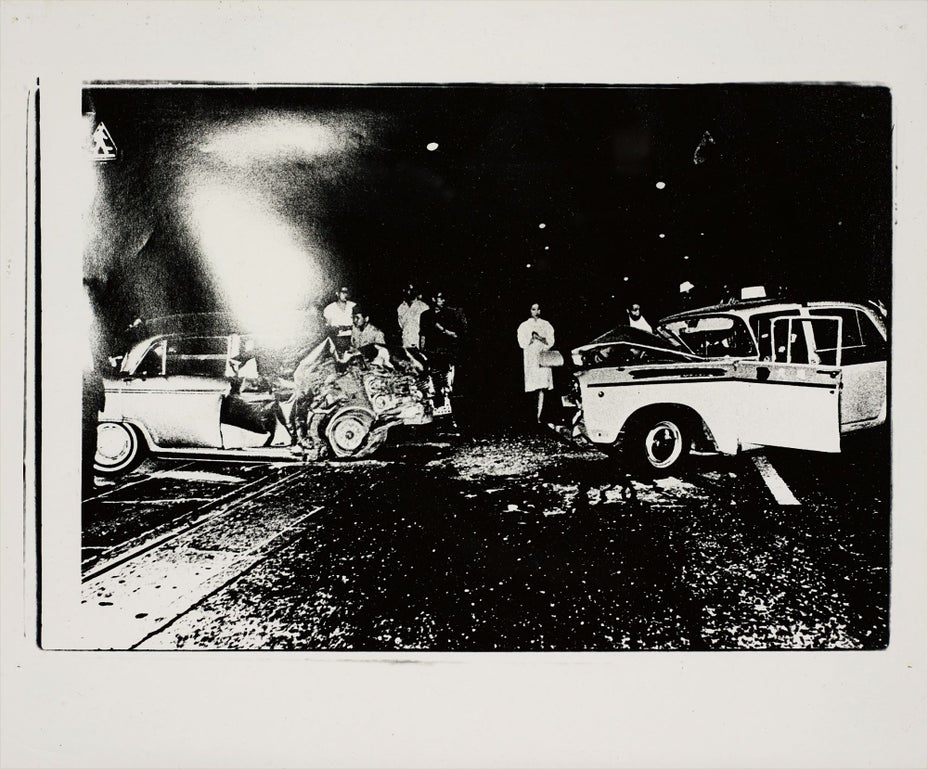
Smash-up from アクシデント [Akushidento] Accident
Estimate
£15,000–25,000
Sold For
£20,000
1969
Gelatin silver print.
Image: 19 x 28.4 cm (7 1/2 x 11 1/8 in.)
Sheet: 25.3 x 30.6 cm (9 7/8 x 12 in.)
Sheet: 25.3 x 30.6 cm (9 7/8 x 12 in.)
Signed in Japanese and rōmaji in pencil and dated in green ink on the verso.
This work is one of only three known vintage prints of this seminal Provoke-era image. One print is in the collection of the Tokyo Institute of Polytechnics and the other print, which set the artist’s world auction record when it sold at auction in 2008, is slightly smaller in size and held privately.
This work is one of only three known vintage prints of this seminal Provoke-era image. One print is in the collection of the Tokyo Institute of Polytechnics and the other print, which set the artist’s world auction record when it sold at auction in 2008, is slightly smaller in size and held privately.
Full-Cataloguing
'The life and death contrast of people and objects – exposed in this one photograph on a poster I happen to see – made a great impact on me as something extremely accidental and strangely scandalous.'
Moriyama Daido
In 1969, the Andy Warhol-inspired Accident series was serialised from January to December in 12 monthly issues of Asahi Camera. For this key series from the short-lived yet highly influential Provoke movement, Moriyama liberally appropriated images from a wide range of sources, including tabloid newspapers, magazines and television. To create Smash-up, Moriyama re-photographed a photograph of a car crash that was reproduced on a police road safety poster. ‘To speak of extremes,’ Moriyama commented in 1969, ‘I consider everything that is in front of me the same, whether they are cigarettes, matches, television, cinema screens, photographs taken by others, or my photographs. They are all [part of one] reality.’
Smash-up first appeared in the June 1969 issue of Asahi Camera alongside five vertical close-up shots of various parts of the original poster. This act of closing in on the photograph reminds us of Michelangelo Antonioni’s Blow-Up (1966) and the sequence of grainy blow-ups of photographs taken by the anti-hero Thomas, who unwittingly has witnessed a murder. In questioning the purpose of photography and rejecting the notion that photography must be art, Moriyama created the present photograph – the epitome of Provoke philosophy and aesthetic.
Moriyama Daido
In 1969, the Andy Warhol-inspired Accident series was serialised from January to December in 12 monthly issues of Asahi Camera. For this key series from the short-lived yet highly influential Provoke movement, Moriyama liberally appropriated images from a wide range of sources, including tabloid newspapers, magazines and television. To create Smash-up, Moriyama re-photographed a photograph of a car crash that was reproduced on a police road safety poster. ‘To speak of extremes,’ Moriyama commented in 1969, ‘I consider everything that is in front of me the same, whether they are cigarettes, matches, television, cinema screens, photographs taken by others, or my photographs. They are all [part of one] reality.’
Smash-up first appeared in the June 1969 issue of Asahi Camera alongside five vertical close-up shots of various parts of the original poster. This act of closing in on the photograph reminds us of Michelangelo Antonioni’s Blow-Up (1966) and the sequence of grainy blow-ups of photographs taken by the anti-hero Thomas, who unwittingly has witnessed a murder. In questioning the purpose of photography and rejecting the notion that photography must be art, Moriyama created the present photograph – the epitome of Provoke philosophy and aesthetic.