Property from a Distinguished New York Collection
162
Dan Flavin
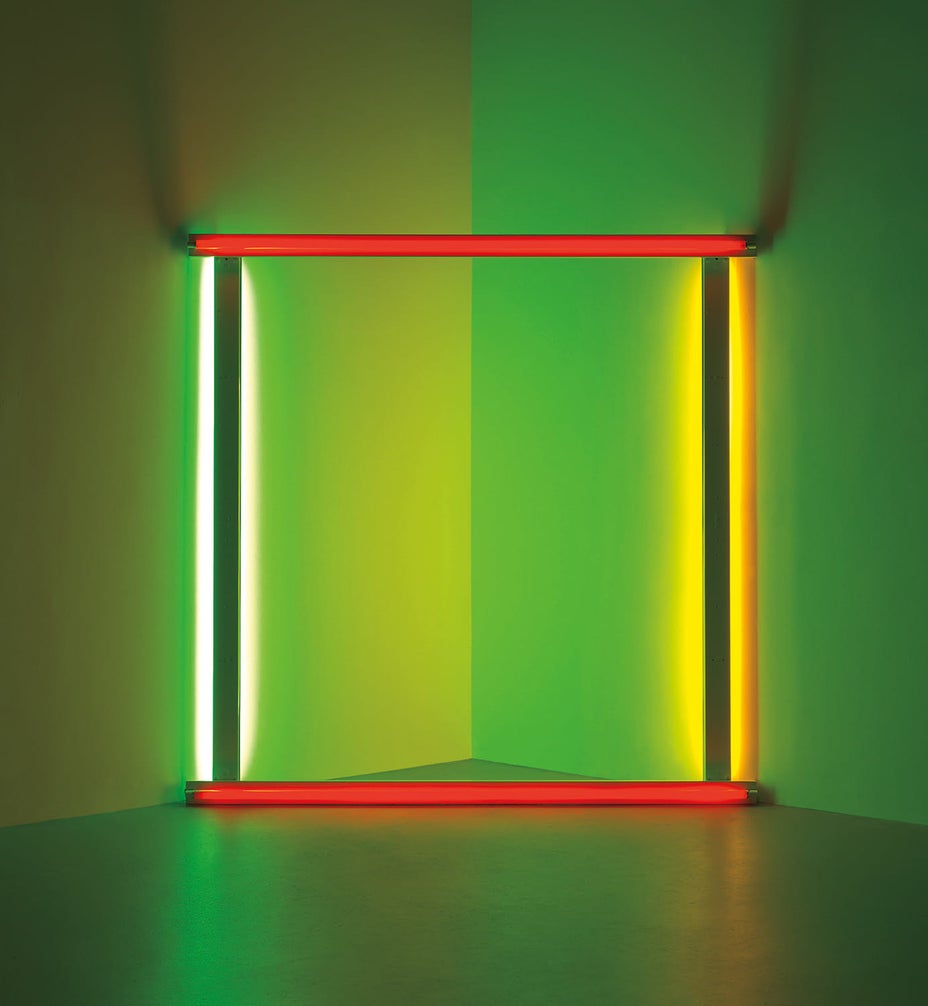
untitled (to Bob and Pat Rohm)
Estimate
$250,000–350,000
Sold For
$325,000
red, green and yellow fluorescent light
96 x 96 x 9 in. (243.8 x 243.8 x 22.9 cm.)
Executed in 1969, this work is number 1 from an edition of 5, of which only 4 were fabricated, and is accompanied by a certificate of authenticity signed by the artist.
Full-Cataloguing
Few artists have defined a particular medium as Dan Flavin, whose pioneering work from the early 1960s to his death in 1996 almost entirely consisted of light in the form of commercially available fluorescent tubes. Executed in 1969 in an edition of five, of which only four were fabricated, untitled (to Bob and Pat Rohm) was created six years after Flavin achieved his artistic breakthrough of employing this industrial readymade to create installations of light and color, or “situations" as he preferred to call them. The present work was dedicated to the Bob Rohm, an artist, and his wife Pat Rohm, both of whom were friends of Flavin’s. The composition held such significance to Flavin that he would create another smaller version of it between 1969 and 1970, another example of which resides in the collection of the Israel Museum, Jerusalem. It is testimony to the significance of untitled (to Bob and Pat Rohm) that Flavin gifted another example of this edition to his close friend and fellow trailblazing artist Donald Judd.
Drawing the viewer in with its suffused fluorescent glow that shimmers in red, green and yellow, the present work epitomizes Flavin’s pioneering phenomenological investigation of color and light that would forever alter the course of art-making. Striving to strip art from its reliance on illusionism, allegory, and narrative, and reduce it to its most essential form, Flavin, in 1960, conceived of the groundbreaking idea to construct sculptures by incorporating electric light. Within the course of just three years, he gave form to this idea by initially juxtaposing light onto monochromatic canvas and then radically removing the canvas altogether with his seminal May 25, 1963 (to Constantin Brancusi).
Despite Flavin's deep awareness of the historical and religious symbolism of light in art and his often personal dedication of his untitled works, he resolutely refused to attach any symbolic or narrative significance to his work. In this he was importantly joined by Donald Judd, together with whom Flavin became known as one of the progenitors of “Minimal Art”, the term coined by Richard Wollheim in 1965 to describe this new tendency, though Flavin and his colleagues opposed this label. untitled (to Bob and Pat Rohm) epitomizes Flavin’s favored construction for what he called the “near squares placed across a corner” (Dan Flavin, quoted in Michael Govan and Tiffany Bell, Dan Flavin: The Complete Lights 1961-1996, New York, 2004, p. 255). It has two yellow and green vertical 8-foot lamps on each side that face into the corner, and two horizontal red 8-foot lamps facing out. In doing so, Flavin has effectively created a frame like structure with a sly nod to the discourse regarding the pictorial space inside a frame and the real space of minimalist sculpture.
Drawing the viewer in with its suffused fluorescent glow that shimmers in red, green and yellow, the present work epitomizes Flavin’s pioneering phenomenological investigation of color and light that would forever alter the course of art-making. Striving to strip art from its reliance on illusionism, allegory, and narrative, and reduce it to its most essential form, Flavin, in 1960, conceived of the groundbreaking idea to construct sculptures by incorporating electric light. Within the course of just three years, he gave form to this idea by initially juxtaposing light onto monochromatic canvas and then radically removing the canvas altogether with his seminal May 25, 1963 (to Constantin Brancusi).
Despite Flavin's deep awareness of the historical and religious symbolism of light in art and his often personal dedication of his untitled works, he resolutely refused to attach any symbolic or narrative significance to his work. In this he was importantly joined by Donald Judd, together with whom Flavin became known as one of the progenitors of “Minimal Art”, the term coined by Richard Wollheim in 1965 to describe this new tendency, though Flavin and his colleagues opposed this label. untitled (to Bob and Pat Rohm) epitomizes Flavin’s favored construction for what he called the “near squares placed across a corner” (Dan Flavin, quoted in Michael Govan and Tiffany Bell, Dan Flavin: The Complete Lights 1961-1996, New York, 2004, p. 255). It has two yellow and green vertical 8-foot lamps on each side that face into the corner, and two horizontal red 8-foot lamps facing out. In doing so, Flavin has effectively created a frame like structure with a sly nod to the discourse regarding the pictorial space inside a frame and the real space of minimalist sculpture.
Dan Flavin
American | B. 1933 D. 1996Dan Flavin employed commercially-sold fluorescent light tubes in order to produce what he liked to call "situations" or installations. His minimalist approach transcended simplicity through his use of neon colors and thoughtful compositions. With straight-edged light beams, Flavin would often create dynamic arrangements reminiscent of Fred Sandback's work with yarn.